Original D&D fused Arneson's refereed dungeon campaign with Gygax's wargame rules into a product anyone could buy. It created the roleplaying game as a commercial form, gave fantasy a shared vocabulary of classes, levels and hit points, and seeded the computer RPG.
Overview
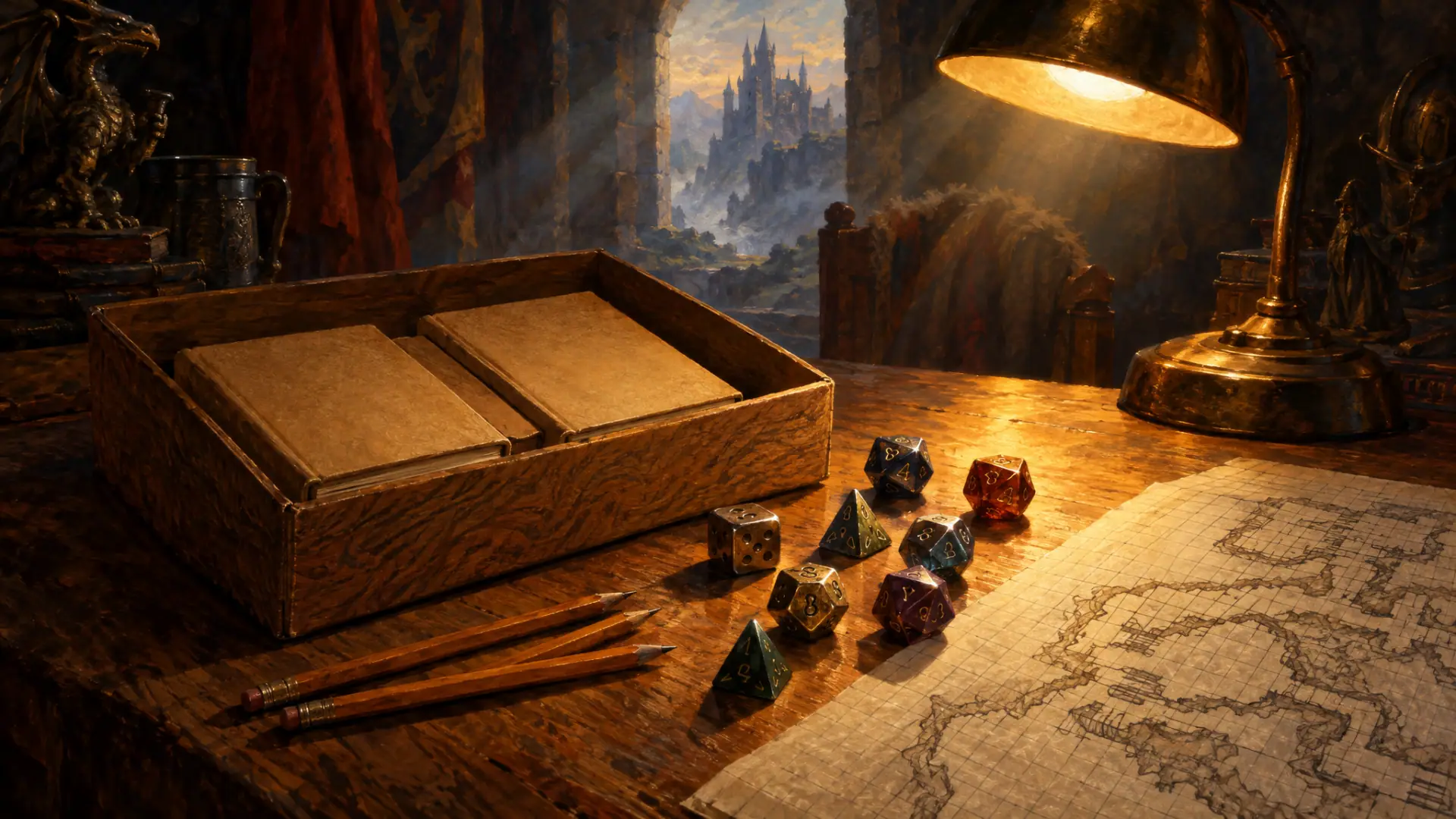
In January 1974 a new company called Tactical Studies Rules, operating out of homes in Lake Geneva, Wisconsin, began selling a $10 box with a mounted warrior pasted onto its woodgrain lid. Inside were three stapled, digest-sized booklets — Men & Magic, Monsters & Treasure and The Underworld & Wilderness Adventures — and a set of reference sheets. The subtitle promised Rules for Fantastic Medieval Wargames Campaigns Playable with Paper and Pencil and Miniature Figures. It was the first commercially published roleplaying game.
The first printing was 1,000 copies. Later printings, from about 1976, came in a white box labeled "Original Collector's Edition," which is why veterans call the whole edition "the white box" and historians call it "OD&D" (Original D&D). It is crude, contradictory and frequently baffling, written for readers who already knew miniatures wargames. It is also the single most consequential game design in this museum: the ancestor of Advanced Dungeons & Dragons, of Tunnels & Trolls and RuneQuest, and — through students who carried it onto university computers — of pedit5 and dnd and, in time, Wizardry: Proving Grounds of the Mad Overlord and Ultima.
Origins
Two lines of play met to make it. In the Twin Cities, Dave Arneson had been refereeing Blackmoor since 1971, a campaign that grew out of David Wesely's Braunstein games. His players each ran one character, explored the dungeons under a model castle, collected treasure and grew stronger from session to session. In Lake Geneva, Gary Gygax was the hobby's great organizer and a prolific rules writer, co-author with Jeff Perren of Chainmail, whose Fantasy Supplement Arneson had used in Blackmoor's early days.
The collaboration can now be traced in detail thanks to the historian Jon Peterson. At the end of 1972 Gygax, planning a new edition of Chainmail, wrote asking Arneson for his Chainmail modifications; Arneson replied that they were minor and that Blackmoor was really driven by its dungeon and its referee-led style, and he sent some tables. Then Arneson and his player David Megarry came to Lake Geneva to demonstrate Megarry's board game Dungeon! — and Arneson ran the local players through Blackmoor. Older accounts date that visit to late 1972; Peterson's 2021 book Game Wizards moves it to the second half of February 1973. Within weeks Gygax had built his own dungeon under Castle Greyhawk and proposed that the two of them publish rules for this kind of play.
Gygax wrote a first draft of about a hundred pages and sent it to Arneson around mid-1973; Arneson's group tried the rules while sending further material, and in the fall Gygax rewrote the game into its three-volume form. Guidon Games, Chainmail's publisher, could not take it on, and Avalon Hill did not understand it. So in October 1973 Gygax and his childhood friend Don Kaye founded Tactical Studies Rules, named in part for their Lake Geneva wargaming club. Printing costs rose beyond what they had, and in December 1973 Brian Blume bought in as a third partner, paying for the print run. By Peterson's reconstruction the booklets were printed one at a time through January 1974, with the last volume perhaps not back from the printer until February; Gygax was already running the game for crowds of players on Sundays.
How it plays
Imagine four friends at a kitchen table. One is the referee — the booklets mostly use that word, though the title "Dungeon Master" soon became standard (see Game Master). The referee has drawn a dungeon on graph paper, level by level, and stocked its rooms with monsters, traps and treasure using the tables in Monsters & Treasure. The others each have a character sheet.
To make a character, a player rolls three six-sided dice for each of six abilities — Strength, Intelligence, Wisdom, Constitution, Dexterity, Charisma — and chooses one of three classes: the Fighting-Man, the Magic-User (who memorizes spells in the manner of Jack Vance's The Dying Earth and forgets each one on casting, the origin of Vancian magic) or the Cleric, a crusading holy warrior. A player may instead be a Dwarf, an Elf or a hobbit (later renamed Halfling), each with restrictions. Each character picks one of three alignments — Law, Neutrality or Chaos — and buys equipment with a few dice-rolls' worth of gold.
Then play is conversation. The referee describes: a corridor, ten feet wide, running north into darkness; a door on the east wall. The players say what their characters do — listen at the door, send the dwarf ahead, map the turns — and one of them draws the map as they go. When there is uncertainty, dice decide: a six-sided die for wandering monsters, surprise and finding secret doors, and, in combat under the booklets' "alternative" system, a twenty-sided die compared against a table of the defender's Armor Class. Characters have Hit points, rolled on six-sided "hit dice," and when those run out, they die. There is no board and no winner. The session ends when the players leave the dungeon or run out of time, and the same characters return next week richer in treasure and Experience points, climbing levels that bring more hit points and spells.
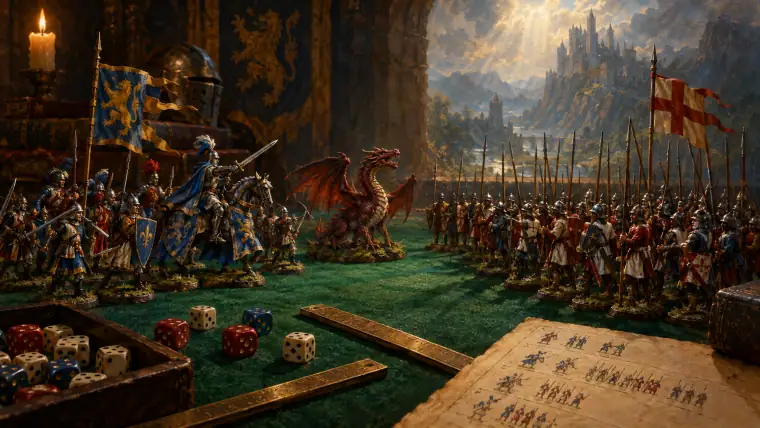
That is the difference from what came before. A Miniatures & Board Wargames such as Chainmail pits sides against each other on an open table under fixed rules. A board game such as Monopoly or Dungeon! has a board, legal moves and a victory condition. D&D has a referee who holds a secret world and adjudicates anything the players attempt, and play that continues indefinitely as a campaign. The rules even allowed for the characters to leave the dungeon for the wilderness, using the hex map of Outdoor Survival, and eventually to build castles and rule baronies.
Reception & impact
The first 1,000 copies were sold mostly by mail, through wargaming newsletters and word of mouth, and at conventions such as Gen Con. A second printing of 1,000 followed in January 1975, a third of 2,000 in April 1975, and a fourth of 5,000 in November 1975, by collectors' counts. Early reviewers in The Space Gamer were struck by its limitless flexibility ("anything can happen") and by how much work it demanded of the referee. Its prose was widely mocked; its influence was not.
The game spread along college and wargaming networks at astonishing speed. Players filled its gaps with house rules, fanzines like Alarums & Excursions, and TSR's own supplements — Greyhawk and Blackmoor (1975), Eldritch Wizardry, Gods, Demi-Gods & Heroes and Swords & Spells (1976) — and the magazine that became The Dragon. Competitors appeared within a year: Tunnels & Trolls and Empire of the Petal Throne in 1975, and soon a whole industry.
Legacy
Two separate lines grew from the box in 1977: the introductory Dungeons & Dragons Basic Set and the codified Advanced Dungeons & Dragons. When TSR declined to pay Arneson royalties on AD&D, arguing it was a different game, he sued; the 1981 settlement is described in The Gygax–Arneson Disputes.
The credit question has been argued ever since, often uncharitably in both directions. A fair summary of the documentary record: Arneson created the kind of game D&D describes — the refereed campaign of individual characters exploring a dungeon, with its roots in Braunstein — and supplied notes and tables from Blackmoor. Gygax wrote the published text, organized its systems into a game others could learn from a book, drew on Chainmail and his own Greyhawk campaign, and, with Kaye and Blume, got it printed. The box credits both, and neither alone produced it.
The white box's descendants run through every later edition to Dungeons & Dragons 5th Edition, through the Old-School Renaissance (OSR) that revived its style, and into the computer: pedit5 and dnd appeared on the PLATO by 1975. Monsters it assembled from myth, folklore and fantasy fiction — orcs, trolls, dragons — became a shared bestiary for half a century of fantasy games.
Marginalia
- Jon Peterson dates the release to January 1974; Gygax had predicted a January launch in a December 1973 letter, and the rules' foreword is dated November 1, 1973.
- The first printing of 1,000 copies was hand-assembled by Gygax and friends and, by collector accounts, took about eleven months to sell out.
- Arneson's royalty was ten percent. "Every retail sale we make is $1.00 to you," Gygax wrote to him in March 1974, urging him to hand out flyers.
- Only $100 was budgeted for art; contributors were paid $2 or $3 a picture, with the same again each time a thousand more copies were printed.
- The rules assumed players owned Chainmail for combat and Avalon Hill's board game Outdoor Survival for wilderness maps.
- The first printings used Tolkien's "hobbits," "ents" and "balrogs"; the names were removed from later printings after legal pressure.
- A first-printing set sold for $22,100 in December 2016.
Quick answers
- When was Dungeons & Dragons first released?
- Dungeons & Dragons was first released in January 1974 (first printing); white-box printings from c. 1976.
- Who created Dungeons & Dragons?
- Dungeons & Dragons was made by Gary Gygax (co-author; wrote the published rules text; TSR co-founder) and Dave Arneson (co-author; creator of the Blackmoor campaign on which the game was modeled).
- Who published or developed Dungeons & Dragons?
- TSR, Inc..
- What kind of work is Dungeons & Dragons?
- Dungeons & Dragons is a tabletop RPG in the Tabletop Roleplaying Games tradition, released for Boxed set: three digest booklets (Men & Magic, Monsters & Treasure, The Underworld & Wilderness Adventures) plus reference sheets.
- Why is Dungeons & Dragons important?
- Original D&D fused Arneson's refereed dungeon campaign with Gygax's wargame rules into a product anyone could buy. It created the roleplaying game as a commercial form, gave fantasy a shared vocabulary of classes, levels and hit points, and seeded the computer RPG.