The rust monster attacks the player's investment rather than the character's hit points. It is one of the first monsters designed purely around game psychology, and it began as a cheap toy.
Origins
The rust monster began, like the Owlbear, in a bag of cheap plastic figures made in Hong Kong. In the early 1970s Gary Gygax was running Chainmail battles on a sand table in Lake Geneva, and he looked through dime stores for anything he could use as a miniature. One bag, labeled "prehistoric animals," held a set of strange monsters. By most accounts they were knock-offs of creatures from Japanese kaiju films and television. Gygax told the story himself, printed in Ed Greenwood's "Ecology of the Rust Monster" in Dragon #88 (August 1984; see The Strategic Review & Dragon). Among the figures was one that "looked rather like a lobster with a propeller on its tail." At first "nothing very fearsome came to mind." Then, he said, "inspiration struck me. It was a 'rust monster.'"
The same bag is credited with several of D&D's oddest creatures. Tim Kask, the first editor of The Dragon, said the umber hulk and the rust monster were Gygax's inventions "to 'explain' two plastic monsters from a bag of weird critters from the dime store." The artist Tony DiTerlizzi, who drew monsters for TSR in the 1990s, later researched the toys and matched them to the rust monster, the owlbear and the bulette, a burrowing "landshark" that first appeared in The Dragon #1 (1976). No myth lies behind any of them. Unlike the Basilisk or the Griffin, these were monsters made to fit the figures Gygax happened to own.
Into the dungeon
What Gygax made of the lobster was cleverer than another thing to kill. The rust monster appeared in Supplement I: Greyhawk (1975), the first expansion to Dungeons & Dragons, by Gygax and Rob Kuntz. It is described there as "inoffensive" but "the bane of metal with ferrous content." Any iron it touches rusts at once, and the monster eats the rust. A sword that strikes it rusts too, and at four times a character's speed it cannot be outrun. It does not threaten the character's Hit points much. It threatens the fighter's armor and the magic sword the player spent months winning. The rust monster attacks the player's investment in Loot & loot tables, and so players remember it with a special dread that critics have noted ever since. One called it "the most feared D&D monster."
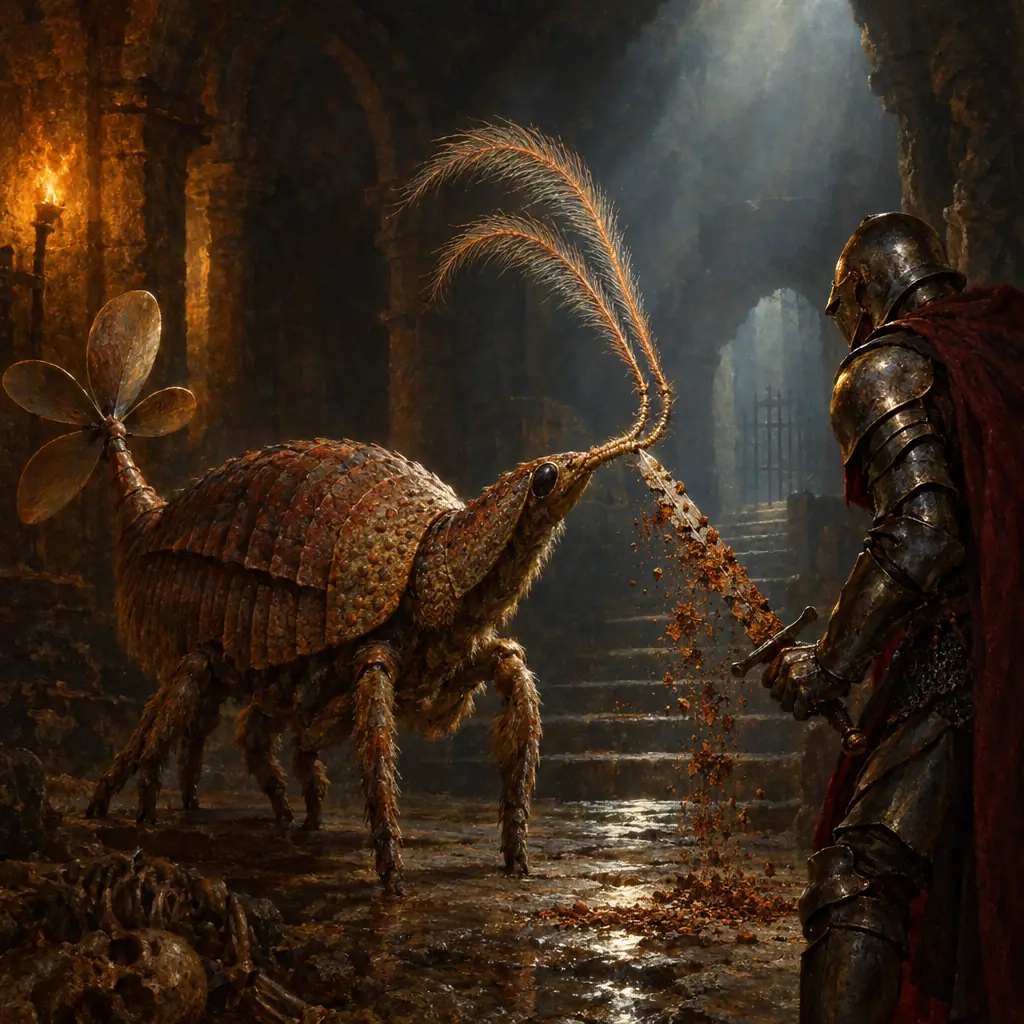
The Monster Manual of 1977 gave it its first picture, by Dave Sutherland: a tick-like creature three feet high and five long, with an armored shell, two long antennae and a tail ending in a propeller. It now ate any metal and moved six times faster than an average character. The Dungeon Masters Guide (1979) joked about it too, with a drawing of an armored fighter leaping into a wizard's arms at the sight of a playful rust monster. The creature stayed in the Basic line and the Rules Cyclopedia (1991), and in computer games it found a home in NetHack, where it eats metal as greedily as on the tabletop.
Variations
Each edition changed the rust monster's look or its rules. The second edition Monstrous Compendium (1989) replaced the propeller with a paddle, and the Monstrous Manual (1993) gave it grasshopper legs and feathery antennae. Third edition (2000) reduced its speed to a character's, gave it a feeble bite and rated it Challenge Rating 3. Fourth edition made the bite the thing that corroded metal and let the monster digest magic items into a recoverable "residuum." Fifth edition (2014) returned to the antennae. Variants include the rust rat of the British magazine Imagine (1985), undead rust monsters, and the O-akasabi-same of Dragon #346 (2006). Paizo kept it in Pathfinder and devoted six pages to it in Dungeon Denizens Revisited (2009).
The rust monster's legacy is a design lesson. A monster can be frightening without being deadly if it threatens what players care about. Every later game that sets an enemy to steal gear or break equipment follows the idea Gygax found in a plastic lobster.
Migration
How the creature traveled from story to story.
- 1975Supplement I: Greyhawk (TSR)An "inoffensive" creature that is "the bane of metal with ferrous content," rusting whatever it touches, and four times as fast as a character.
- 1977AD&D Monster ManualDave Sutherland pictures it for the first time: tick-like, armored, antennae waving, a propeller on the tail.
- 1984Dragon #88Ed Greenwood's "Ecology of the Rust Monster" prints Gygax's own account of the dime-store toy.
- 1987NetHackThe rust monster eats metal in the roguelike tradition too.
- 1993Monstrous Manual (AD&D 2nd ed.)A new insect-like look with grasshopper legs and feathery antennae.
- 2000D&D 3rd Edition Monster ManualSlowed to a character's pace, given a weak bite and rated Challenge Rating 3.
- 2014D&D 5th Edition Monster ManualStill a staple, now classed as a monstrosity.
Marginalia
- Gygax recalled a figurine that "looked rather like a lobster with a propeller on its tail" — then "inspiration struck me. It was a 'rust monster.'"
- The toy came from a bag of plastic monsters made in Hong Kong that Gygax bought at a dime store for his sand-table games.
- Dragon editor Tim Kask said the umber hulk and the rust monster were Gygax's inventions to explain two plastic monsters from the same dime-store bag.
- The artist Tony DiTerlizzi later traced the rust monster, owlbear and bulette to the same line of cheap toy figures.
- In the 1977 Monster Manual it could smell metal from 90 feet away and moved six times faster than an average character.
- Fourth edition let it digest magic weapons and leave behind "residuum" that could be recovered to make new ones.
Quick answers
- Where does the Rust Monster come from?
- Original D&D monster (1975), invented by Gary Gygax to explain a Hong Kong–made plastic toy that looked like a lobster with a propeller on its tail.
- When did the Rust Monster first appear?
- 1975, in Supplement I: Greyhawk (TSR).
- How did the Rust Monster get into games?
- Key appearances: Supplement I: Greyhawk (TSR) (1975), AD&D Monster Manual (1977), NetHack (1987), Monstrous Manual (AD&D 2nd ed.) (1993) and D&D 3rd Edition Monster Manual (2000).
- Why is the Rust Monster significant?
- The rust monster attacks the player's investment rather than the character's hit points. It is one of the first monsters designed purely around game psychology, and it began as a cheap toy.