5th Edition reunited a fractured player base and presided over the largest boom in the game's history, while its open reference document became a foundation for the wider industry.
Overview
Fifth Edition is the Dungeons & Dragons that the world finally played. Released in 2014 by Wizards of the Coast, with Mike Mearls and Jeremy Crawford as co-lead designers, it traded the tactical density of 4th Edition for a lighter, faster rules set built on one elegant idea — advantage and disadvantage — and arrived just as streaming video, podcasts and later a global pandemic brought tabletop roleplaying to an unprecedented audience. Wizards reported growth for seven consecutive years through 2020, when revenue rose 35 percent.
In September 2024 a revised Player's Handbook opened a backward-compatible update, often called "5.5e" by fans, extending the edition into its second decade.
Origins
By 2012 the "edition wars" had split D&D's audience among 4th Edition, older editions and Paizo's Pathfinder Roleplaying Game. Wizards responded with an unusually public development process. The "D&D Next" playtest opened on May 24, 2012, and ran until September 20, 2013, allowing anyone to download rules and send feedback — a first for a core D&D edition.
The finished game rolled out in stages in 2014: free Basic Rules on July 3, a Starter Set on July 15, the Player's Handbook on August 19, the Monster Manual on September 30 and the Dungeon Master's Guide on December 9. Its design deliberately borrowed from every earlier edition: the class variety of 3rd, the short rests and at-will cantrips of 4th, and the lightness and quick play of Basic D&D.
How it plays
The d20 remains central — roll, add modifiers, beat a Difficulty Class or Armor Class — but the stack of situational modifiers is gone. When circumstances favor a character, they have advantage: roll two d20s and use the higher. When circumstances hinder them, they have disadvantage: use the lower. Advantage and disadvantage do not stack; any amount of each cancels out. The rule is fast, intuitive and statistically powerful, and it became the edition's emblem.
A single proficiency bonus, rising from +2 at first level to +6 at the highest, applies to attacks, skills, saving throws and tools in which a character is trained. Designers kept numbers within a narrow range — an approach they called "bounded accuracy" — so low-level monsters remain threats in groups and ordinary tasks stay achievable at every level. Characters choose a background that grants skills and roleplaying hooks; spellcasters use spell slots, many spells require concentration, and short and long rests govern recovery through Hit Dice.
The 2024 revision, launched with the Player's Handbook on September 17, 2024, followed by the Dungeon Master's Guide in November 2024 and the Monster Manual in February 2025, refined rather than replaced the system. "Species" replaced "race"; backgrounds now grant ability score increases; each of the twelve classes received four subclasses in the core book; and martial characters gained weapon mastery properties.
Reception & impact
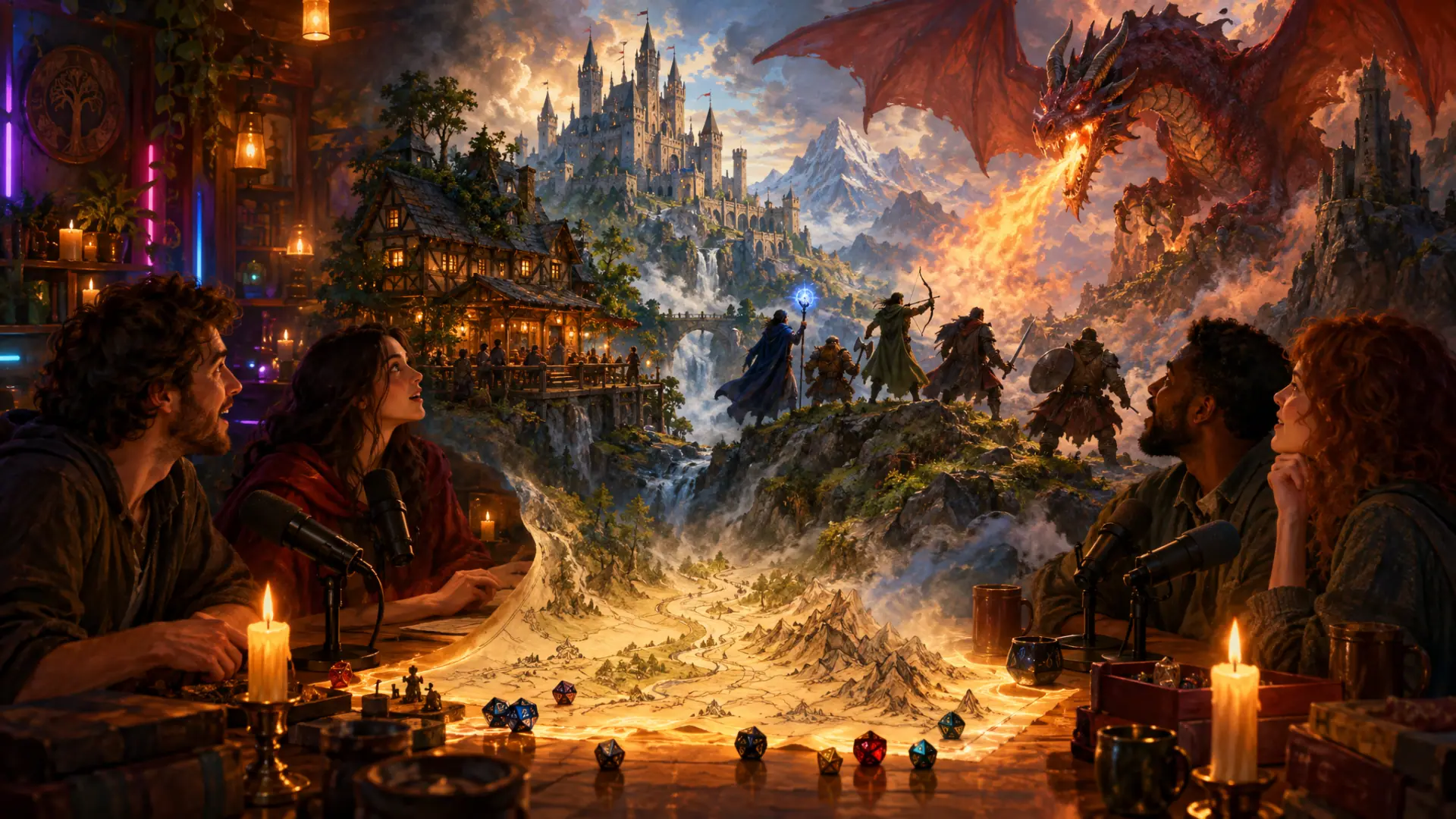
5th Edition coincided with — and fed — the Actual-Play Boom. Critical Role, launched in 2015 with Matthew Mercer as game master, turned a 5e campaign into a streaming phenomenon and later the animated series The Legend of Vox Machina. Netflix's Stranger Things (2016) put D&D in popular culture, and Virtual Tabletops and the digital toolset D&D Beyond (2017) carried groups online during the COVID-19 pandemic. Wizards reported that 2020 was the brand's biggest year yet. Films followed with Dungeons & Dragons: Honor Among Thieves (2023).
On computers, Larian Studios' Baldur's Gate 3 (2023) adapted 5th Edition rules into a critical and commercial triumph, introducing the edition's rules to millions of video-game players.
Legacy
The edition's openness became a battleground. In January 2023, Wizards' plans to revise the Open Game License provoked a revolt among players and publishers; the company retreated and released the System Reference Document 5.1 under a Creative Commons license, making its core rules permanently open. The revised 2024 Player's Handbook became, by Wizards' account, the fastest-selling D&D product ever.
5th Edition's lasting achievement is scale. It turned Dungeons & Dragons from a hobby with a devoted core into a shared cultural language — a game that millions of people learned by watching others play before they ever rolled a die themselves.
Marginalia
- D&D Next's public playtest ran from May 24, 2012 to September 20, 2013 — a first for a core D&D edition.
- Advantage and disadvantage replace most bonuses and penalties: roll two d20s and take the higher or the lower.
- Wizards reported that D&D revenue rose 35% in 2020, the brand's seventh consecutive year of growth.
- After the January 2023 OGL controversy, Wizards released the SRD 5.1 under a Creative Commons CC-BY-4.0 license.
- The revised 2024 Player's Handbook became the fastest-selling D&D product ever, according to Wizards of the Coast.
- Larian's Baldur's Gate 3 (2023) adapted 5th Edition rules for one of the most acclaimed computer RPGs of its decade.
Quick answers
- When was Dungeons & Dragons 5th Edition first released?
- Dungeons & Dragons 5th Edition was first released in 2014 (revised core books 2024–25).
- Who created Dungeons & Dragons 5th Edition?
- Dungeons & Dragons 5th Edition was made by Mike Mearls (co-lead designer) and Jeremy Crawford (co-lead designer).
- Who published or developed Dungeons & Dragons 5th Edition?
- Wizards of the Coast.
- What kind of work is Dungeons & Dragons 5th Edition?
- Dungeons & Dragons 5th Edition is a tabletop RPG in the Tabletop Roleplaying Games tradition, released for Player's Handbook, Dungeon Master's Guide, Monster Manual, Free Basic Rules / SRD and D&D Beyond.
- Why is Dungeons & Dragons 5th Edition important?
- 5th Edition reunited a fractured player base and presided over the largest boom in the game's history, while its open reference document became a foundation for the wider industry.