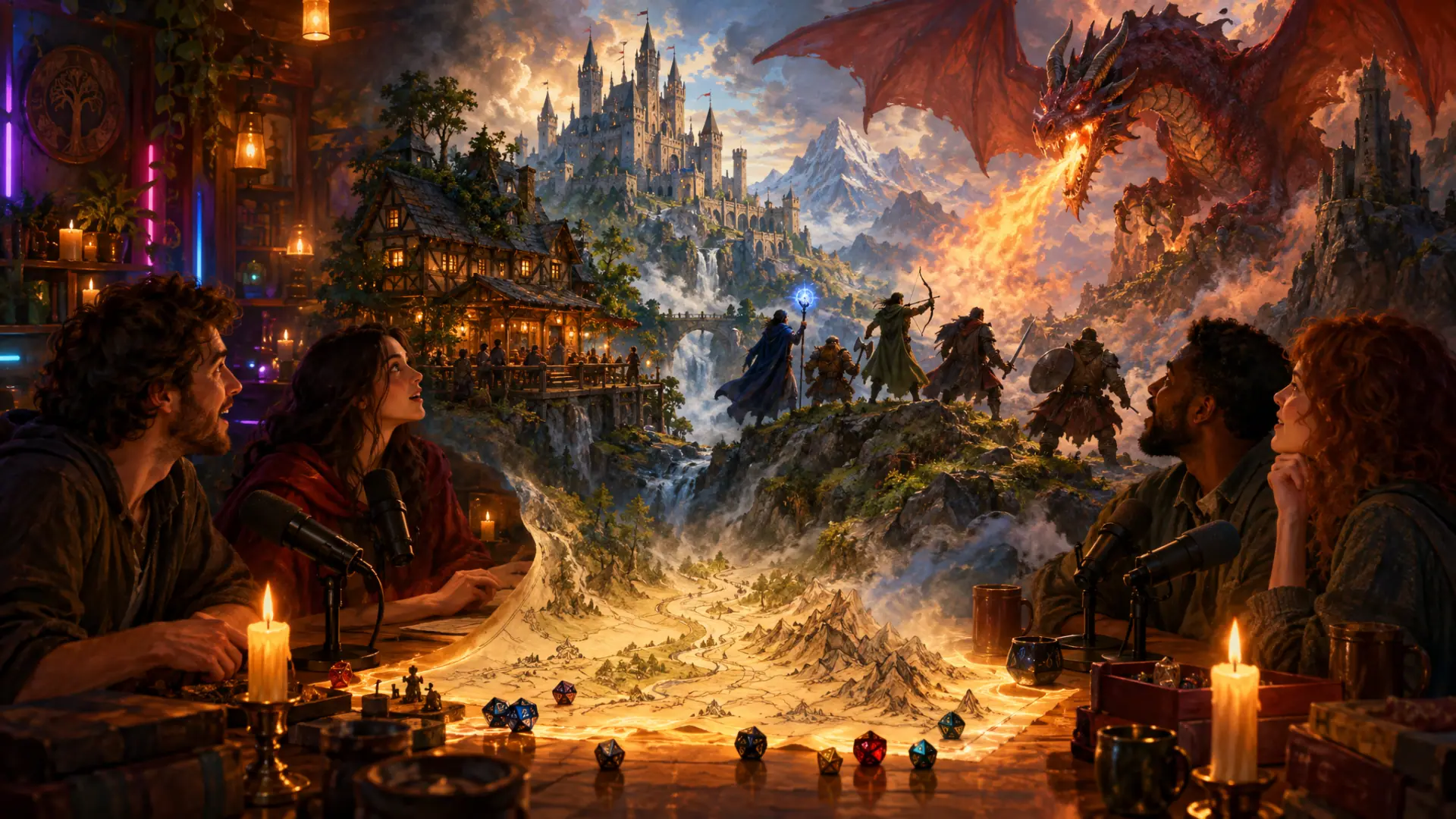
Since 2014 D&D has reached its greatest popularity. Critical Role made play into entertainment, Elden Ring and Baldur's Gate 3 swept awards, and romantasy topped bestseller lists.
On March 12, 2015, eight voice actors sat around a table in a small studio in Los Angeles, with character sheets, dice, and a camera. They had been playing a D&D campaign privately for two years, run by one of them, Matthew Mercer, and the online network Geek & Sundry had asked to broadcast it live on Twitch. The first episode of Critical Role was not especially polished: the players talked over one another, the camera angles were unsteady, and rules were occasionally forgotten. But the audience was watching the players themselves, their jokes, their losses, and their characters, and it kept growing. Within a few years, watching other people play D&D had become a popular form of entertainment. The game's revival was already under way, and it would become the largest in its history.
Fifth edition
The revival began with a simpler game. After the division of the 4th Edition years described in Screens, Sandboxes & the Open Game, Wizards of the Coast spent two years in public playtesting and then released D&D 5th Edition: a Starter Set in July 2014, the Player's Handbook on August 19, the Monster Manual on September 30, and the Dungeon Master's Guide on December 9. Its lead designers, Mike Mearls and Jeremy Crawford, had removed much of the complexity of recent editions. The core mechanic was still a d20 roll, and the edition added "advantage" and "disadvantage," in which a player rolls two dice and keeps the higher or lower result. Other rules were left to the judgment of the Dungeon Master. It was easy to teach, flexible, and much closer in spirit to the older editions, so that lapsed players could return and new ones could start quickly.
In January 2016 Wizards released the System Reference Document 5.1 under the Open Game License, inviting third-party publishers back. In August 2017 it launched D&D Beyond, a digital character builder and rules library. Popular culture also helped. On July 15, 2016, Netflix premiered Stranger Things, which opened with four boys in 1983 playing D&D in a basement and named its monsters after the Demogorgon and the Mind Flayer. The show presented the 1980s hobby that had once alarmed parents, described in The Tabletop Golden Age & the Satanic Panic, as a warm memory of childhood friendship. It ran for five seasons, and the final episode aired on December 31, 2025.
Watching other people play
Critical Role turned what had been an internet curiosity into a business. The actual-play boom followed: Dimension 20, led by Brennan Lee Mulligan, began in 2018; podcasts such as The Adventure Zone and many Twitch streams followed; and the audiences were large enough that many viewers came to D&D by watching it before playing it. Mercer's performance also created a problem that became known as the "Matt Mercer effect": new players expected every game master to be a professional voice actor running a detailed campaign. The phrase showed how much actual play had changed expectations of the game.
In March 2019 the cast launched a Kickstarter to fund a single animated special about their first party. It raised about $11.3 million, then the most money raised on the platform by a film or television project. Amazon bought the project, and The Legend of Vox Machina premiered on Prime Video on January 28, 2022. Its third season followed in October 2024. The Mighty Nein, adapted from their second campaign, premiered on November 19, 2025. The company opened its own subscription service, Beacon, in May 2024, finished its third campaign in February 2025, and began a fourth on October 2, 2025. That campaign, set in a new world and played under the 2024 rules, had Mulligan as game master and Mercer as a player for the first time. A home game had grown into a media company.
The party returns
Computer RPGs were changing at the same time. The crowdfunded games described in Screens, Sandboxes & the Open Game arrived: Pillars of Eternity (March 2015) from Obsidian, and Larian's Divinity: Original Sin followed by Divinity: Original Sin II (September 2017), which combined turn-based combat with elemental interactions and a four-player cooperative campaign. Red Hook's Darkest Dungeon (January 2016) put its heroes under psychological strain as well as physical danger. The two most successful games of the period, however, came from Poland and Japan.
The Witcher 3: Wild Hunt (May 19, 2015), from CD Projekt Red, was an open-world RPG with side quests written as carefully as the main story, and it brought Sapkowski's monster hunter Geralt to a global audience. By May 2023 CD Projekt reported that it had sold more than 50 million copies. Netflix premiered its own Witcher series on December 20, 2019, and the fourth season, with Liam Hemsworth replacing Henry Cavill as Geralt, was released on October 30, 2025. CD Projekt revealed The Witcher IV with a trailer at The Game Awards in December 2024.
In February 2022 FromSoftware released Elden Ring. Directed by Hidetaka Miyazaki, with background mythology written by George R. R. Martin, it placed the soulslike model in an open world, the Lands Between, which the player could explore in almost any order. Difficult games had been a niche, but Elden Ring won Game of the Year at The Game Awards in December 2022 and passed 30 million copies sold in April 2025. Its expansion, Shadow of the Erdtree (June 2024), sold more than 10 million copies, and a cooperative spin-off, Nightreign, followed in May 2025. Bethesda's classic sold again too: on April 22, 2025, The Elder Scrolls IV: Oblivion Remastered was released without advance announcement and was played by millions within days.
The Japanese tradition described in The Japanese Line: Console RPGs returned to its own classics. Square Enix remade Final Fantasy VII as a multi-part project, beginning with Final Fantasy VII Remake (April 2020) and Rebirth (February 29, 2024), and rebuilt Dragon Quest III in its "HD-2D" style (November 14, 2024). Final Fantasy XIV, rescued from failure in the previous chapter, became one of the most popular subscription MMORPGs, and its Dawntrail expansion arrived in July 2024. A new business model also rose to prominence. miHoYo's Genshin Impact (September 2020) combined an open world, anime-style characters, and paid random draws for new heroes, and it earned enough to make the gacha RPG a major force, especially on phones. Hogwarts Legacy (February 2023) turned Harry Potter's school into an open-world RPG, and Obsidian returned to fantasy with Avowed (February 2025). By the mid-2020s the RPG was one of the most commercially successful genres in games, on every platform.
Baldur's Gate 3
In 2019 Larian Studios, the Belgian company led by Swen Vincke, announced that it had the rights to make the third Baldur's Gate. It released an early-access version on October 6, 2020, and spent nearly three years revising it in response to player feedback. Baldur's Gate 3 was released for PC on August 3, 2023, and for PlayStation 5 on September 6. It used D&D's fifth edition rules in turn-based form, gave the player a great deal of freedom to solve problems in unexpected ways, and included motion-captured, fully voiced companions, among them a vampire spawn and a tiefling barbarian, with whom players formed strong attachments. Its story began with a mind flayer abduction, ranged across the Forgotten Realms, ended in the city of Baldur's Gate from the 1998 game, and branched in an enormous number of directions.
It won Game of the Year at The Game Awards on December 7, 2023, along with many other honors, and by late 2025 Vincke said it had sold more than 20 million copies. Larian announced in 2024 that it would not make expansions or a sequel. At The Game Awards on December 11, 2025, it revealed its next game, a dark fantasy titled Divinity, returning to the world of its earlier series. That night the French studio Sandfall Interactive's Clair Obscur: Expedition 33, a turn-based RPG made by a small team, won nine awards, including Game of the Year, the most by any game in the event's history. The party-based, turn-based RPG, dismissed as commercially dead in the late 1990s, was winning the industry's top awards.
Licenses and lockdowns
The COVID-19 pandemic made online play normal. With in-person groups unable to meet, players moved to virtual tabletops such as Roll20 and Foundry Virtual Tabletop, released in version 1.0 in May 2020, and to video calls. Many groups that formed online during lockdowns continued afterward. Hasbro began treating D&D as a major franchise. In April 2022 it announced the purchase of D&D Beyond from Fandom for $146.3 million.
Then Wizards made a serious mistake. On January 5, 2023, the journalist Linda Codega published a leaked draft of a new "OGL 1.1" in Gizmodo. It would have required royalties from large publishers and appeared to revoke the license under which third-party D&D material had been published for two decades. The response was fast and angry. Players canceled D&D Beyond subscriptions in protest, and Paizo announced its own irrevocable Open RPG Creative (ORC) license, which other publishers joined. On January 27 Wizards abandoned the plan, left the original OGL in place, and released the System Reference Document 5.1 under a Creative Commons license, which it could not later withdraw. It was a striking reversal, forced by the company's own customers.
Two months later the film Dungeons & Dragons: Honor Among Thieves (March 31, 2023) received warm reviews and grossed about $208 million worldwide. Audiences and critics liked it, but its box office was modest against a reported production budget of about $150 million, and no sequel was announced. D&D celebrated its 50th anniversary in January 2024, and Wizards released revised core rules: a new Player's Handbook in September 2024, a Dungeon Master's Guide that November, and a Monster Manual in February 2025. In 2026 it published Ravenloft: The Horrors Within and, at Gen Con that summer, announced a Dungeons & Dragons: World of Warcraft sourcebook, which combined two of the franchises in this museum.
Indie tables and crowdfunded giants
The largest companies drew most of the attention, but the smaller designers were the most inventive. John Harper's Blades in the Dark (2017), built on the rules family descended from Apocalypse World, organized play around heists by a gang of criminals in a haunted industrial city, and its rules became the basis of many other games. From Sweden, Mörk Borg (2019) presented a doom-metal apocalypse in its page design as much as its rules. Necrotic Gnome's Old-School Essentials (2019) reorganized the 1981 Basic rules for easy reference at the table. Free League Publishing published a second edition of The One Ring in 2022. Safety tools, such as the X-card and "lines and veils," became common at public tables. Solo and journaling RPGs also found audiences.
Board games reached a similar scale. Isaac Childres's Gloomhaven (2017), a campaign-length dungeon-crawler board game in a box weighing about ten kilograms, became a hobby phenomenon. Its sequel, Frosthaven, raised nearly $13 million on Kickstarter in 2020. In 2024 the Cosmere Roleplaying Game, based on Brandon Sanderson's novels, raised about $15.1 million, the most for any tabletop game on the platform until 2026. Gen Con, the convention that began in Gygax's Lake Geneva in 1968, drew more than 71,000 attendees to Indianapolis in 2024, D&D's 50th-anniversary year.
Romantasy, LitRPG, and the streaming era
The biggest changes in fantasy publishing in this period came from readers who had not been the genre's usual audience. Sarah J. Maas's A Court of Thorns and Roses (2015) and its sequels, driven by recommendations on social media, especially BookTok, helped make romantasy one of the fastest-growing categories in the bookstore. Rebecca Yarros's Fourth Wing (May 2023), a romance set at a war college for dragon riders, became a phenomenon. Its third volume, Onyx Storm, sold 2.7 million copies across formats in its first week in January 2025, according to its publisher, and its hardcover sold more copies in a first week than any adult title since Circana BookScan began tracking in 2004. At the same time LitRPG, fiction that shows character statistics and levels on the page, grew from web serials into a publishing genre. Matt Dinniman's Dungeon Crawler Carl, self-published from 2020, became a bestseller through its audiobooks, and in 2026 Peacock ordered a television series based on it.
Television committed heavily to fantasy, with mixed results. Amazon's The Lord of the Rings: The Rings of Power premiered in September 2022, returned in August 2024, and scheduled a third season for November 11, 2026. Its Wheel of Time series, which began in 2021, was canceled in May 2025 after three seasons. HBO announced that its Harry Potter series would premiere on December 25, 2026.
The period also brought losses among the people this museum celebrates. Terry Pratchett died in 2015, Ursula K. Le Guin in 2018, and Christopher Tolkien, who had spent nearly half a century editing his father's work, in January 2020. The designer Jennell Jaquays died in January 2024 and Akira Toriyama that March. Rebecca Heineman, co-founder of Interplay, died in November 2025. In 2026 the hobby lost Lou Zocchi, known for his precision dice, in April; John Blanche, whose paintings defined the look of Games Workshop's worlds, in June; and the children's fantasy author Jane Yolen, also in June.
What comes next
This is the final chapter, and it is not finished. Dice are sold in bookstores, and new players often learn D&D from a stream before they ever play. Every source this museum has followed now feeds the present: the myths behind Tolkien, the pulps behind Appendix N, the wargames behind D&D, and the online worlds described in Online Worlds: From MUD1 to World of Warcraft. Roleplaying is no longer a subculture, and the mainstream culture it has joined is increasingly shaped by it. The previous thirteen chapters trace how that happened.