The dungeon-crawler board game packaged the most famous scene in roleplaying, the underground expedition, into a box anyone could run, and its cooperative campaign designs became some of the most successful tabletop games ever crowdfunded.
Hallmarks
- A party of heroes explores a dungeon room by room
- Tactical combat on a grid, with miniatures, line of sight and positioning
- An opponent that is either an overlord player or the game's own AI of cards and dice
- Loot, leveling and equipment between quests
- Scenario books or campaigns that link sessions together
- Modular board tiles that reveal the dungeon as it is explored
What it is
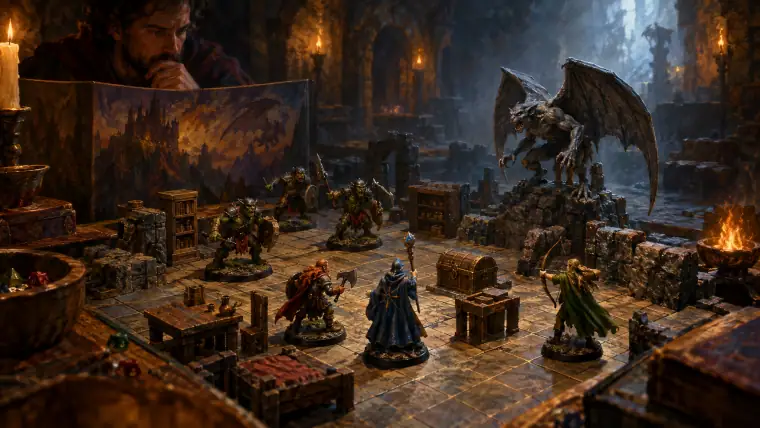
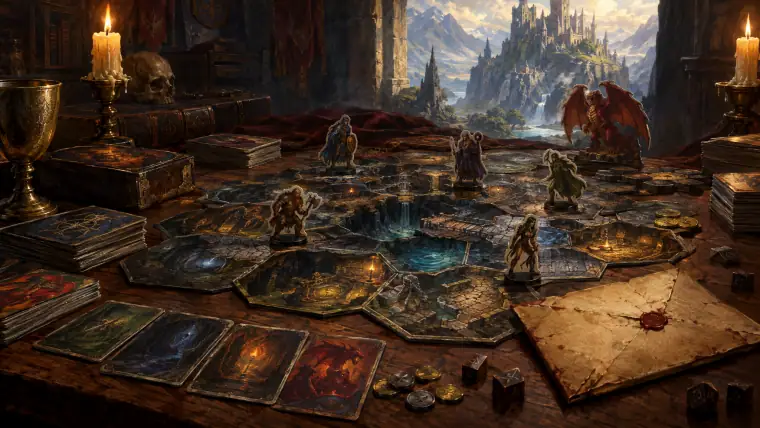
The dungeon-crawler board game is the Fantasy Adventure Board Games narrowed to its most iconic scene. A The party of heroes, usually represented by miniatures, enters an underground complex laid out on tiles or a printed grid. They open doors, spring traps, fight monsters square by square, count line of sight, and haul Loot & loot tables back to town. Where a broader adventure game like Talisman roams an entire world at a brisk pace, the crawler zooms in until positioning, facing and the order of actions matter as much as the roll of a die.
The genre's defining question is who plays the dungeon. In overlord designs, one player controls the monsters and traps, a competitive cousin of the Game Master. In cooperative designs, a deck of event cards, a monster behavior system or an app runs the opposition and all players stand together. Almost every crawler is built to be played as a series of scenarios, and the best-loved ones become full campaigns.
Origins
The idea is as old as roleplaying. David Megarry's Dungeon!, prototyped around 1972 by a player in Dave Arneson's Blackmoor campaign and published by TSR, Inc. in 1975, turned the D&D Dungeon crawl into a race for treasure across a six-level board. But Dungeon! was abstract: heroes hopped between rooms and resolved fights with a single roll.
The modern form arrived in 1989 with HeroQuest, designed by Stephen Baker for Milton Bradley Company in partnership with Games Workshop. It had everything the genre still uses: four heroes against a player-wizard (Morcar in the UK, Zargon in North America), a gridded board revealed as the heroes explored, plastic furniture and monsters, custom combat dice, and a quest book linking adventures. That same year Games Workshop published Jervis Johnson's Advanced HeroQuest, with a modular board and dungeons generated randomly by dice, a tabletop parallel to Procedural generation in the Roguelikes.
Evolution
Warhammer Quest (1995) was the next leap. Designed by Andy Jones for Games Workshop, it dispensed with the overlord entirely: a dungeon deck built the complex as the heroes advanced and a random event could fire on every unlucky roll. Between expeditions, heroes trained in towns and climbed battle levels, and an optional Roleplay Book pushed the game toward a full Tabletop Roleplaying Games.
After a quieter decade, Fantasy Flight Games revived the big-box crawler with Kevin Wilson's Descent: Journeys in the Dark (2005), whose Overlord spent "threat" to play trap and spawn cards. Wizards of the Coast answered with the cooperative D&D Adventure System, beginning with Castle Ravenloft (2010) for one to five players, then Wrath of Ashardalon and The Legend of Drizzt (both 2011).
Crowdfunding transformed the genre in the 2010s. Isaac Childres's Gloomhaven, funded on Kickstarter in 2015 and released by Cephalofair Games in 2017, replaced attack dice with hand management, added legacy elements and sealed boxes that open as the story unfolds, and held the top spot on BoardGameGeek from 2017 until February 2023. Its follow-up Frosthaven raised nearly $13 million on Kickstarter in 2020. Hasbro's 2020 campaign to remake HeroQuest reached its $1 million goal within a day. The wider story is told in Crowdfunding & the Kickstarter Era.
The scale of the boxes tells its own story. Warhammer Quest's 1995 box held 32 board sections, 91 plastic miniatures and 108 cards; Gloomhaven's first Kickstarter, launched in September 2015, raised $386,104 from 4,904 backers, and the finished game won six Golden Geek Awards in 2017, including Best Overall Game. What had begun as a toy-shop novelty had become the heavyweight end of the hobby. Wizards' Adventure System kept going too, with Temple of Elemental Evil (2015), Tomb of Annihilation (2017) and Waterdeep: Dungeon of the Mad Mage (2019), each playable solo.
How to tell it apart
Versus the broader adventure board game. Talisman, Magic Realm and Runebound are adventures across a map; a crawler is tactical combat in confined spaces, built around miniatures and grids. The crawler is the adventure game's sub-genre, not its synonym.
Versus the roleplaying game. The crawler keeps the Tabletop Roleplaying Games's dungeon and discards its freedom. There is no negotiating with the goblin guard unless a card says so; the overlord, when there is one, plays to win rather than to tell a story.
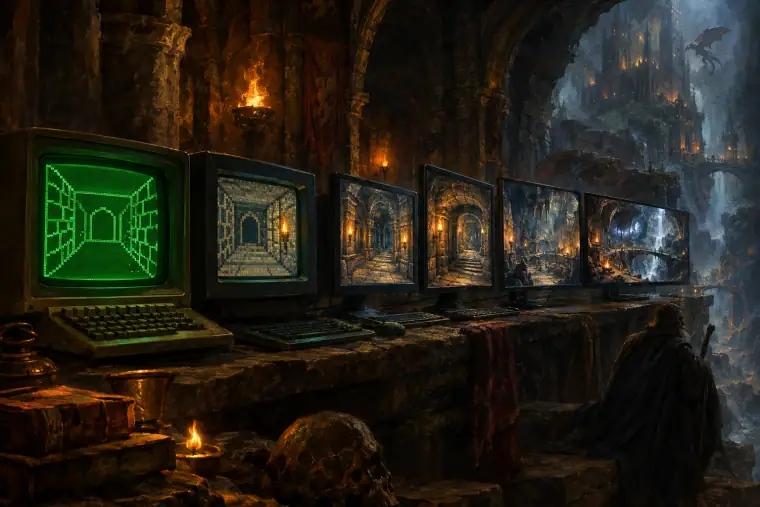
Versus the digital dungeon crawler. The computer First-Person Dungeon Crawlers ('Blobbers') ("blobber") shows the maze in first person, one step at a time, with the party moving as a block; its board-game namesake is viewed from above, each hero a separate figure. Both descend from the same underground expedition in Dungeons & Dragons.
Versus the wargame skirmish. A miniatures Miniatures & Board Wargames matches two forces of expendable figures; the crawler's heroes persist and grow from quest to quest.
Where to start
- HeroQuest — the template, and still the friendliest introduction (remade in 2021).
- Warhammer Quest — the first great fully cooperative crawl.
- Descent: Journeys in the Dark — the overlord model at its most lavish.
- Gloomhaven — the campaign crawler that redefined the genre's ambition.
- Dungeon! — for the 1975 roots, and for younger players.
Marginalia
- Dungeon crawling on the board dates to Dungeon! in 1975, a year after D&D.
- HeroQuest's combat dice carry three skulls, two hero shields and one monster shield.
- Games Workshop's Advanced HeroQuest (1989) generated its dungeons randomly with dice as the heroes explored.
- Warhammer Quest (1995) removed the evil overlord player, letting a deck of cards run the dungeon.
- Descent: Journeys in the Dark grew out of Kevin Wilson's Doom: The Boardgame (2004).
- Gloomhaven uses no dice for attacks: each hero plays two cards a turn, the top of one and the bottom of the other.
Quick answers
- What is Dungeon-Crawler Board Games?
- Plastic heroes, cardboard corridors and a door about to open: the board game that stages the dungeon crawl room by room, with one friend playing the evil wizard or the deck itself springing the traps.
- What are the hallmarks of Dungeon-Crawler Board Games?
- A party of heroes explores a dungeon room by room; Tactical combat on a grid, with miniatures, line of sight and positioning; An opponent that is either an overlord player or the game's own AI of cards and dice; Loot, leveling and equipment between quests; Scenario books or campaigns that link sessions together; Modular board tiles that reveal the dungeon as it is explored.
- When did Dungeon-Crawler Board Games emerge?
- 1975 (Dungeon!); defined by HeroQuest, 1989.
- What are the key works of Dungeon-Crawler Board Games?
- HeroQuest, Warhammer Quest, Descent: Journeys in the Dark, Gloomhaven and Dungeon!.