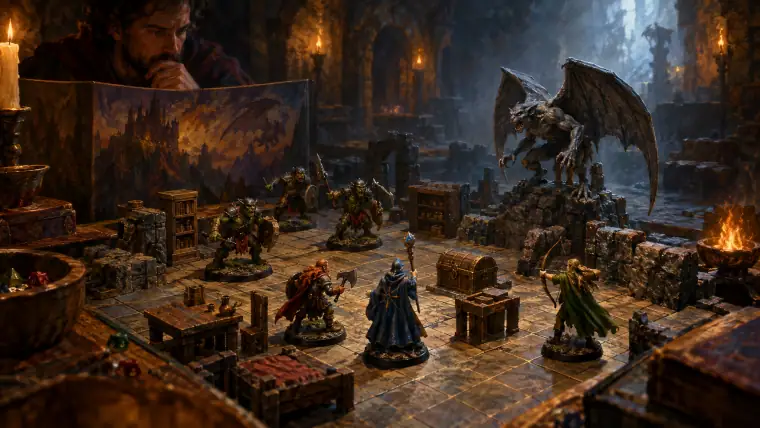
Milton Bradley brought fantasy adventure to the mass market: its electronic Dark Tower and, above all, HeroQuest introduced millions of children to dungeon crawling and the idea of one player running the monsters.
History
Milton Bradley opened Massachusetts's first color lithography shop in Springfield in 1860. His best-selling print, a portrait of Abraham Lincoln, became obsolete when Lincoln grew a beard, so Bradley looked for another use for his press and invented a board game. The Checkered Game of Life sent players along a track from Infancy to Happy Old Age, avoiding Ruin; it used a spinner rather than dice, which carried the taint of gambling. By spring 1861 it had sold more than 45,000 copies. During the Civil War Bradley sold compact game kits to soldiers stationed in Springfield, and after 1869 he threw himself into the kindergarten movement, making Froebel's educational "gifts," crayons and colored papers.
The company survived its founder's generosity, the Depression and a near-bankruptcy in 1940, when Springfield businessman James J. Shea took over. Under Shea and his son, Milton Bradley became a giant: Candy Land, Chutes and Ladders, television tie-ins, The Game of Life for its 1960 centennial, Twister, Operation, Battleship and Yahtzee. It bought Playskool, moved manufacturing to a 1.1-million-square-foot plant in East Longmeadow, and entered electronics with Simon (1978), the Microvision (1979), the first handheld console with interchangeable cartridges, and the Vectrex home console (1983).
Fantasy arrived in 1981 with Dark Tower, an electronic board game in which a battery-powered tower tracked players' warriors, food and treasure as they sought keys to a sorcerer's keep. Its 1980s Gamemaster series of large war games included Axis & Allies and Conquest of the Empire. In 1984 Hasbro bought Milton Bradley, ending 124 years as an independent company.
The company's great fantasy contribution came from Britain. Designer Stephen Baker, who had worked at Games Workshop, moved to Milton Bradley and persuaded its head of development, Roger Ford, to let him make a fantasy game. The result, developed with Games Workshop, was HeroQuest (1989 in Britain and Europe, 1990 in North America): four heroes, a gamemaster playing the evil wizard Zargon, plastic furniture and monsters drawn from the Warhammer world, and a quest book of linked adventures. It was a dungeon-crawler board game for the toy aisle, and it sold across Europe and Australia. Expansions followed, and so did Battle Masters (1992), another Games Workshop collaboration, this time a mass-battle game with a giant vinyl mat.
In 1998 Hasbro merged Milton Bradley with Parker Brothers to form Hasbro Games, and the brand name was retired in 2009 in favor of Hasbro's own.
Notable work
The Checkered Game of Life, Candy Land, Twister, Battleship, Operation, Simon, the Microvision, Dark Tower, the Gamemaster series, HeroQuest and Battle Masters.
Legacy
Milton Bradley's fantasy games were a small part of a vast catalog, but their reach was enormous. HeroQuest put the rituals of roleplaying, a party of adventurers, a referee running the monsters and a campaign of linked quests, into the hands of children who had never seen D&D, and Games Workshop's own Advanced HeroQuest (1989) led in turn to Warhammer Quest (1995). When Hasbro revived HeroQuest in 2020 under its Avalon Hill brand, a crowdfunding campaign hit its goal within a day: proof of how long the memory of that plastic dungeon lasted.
Marginalia
- Milton Bradley's first hit, The Checkered Game of Life (1860), sold more than 45,000 copies by spring 1861; it used a spinner instead of dice to avoid associations with gambling.
- During the Civil War the company sold small travel game kits to Union soldiers in Springfield.
- Bradley's chosen six colors for kindergarten art materials remained the standard for children's art supplies through the 20th century.
- The company re-released its first game for its 1960 centennial as The Game of Life, with the goal changed from Happy Old Age to becoming a millionaire.
- In 1979 it released the Microvision, the first handheld console with interchangeable cartridges.
- HeroQuest (1989), designed by Stephen Baker with Games Workshop, was released in Europe in 1989 and North America in 1990.
- Hasbro's 1984 purchase ended 124 years of independence.
Quick answers
- What was Milton Bradley Company?
- America's great family-game maker, from The Checkered Game of Life in 1860 to Twister and Simon, which in 1989 teamed with Games Workshop to put a plastic dungeon in toy stores with HeroQuest.
- When was Milton Bradley Company founded?
- Milton Bradley Company was founded in 1860 and was based in Springfield, Massachusetts; later East Longmeadow, Massachusetts; it closed in 1998.
- Who founded Milton Bradley Company?
- Milton Bradley (1836–1911), a lithographer.
- What is Milton Bradley Company known for?
- HeroQuest.
- What happened to Milton Bradley Company?
- Bought by Hasbro in 1984; merged with Parker Brothers into Hasbro Games in 1998; the brand name was dropped in 2009.