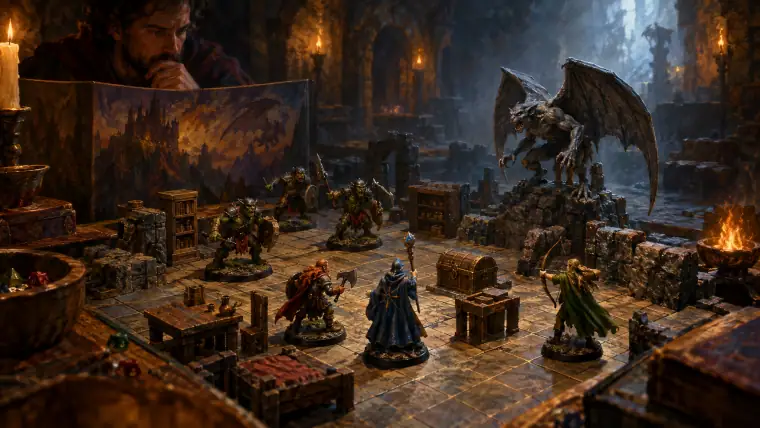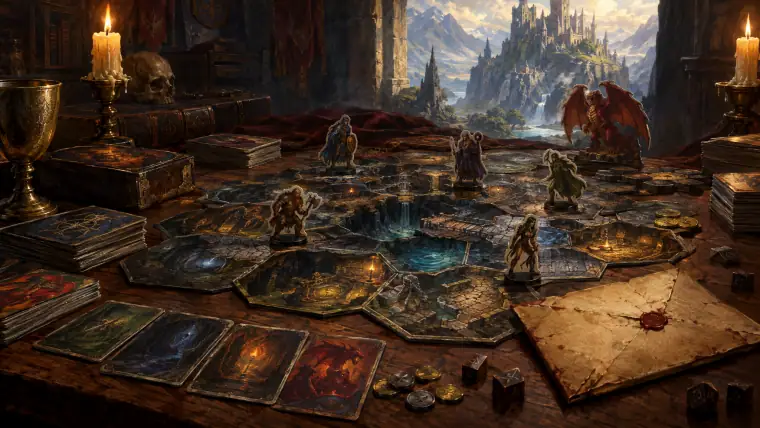
Baker's HeroQuest turned the tabletop roleplaying dungeon into a family board game with a game master, introducing a generation of children to fantasy gaming. It is a direct ancestor of the modern dungeon-crawler board game.
Life
Stephen Baker's early life is not well documented, and no reliable source gives his birth date. By his own professional biography he was born in London, spent more than twenty-five years working for Hasbro and its Milton Bradley division in Europe and the United States, and moved to the United States in 2000. In September 2019 he left Hasbro to start his own studio, Stephen Baker Design LLC, and has since worked as a freelance designer, consultant and inventor.
His career began at Games Workshop, the British company that in the 1980s was publishing Warhammer Fantasy Battle, importing American roleplaying games and running White Dwarf. In the late 1980s he moved to Milton Bradley Company, the mass-market toy and game giant.
Work
At Milton Bradley, Baker persuaded the head of development to let him make a fantasy game, on condition that he kept it simple. He went back to his former employer to produce the plastic miniatures the game would need, and ended up drawing on Games Workshop's fantasy expertise for the design as well. The result was HeroQuest, released in Britain, Europe and Australia in 1989 and in North America, subtitled Game System, in 1990.
HeroQuest brought the logic of a tabletop Dungeon crawl to the toy shop. Four heroes, the Barbarian, the Dwarf, the Elf and the Wizard, explore a dungeon built on the board, room by room, from doors, furniture and monsters. A fifth player, the evil sorcerer Morcar (Zargon in North America), plays Game Master, revealing rooms, springing traps and moving orcs, goblins, Fimir, Chaos warriors and undead. The quest book let the game master rebuild the same board as a new dungeon each time, which made HeroQuest what its American subtitle claimed: a system, not a single scenario. Baker was candid that it could be too easy if the heroes cooperated perfectly. In a 1989 interview he said the game was aimed at 10–12-year-olds who played with their parents, and that "they play in a very competitive, rather than co-operative way."
The partnership continued. Games Workshop used its rights from the deal to produce the deeper Advanced HeroQuest (1989), and Baker designed two more Milton Bradley–Games Workshop titles: Space Crusade (1990), a simplified science-fiction cousin of HeroQuest in which Space Marines board an alien hulk, and Battle Masters (1992), a large, simple wargame in the style of Warhammer Fantasy Battle. Long after moving to the United States he co-designed Heroscape (2004) with Craig Van Ness and Rob Daviau, a miniatures game played on stackable hexagonal terrain that pitted warriors from across history, science fiction and fantasy against each other, and gathered a devoted following.
When Hasbro's Avalon Hill revived HeroQuest through crowdfunding in 2020–21, Baker returned to write new material, including the training quest Rogar's Hall and the quest book Prophecy of Telor. Coverage of the 2025 introductory set HeroQuest: First Light also credited his involvement.
Legacy
For many children in Europe and Australia around 1990, HeroQuest was their first experience of fantasy gaming, sold alongside mass-market family games rather than in hobby shops. It showed that the roleplaying dungeon could be boxed, simplified and sold to families without losing its appeal. Its lineage runs through Games Workshop's Warhammer Quest (1995) and Fantasy Flight's Descent: Journeys in the Dark (2005) to the campaign-driven dungeon crawlers of the crowdfunding era, including Gloomhaven. The success of the 2020s revival, with new heroes, expansions and a companion app more than thirty years after the original, shows how durable Baker's simple design has been.
Marginalia
- He persuaded Milton Bradley's head of development to let him make a fantasy game on condition that he kept it simple.
- He first approached Games Workshop only to make HeroQuest's plastic miniatures, then brought the company in on the game's development.
- In 1989 he said the game was aimed at 10–12-year-olds who played with their parents, and that they played competitively rather than cooperatively.
- HeroQuest's evil game master is Morcar in Britain and Zargon in North America.
- His Space Crusade (1990) and Battle Masters (1992) were further Milton Bradley–Games Workshop collaborations.
- He co-designed Heroscape (2004) with Craig Van Ness and Rob Daviau.
Quick answers
- Who is Stephen Baker?
- A Games Workshop alumnus who moved to Milton Bradley and designed HeroQuest, the 1989 box of plastic heroes and monsters that put the dungeon crawl on toy-shop shelves, then Space Crusade, Battle Masters and Heroscape.
- What is Stephen Baker known for?
- Stephen Baker is best known for HeroQuest.
- Why does Stephen Baker matter to fantasy and games?
- Baker's HeroQuest turned the tabletop roleplaying dungeon into a family board game with a game master, introducing a generation of children to fantasy gaming. It is a direct ancestor of the modern dungeon-crawler board game.