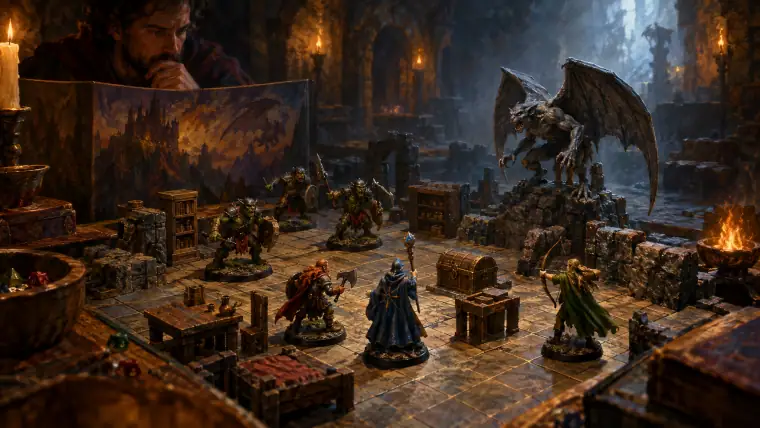
Games Workshop was the gateway through which roleplaying reached Britain and Europe, and its Warhammer worlds, gothic and grim, became one of the most influential fantasy settings outside Tolkien and D&D.
History
Games Workshop began in 1975 at 15 Bolingbroke Road in west London, founded by John Peake, Ian Livingstone and Steve Jackson (the British designer, no relation to the American Steve Jackson). Its first products were handmade wooden boards for backgammon, Go and other traditional games, sold by mail order, and its newsletter, Owl and Weasel, reported on the new "progressive" games. Peake, who preferred the traditional kind, left in early 1976, taking the company's main income with him.
What saved the business was Dungeons & Dragons. Livingstone and Jackson won exclusive British distribution of TSR, Inc.'s products, ran conventions such as Games Day, and in June 1977 replaced Owl and Weasel with White Dwarf, soon Britain's leading hobby magazine. Gygax floated a merger; the founders backed out, and TSR set up its own UK arm in 1980. The first Games Workshop shop opened in April 1978 in Hammersmith. In late 1978 the company funded Citadel Miniatures in Newark-on-Trent, which made the metal figures that became its signature. Its publishing arm printed British editions of American games that were expensive to import, among them RuneQuest, Call of Cthulhu, Traveller and Middle-earth Role Playing.
The early 1980s were a creative explosion. Jackson and Livingstone wrote The Warlock of Firetop Mountain (1982) for Puffin, launching Fighting Fantasy. In 1983 the company published Robert Harris's board game Talisman and the first edition of Warhammer, a mass-battle miniatures game. Warhammer Fantasy Roleplay (1986), Blood Bowl (1986) and Warhammer 40,000 (1987) followed. Under Bryan Ansell, who became managing director and majority owner in the mid-1980s, the focus shifted from roleplaying and board games to miniatures, with the company's own shops as the heart of the business. Designer Stephen Baker went from Games Workshop to Milton Bradley Company, and the two firms collaborated on HeroQuest (1989), which put Warhammer-style monsters into toy shops.
In December 1991 Ansell, Livingstone and Jackson sold out in a £10 million management buyout led by Tom Kirby, backed by the private equity firm ECI. The company narrowed its focus to its two Warhammer wargames and a younger, family-oriented retail chain, a turn that made money but alienated some older fans. It floated on the London Stock Exchange in 1994, moved all British operations to Lenton, Nottingham, in 1997, and expanded across Europe, North America and Australia. Later ventures included the Black Library novels, a Lord of the Rings strategy battle game licensed alongside the Peter Jackson films from 2001, and licensed video games. In 2015 it replaced the Warhammer world with Warhammer Age of Sigmar, and in 2024 it returned to the old setting with Warhammer: The Old World. Games Workshop joined the FTSE 100 on 20 December 2024 and, under CEO Kevin Rountree, reported revenue of about £627 million for its 2026 financial year.
Notable work
White Dwarf; the British editions of D&D and other American RPGs; Fighting Fantasy; Talisman; Warhammer Fantasy Battle and Warhammer Fantasy Roleplay; Warhammer 40,000; Blood Bowl; HeroQuest and Warhammer Quest (1995); and the Middle-earth Strategy Battle Game.
Legacy
Games Workshop shaped British fantasy gaming more than any other company. Its founders brought D&D across the Atlantic, its gamebooks turned schoolchildren into adventurers, and its Warhammer setting, with its Chaos gods, gunpowder empires and doomed grandeur, spread through video games such as Warhammer: Mark of Chaos and the Total War: Warhammer series and influenced the look of later dark fantasy. The Nottingham area, home to so many former staff and spin-off companies, is still nicknamed the "lead belt."
Marginalia
- It was founded in 1975 at 15 Bolingbroke Road, London, originally to make wooden boards for backgammon, mancala, nine men's morris and Go.
- Co-founder John Peake left in early 1976 because he preferred traditional games to the 'progressive' ones his partners championed.
- Its newsletter Owl and Weasel (from February 1975) was replaced by White Dwarf in June 1977.
- Gygax gave Games Workshop exclusive UK distribution of TSR products; a proposed merger of the two companies fell through.
- The first Games Workshop shop opened in April 1978 at 1 Dalling Road, Hammersmith.
- In 1991 majority owner Bryan Ansell, Livingstone and Jackson sold their shares in a £10 million management buyout led by Tom Kirby.
- The company moved all its UK operations to Lenton, Nottingham, in 1997 and joined the FTSE 100 on 20 December 2024.
Quick answers
- What is Games Workshop?
- Three friends' London mail-order business that imported D&D to Britain, launched White Dwarf and Fighting Fantasy, then built Warhammer into a miniatures empire now worth a place in the FTSE 100.
- When was Games Workshop founded?
- Games Workshop was founded in 1975 and is based in Nottingham, England (founded in London).
- Who founded Games Workshop?
- Steve Jackson and Ian Livingstone.
- What is Games Workshop known for?
- Warhammer Fantasy Battle, Warhammer Fantasy Roleplay, Talisman, Warhammer Quest, HeroQuest and Fighting Fantasy.
- What happened to Games Workshop?
- Management buyout in 1991; listed on the London Stock Exchange since 1994 and in the FTSE 100 since December 2024.