In the 1990s a Seattle card game made millions, a vampire game drew new players to the tabletop, TSR went bankrupt in all but name, and Diablo and Baldur's Gate brought the computer RPG back.
In the summer of 1993 a young company from the Seattle area showed a new game at the Origins convention. Wizards of the Coast was only three years old and had published a few roleplaying supplements. Its new product was sold in sixty-card starter decks and fifteen-card booster packs with randomized rarity, so no two players had the same set. Buyers went back for more packs, then more still. Within months shops were rationing the game, dealers were selling single cards, and the RPG publishers who shared the hobby's shelf space could see what was happening. Magic: The Gathering was the most important new game of the decade. Its money would, within four years, pay for the purchase of D&D itself.
The cardboard crack
Peter Adkison, a Boeing systems analyst, founded Wizards of the Coast in 1990 in his basement. He met Richard Garfield, a mathematics doctoral student at the University of Pennsylvania, and asked him for a game that could be played in the short gaps at conventions. Garfield revived ideas from a card game he had been developing for years. In the result, dueling wizards summoned creatures with Mana drawn from five colors of land, and each card could change the rules in its own way. The collectible model made the design commercial: players bought sealed, randomized packs, so every player's card pool and every deck was different. The first printing, later known as Alpha, was released on August 5, 1993, and its 2.6 million cards sold out almost immediately. Magic soon had tournaments, a professional circuit (the first Pro Tour was held in New York in February 1996), a secondary market with prices for individual cards, and critics who compared it to gambling. Players soon nicknamed it "cardboard crack."
The collectible card game became a gold rush. Nearly every company with a license rushed out a card game, including Star Trek, Star Wars, and Middle-earth. In 1994 TSR released Spellfire, a card game built from its settings and its existing art. Alderac Entertainment Group's Legend of the Five Rings (1995) developed a storyline shaped by tournament results, then a roleplaying game in 1997. Most of the imitators failed within a few years. What remained was a new financial model for fantasy gaming, built on repeat purchases, and it drained customers and cash from traditional RPGs in the hobby shops. In 1999 Wizards added the English-language Pokémon trading card game, the tie-in to the phenomenon told in The Japanese Line: Console RPGs.
The Masquerade
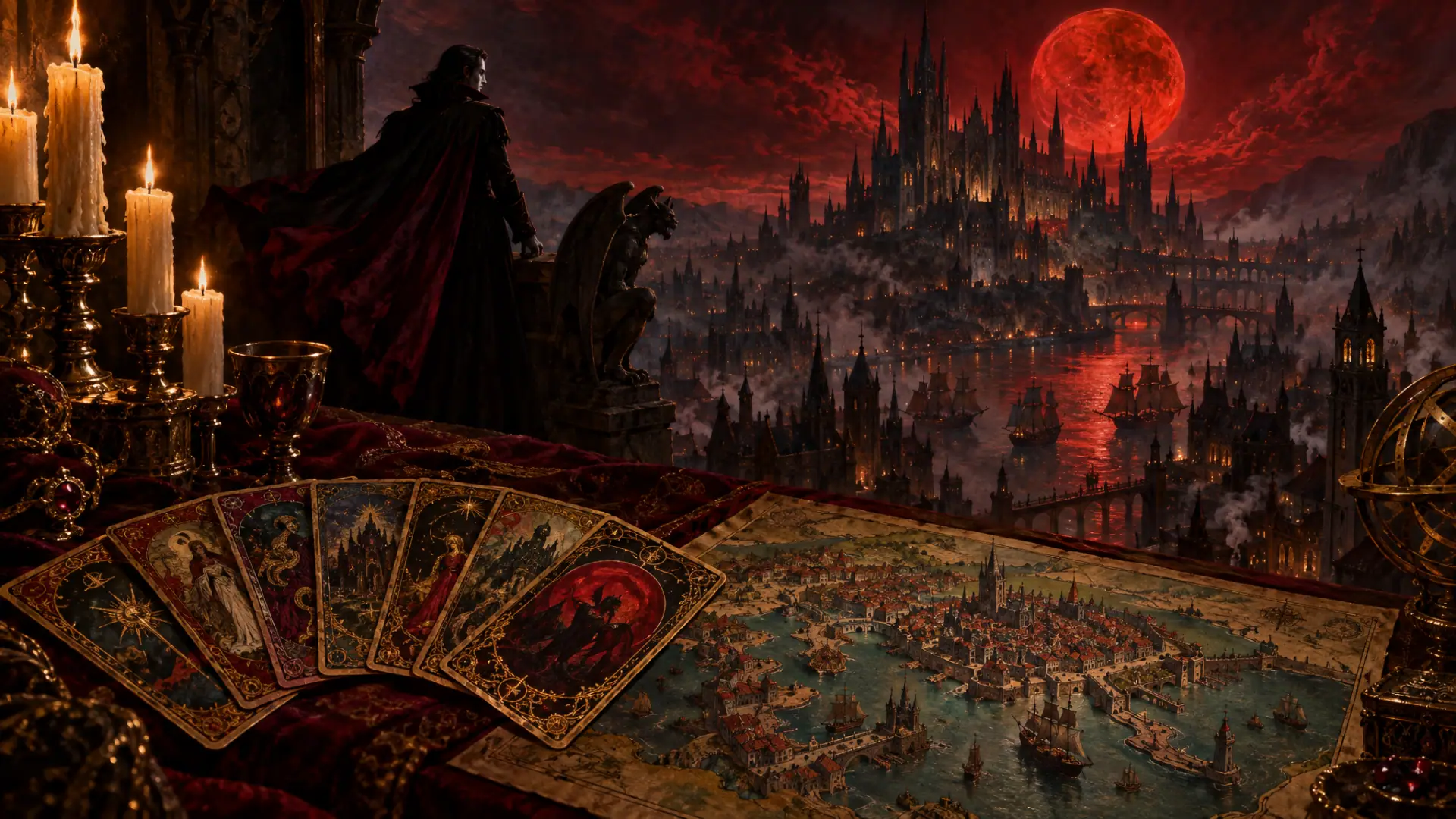
At the same time, a different kind of roleplaying game was drawing new players. Mark Rein·Hagen, co-designer of Ars Magica, merged his company Lion Rampant with Stewart Wieck's White Wolf magazine in 1991 to form White Wolf. That year they released Vampire: The Masquerade. Its players were monsters rather than heroes. Its vampires feared losing their humanity, belonged to clans with political agendas, and hid from humankind behind the Masquerade. It used a simple dice pool, the "Storyteller System," and gave the game master the title of Storyteller to signal that the story came first and the numbers second. The books were illustrated with goth-inflected art, sold in bookstores as well as game shops, and appealed to readers of Anne Rice rather than Tolkien.
Vampire drew in players whom D&D had often failed to reach, especially women and young adults from goth and alternative scenes. White Wolf expanded it into the "World of Darkness," with Werewolf: The Apocalypse (1992), Mage: The Ascension (1993), and others, and in 1993 released Mind's Eye Theatre, a rule set for playing Vampire in costume at nightclubs and conventions without dice. It became one of the most widely played LARP systems in North America. The line even reached television in 1996 as the short-lived Fox series Kindred: The Embraced. Urban fantasy and personal horror had entered the RPG mainstream, and the narrative-first games of the 2000s would build on White Wolf's example.
The fall of TSR
Under Lorraine Williams, TSR published more and more. AD&D Second Edition supported a new world nearly every year. Ravenloft became a gothic horror setting in 1990. Dark Sun (1991) was a brutal desert world with psionics and sorcerer-kings, illustrated by Brom. Planescape (1994) centered on the city of Sigil, with factions, cant, and Tony DiTerlizzi's distinctive art. Spelljammer, Al-Qadim, Birthright, Mystara, and more followed, alongside boxed adventures and novels, dozens a year. Many of these products were imaginative and remain well regarded. Commercially they competed with one another. Each new setting split the audience, and hobby shops couldn't stock them all. The novel program and a distribution deal with Random House tied TSR to returns of unsold books. The company also experimented with the Dragon Dice game (1995), while its own customers were being drawn to Magic.
By the end of 1996 TSR was deep in debt and short of cash, couldn't pay its printers, and had effectively stopped publishing. On April 10, 1997, Wizards of the Coast announced it would buy TSR, together with Five Rings Publishing, in a deal reported at $25 million. Adkison, himself a longtime D&D player, moved the operation from Lake Geneva to the Seattle suburb of Renton. Gen Con, which TSR owned, came with the purchase. Two years later, in September 1999, the toy company Hasbro bought Wizards of the Coast for about $325 million. D&D, the game Gygax and Arneson had assembled from wargames, was now a toy company's brand. Hasbro had also bought the wargame pioneer Avalon Hill in 1998.
Other companies had kept tabletop gaming varied through the decade. Palladium Books' Rifts (1990) mixed every genre on a ruined Earth. FASA's Earthdawn (1993) was a fantasy prehistory of the Shadowrun world. Games Workshop's Warhammer Quest (1995) extended the dungeon crawl on the tabletop. But no company could replace the brand at the center of the hobby. Wizards' first large decision about it, a complete redesign, is told in Screens, Sandboxes & the Open Game.
Winter for the computer RPG
In the early 1990s the Western computer RPG went into decline. The Gold Box line ended with games built on an aging engine. Origin's Ultima VIII: Pagan (1994) was rushed, heavily action-oriented, and widely seen as a disappointment. Sir-Tech took years between Wizardry games. New players flocked to strategy games, flight simulators, and first-person shooters such as Doom (1993), and in the trade press of the mid-1990s writers asked whether the CRPG was dying. A few games looked ahead. Bethesda Softworks, a Maryland company then known for sports and licensed games, released The Elder Scrolls: Arena in 1994, conceived partly by Julian LeFay. It was followed on August 31, 1996, by Daggerfall, a procedurally generated province reported to be roughly the size of Great Britain, with thousands of towns and dungeons. It was buggy and vast, and it anticipated the open worlds of the next decade. The early part of the decade still produced good games; the trouble was that each one seemed to sell to a smaller audience. Sir-Tech's Wizardry VII: Crusaders of the Dark Savant (1992) put rival AI parties in its world, racing the player for the same artifacts. New World's Clouds of Xeen (1992) and Darkside of Xeen (1993) could be installed together to form one larger game, World of Xeen. Westwood's Lands of Lore (1993) polished the real-time dungeon of Eye of the Beholder. Dynamix and Sierra's Betrayal at Krondor (1993), set in the world of novelist Raymond E. Feist, was written like a book, with chapters and prose narration, and it showed how fantasy fiction and computer RPGs might be combined more closely. But these were niche successes in a market increasingly organized around CD-ROM spectacle and fast action. Big budgets were going to full-motion video and 3D shooters, and publishers were reluctant to fund 100-hour games of statistics and dialogue.
New World Computing's Heroes of Might and Magic (1995) turned RPG progression into turn-based strategy and became a hit. In 1996 The 3DO Company bought New World.
Diablo's descent
The revival came from two directions within about two years. The first was Diablo, developed by Condor, a San Francisco Bay Area studio founded by David Brevik and the brothers Max and Erich Schaefer, which Blizzard Entertainment bought during development and renamed Blizzard North. Brevik had loved Rogue and its descendants and originally planned the game as a turn-based roguelike. The team switched it to real time: a click, a sword swing, a skeleton shattering. Diablo was released on December 31, 1996. It had sixteen procedurally generated dungeon levels under the town of Tristram, randomized loot in color-coded tiers of rarity, and free online multiplayer through Blizzard's new Battle.net service. Its sessions were short and it was easy to return to.
Diablo compressed the RPG into a loop of fighting, collecting better equipment, and descending further, and it was very widely imitated. Diablo II (June 29, 2000) added five classes, skill trees, and an economy of item trading, much of it carried on over Battle.net with its own informal currency. The action RPG had become a genre of its own.
The Infinity Engine
The second direction came from Edmonton, Alberta. In 1995 three physicians, Ray Muzyka, Greg Zeschuk, and Augustine Yip, founded BioWare. Their game, developed for Interplay under lead designer James Ohlen, became Baldur's Gate, released on December 21, 1998. It used AD&D Second Edition rules, the Forgotten Realms setting, a party of up to six, painted isometric backgrounds, and a combat system later known as real-time with pause: battles ran in real time but could be stopped at any moment to give orders. It offered what Diablo didn't: companions with personalities who argued with one another, a mystery that unfolded slowly, and a tabletop campaign's sense of consequence. It sold strongly and showed the industry that the long, party-based computer RPG still had a large audience.
The engine behind it, the Infinity Engine, supported a sequence of now-classic games. Interplay's in-house RPG division, Black Isle Studios, led by Feargus Urquhart, had grown out of the team behind the post-apocalyptic Fallout (1997), the spiritual successor to Wasteland, and made Fallout 2 (1998). With the Infinity Engine it produced Planescape: Torment (December 12, 1999). Written chiefly by Chris Avellone, it cast the player as an immortal amnesiac in Sigil and asked "What can change the nature of a man?" It sold modestly but received enormous critical praise, and it showed that an RPG could be as dense and literary as a novel. Icewind Dale (June 2000), with Josh Sawyer as lead designer, focused on tactical dungeon combat. Baldur's Gate II: Shadows of Amn (September 24, 2000) took the formula to its fullest scale, with romances, strongholds, and the mage Jon Irenicus, and it is still widely regarded as one of the best RPGs ever made.
The doorstoppers and a boy wizard
Literature was changing too. Robert Jordan's The Wheel of Time began with The Eye of the World in January 1990 from Tor. Its later volumes reached the top of the New York Times list, and it made the multi-thousand-page epic series a mainstream publishing product. In 1995 Robin Hobb's Farseer Trilogy opened with a closely observed first-person account of an assassin's training, and Philip Pullman's Northern Lights began His Dark Materials, which Pullman framed partly as an answer to Lewis's Narnia. In August 1996 George R. R. Martin's A Game of Thrones began A Song of Ice and Fire, which killed its apparent protagonist and brought political realism to the epic. In 1999 Steven Erikson's Gardens of the Moon, developed from a GURPS campaign he played with his friend Ian Cameron Esslemont, began Malazan Book of the Fallen. In Poland, Sapkowski's Witcher saga novels appeared between 1994 and 1999.
The largest event was a British children's book. Harry Potter and the Philosopher's Stone was published by Bloomsbury on June 26, 1997, from a first-time author, J. K. Rowling. By 2000 Harry Potter was an international phenomenon, with midnight release parties and adults reading children's fantasy on commuter trains. The series brought a huge new generation to fantasy, including many of the readers and players of the decades that followed.
On screen, fantasy in the 1990s mostly meant television rather than film. The syndicated series Hercules: The Legendary Journeys (1995–99) and its spin-off Xena: Warrior Princess (1995–2001) mixed myth, camp, and swordplay for large audiences. Both were filmed in New Zealand, which helped build up the local crews and production experience that Peter Jackson would draw on at the end of the decade. Hollywood's big fantasy features of the period, such as Dragonheart (1996), were occasional and uneven, and a studio film of Dungeons & Dragons was already in troubled production. Anime found a Western home audience through home video and cable television, bringing Record of Lodoss War and the Japanese fantasy style described in The Japanese Line: Console RPGs to American fans.
What came next
By 2000 the pieces were in place for a new era. Hasbro owned D&D and was preparing a new edition built on an open license. BioWare had shown that the tabletop's depth could be delivered on a computer screen. Blizzard had shown that the genre's loop could be made compulsive. And players were connecting to one another online in growing numbers. Hundreds of thousands were already living in Ultima Online and EverQuest, whose origins go back to the text worlds of the late 1970s. That parallel story, from the first MUD to World of Warcraft, is the subject of Online Worlds: From MUD1 to World of Warcraft.