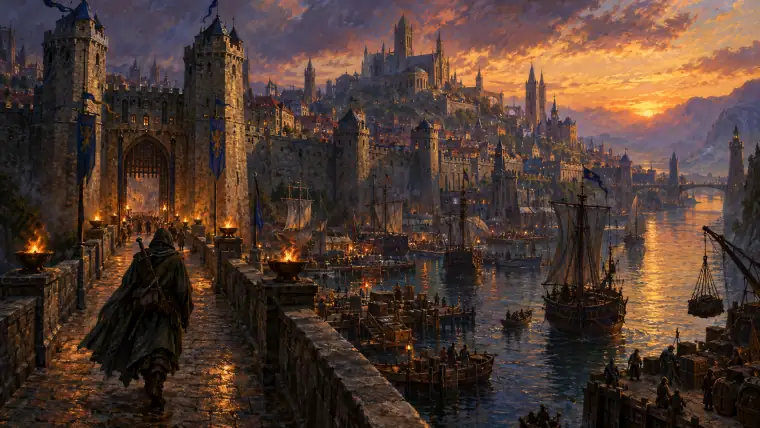
Icewind Dale showed that the Infinity Engine could carry a pure, combat-first dungeon adventure in the old tabletop style, and Jeremy Soule's score made its frozen north one of the most atmospheric settings of the era.
Overview
Where Planescape: Torment had pushed BioWare's Infinity Engine toward the novel, Icewind Dale pulled it back toward the dungeon. Developed by Black Isle Studios and released by Interplay in North America on June 29, 2000, it dropped the recruitable companions and branching city life of Baldur's Gate in favor of something closer to a classic tabletop module: a party you build yourself, a linear run of dungeons, and fights against large groups of enemies. Its setting was the frozen northern frontier of the Forgotten Realms, already famous from R. A. Salvatore's novels, and its music by Jeremy Soule was widely acclaimed.
Origins
Black Isle, the internal role-playing division of Interplay founded by Feargus Urquhart in 1996, had published Baldur's Gate and built Torment on its engine. Icewind Dale was the third Infinity Engine game, directed by Urquhart and produced by Chris Parker and Darren Monahan, with a lead design group of Steve Bokkes, Josh Sawyer, John Deily and Chris Avellone. Sawyer had joined Black Isle as a web designer only in 1999; the Icewind Dale games started the career that would lead him to direct Fallout: New Vegas and Pillars of Eternity.
The region was chosen with care. The Icewind Dale Trilogy, which had introduced the drow ranger Drizzt Do'Urden in 1988, had made Ten-Towns and the Spine of the World familiar to a generation of D&D readers. The game tells a different story in the same land, but it winks at the books: the evil at its center feeds on Crenshinibon, the Crystal Shard from Salvatore's first novel.
How it plays
Players begin by rolling up to six characters, choosing race, class, alignment, ability scores and weapon proficiencies for each, exactly as they would at a table. The AD&D 2nd Edition rules run underneath, with the computer rolling the dice, and combat is real time with the option to pause at any moment, the Infinity Engine's real-time-with-pause system. Without companions to argue with, the drama is tactical: positioning a wall of fighters in a narrow cave mouth, timing a mage's area spells, and husbanding healing through long crawls. Critics noted the flip side, that the game was uniform and combat-heavy, with little interaction or investigation.
The story opens in Easthaven, where the town's leader, Hrothgar, recruits the party for an expedition to the village of Kuldahar, sheltered by a giant, magically warm tree. Frost giants ambush the column and bury the road in an avalanche. From there the party works through the crypts of the Vale of Shadows, where the cursed barbarian spirit Kresselack waits; the caverns of Dragon's Eye, where the marilith Yxunomei holds the stolen Heartstone Gem; the fortress of the Severed Hand; and the dwarven ruin of Dorn's Deep. The villain is Brother Poquelin, a priest who is really the exiled devil Belhifet, raising an army with the Crystal Shard. The finale returns to a ruined Easthaven, where he tries to open a portal to the Nine Hells beneath the temple of Tempus. In a final twist, the game's genial narrator is revealed to be Belhifet himself, plotting his return.
Reception & impact
Icewind Dale debuted at number four in the U.S. charts with 39,285 copies in its first week, sold 145,564 copies domestically by the end of 2000, and passed 400,000 worldwide by April 2001. Metacritic lists it at 87. It was nominated widely for role-playing game of the year, but in 2000 it ran into its own family: BioWare's Baldur's Gate II took those awards, and the Academy of Interactive Arts & Sciences gave its PC role-playing prize to Diablo II.
The expansion Heart of Winter followed on February 21, 2001, shaped by fan feedback about class balance, and the downloadable Trials of the Luremaster in July 2001. Icewind Dale II arrived on August 27, 2002, the only Infinity Engine game to use the new D&D 3rd Edition rules and one of the last games Black Isle released before Interplay laid off its staff in December 2003.
Legacy
Icewind Dale kept alive the idea that a computer RPG could simply be a good dungeon crawl for a party of player-made heroes, the tradition of Pool of Radiance and Eye of the Beholder. When Obsidian, founded by Black Isle veterans, turned to Kickstarter in 2012, Pillars of Eternity was pitched in the name of the Infinity Engine games, Icewind Dale among them. Beamdog's Overhaul Games released Icewind Dale: Enhanced Edition in 2014, and Belhifet's promised return was finally staged in Beamdog's Baldur's Gate: Siege of Dragonspear (2016). Soule, meanwhile, went on to score Morrowind and Neverwinter Nights.
Marginalia
- Unlike Baldur's Gate, it has no recruitable companions: the player creates the whole party of up to six.
- The artifact at the heart of the plot is Crenshinibon, the Crystal Shard of R. A. Salvatore's first novel.
- The narrator, voiced by David Ogden Stiers, turns out in a twist ending to be the defeated devil Belhifet.
- It debuted at number four in the U.S. with 39,285 copies sold in its first week.
- Jim Cummings, Minsc's voice in Baldur's Gate, voices both Hrothgar of Easthaven and the archdruid Arundel.
- Josh Sawyer joined Black Isle as a web designer in 1999 and rose to designer on this game and lead designer of Icewind Dale II.
Quick answers
- When was Icewind Dale first released?
- Icewind Dale was first released in 2000 (Windows).
- Who created Icewind Dale?
- Icewind Dale was made by Feargus Urquhart (director), Josh Sawyer (lead designer) and Chris Avellone (lead designer).
- Who published or developed Icewind Dale?
- Black Isle Studios, Interplay Productions and TSR, Inc..
- What kind of work is Icewind Dale?
- Icewind Dale is a computer RPG in the Western Computer RPGs (CRPG) tradition, released for Windows, Mac OS / Mac OS X (2002) and Enhanced Edition: Windows, OS X, Linux, iOS, Android (2014).
- Why is Icewind Dale important?
- Icewind Dale showed that the Infinity Engine could carry a pure, combat-first dungeon adventure in the old tabletop style, and Jeremy Soule's score made its frozen north one of the most atmospheric settings of the era.