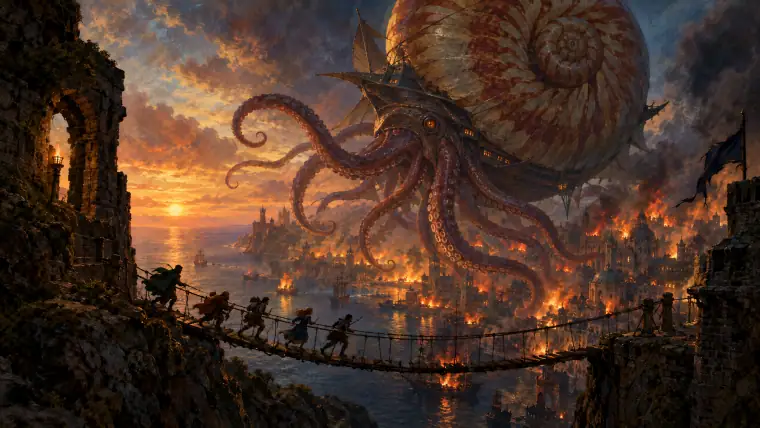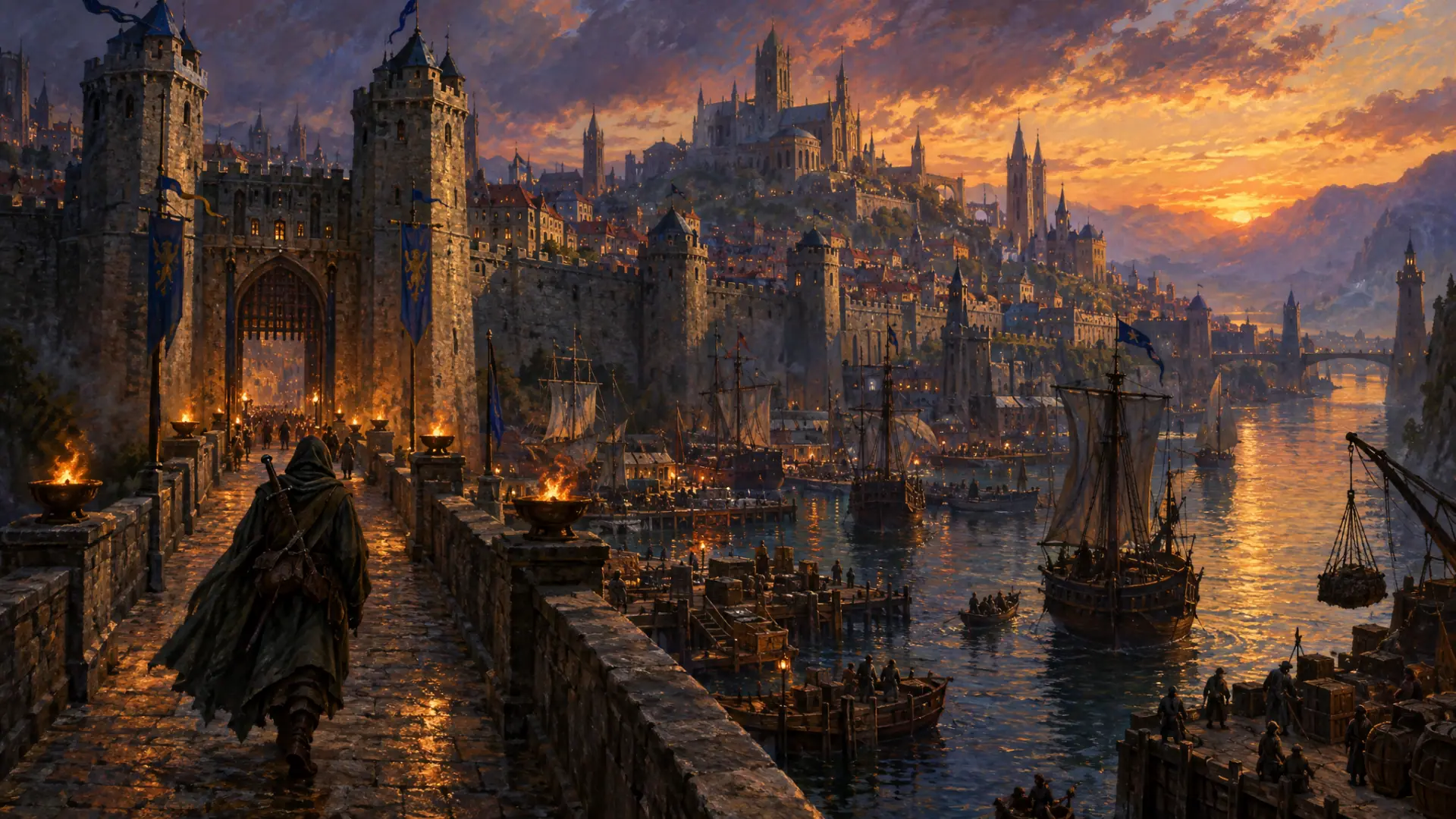
Baldur's Gate revived the Western computer RPG at the moment the genre seemed finished, turned a young Canadian studio into BioWare, and launched the Infinity Engine family that defined the late-1990s D&D game.
Overview
In the mid-1990s, the conventional wisdom held that the computer role-playing game was dying. SSI's licensed D&D line had run out of steam, the shelves belonged to real-time strategy and first-person shooters, and publishers were wary of hundred-hour fantasy epics. Baldur's Gate, released in North America on December 21, 1998, ended that argument. Developed by a young Edmonton studio called BioWare and published by Interplay under its Black Isle Studios label, it put a party of adventurers on the Forgotten Realms' Sword Coast, ran them under the AD&D 2nd Edition rules, and sold on a scale no one had expected from the genre.
Origins
BioWare was founded in 1995 by a small group led by three recently qualified medical doctors, Ray Muzyka, Greg Zeschuk and Augustine Yip (with Trent and Brent Oster and Marcel Zeschuk), and had shipped only one game, the mech combat title Shattered Steel (1996). Its next project began life as a real-time strategy prototype called Battleground: Infinity. That prototype evolved into a fantasy role-playing game, and when Interplay, which by then held the rights to make computer games from TSR's D&D, took it on, it became a Forgotten Realms title. The engine kept the prototype's name: the Infinity Engine.
The work was enormous for a first-time RPG team. Development ran from 1995 and has been estimated at about 90 person-years, with the team building the engine and the content at the same time. The Infinity Engine drew its world as huge pre-rendered 2D backgrounds, painted isometric scenes over which sprite characters moved, and used the Lua language for its debugging scripts. Time pressure showed in some of the game's simpler areas, but the core was there: a real map to explore, a party with voices and opinions, and a story revealed piece by piece. Lead designer James Ohlen wrote the game with Lukas Kristjanson, and Muzyka produced it.
How it plays
The player creates a single character, choosing race, class and alignment in the AD&D manner, and recruits up to five companions for a party of six. Combat runs in real time but can be paused at any moment to issue orders, the real-time-with-pause system that became the Infinity Engine's signature and the model for a generation of party RPGs. Under the hood lies the tabletop machinery of THAC0, Armor Class, saving throws and memorized spells; the game turns it into a spectacle of fireballs and arrow volleys without hiding the dice.
The story opens in Candlekeep, a fortress-library where the protagonist was raised by the mage Gorion. When Gorion is murdered on the road, the ward sets out with childhood friend Imoen into a Sword Coast gripped by an iron crisis: ore from the Nashkel mines is tainted, weapons are breaking, and war with Amn looms. The trail leads to the Iron Throne merchant cartel and its enforcer Sarevok, and finally to the truth that the hero and Sarevok are both Bhaalspawn, children of the dead god of murder. Sarevok means to spark a war whose bloodshed will raise him to his father's throne.
The Sword Coast is broad and largely open, with 25 recruitable companions who bicker, quarrel and sometimes walk out. The most famous is Minsc, a ranger with a head injury and a hamster named Boo. Ohlen created him for a tabletop campaign; Kristjanson expanded him for the game, and Jim Cummings gave him his voice and his battle cry, "Go for the eyes, Boo!"
Reception & impact
The first 50,000 copies sold out immediately. The game debuted at number three in the United States in early January 1999, claimed the top spot for January in both the American and German markets, and had sold about 175,000 copies worldwide by mid-January and roughly a million by November 1999. By early 2003 it had sold about 2.2 million. Interplay nonetheless posted a loss of about $28 million for 1998, partly because the game arrived so late in the year.
Critics were rapturous. PC Gamer said it "reigns supreme over every RPG currently available," and the Academy of Interactive Arts & Sciences named it PC Role-Playing Game of the Year. Reviewers credited it with reviving the computer RPG almost single-handedly. The expansion Tales of the Sword Coast, released on May 4, 1999, added Durlag's Tower, Ulgoth's Beard and the Isle of Ice, raised the experience cap to 161,000, and won the Origins Award for Best Roleplaying Computer Game of 1999.
Legacy
Baldur's Gate built a family. Black Isle licensed the Infinity Engine for Planescape: Torment (1999) and Icewind Dale (2000), and BioWare returned with Baldur's Gate II: Shadows of Amn (2000). The studio's formula of a chosen protagonist, talkative companions and a map full of side quests carried through Neverwinter Nights and Dragon Age: Origins, and the pause-and-plan combat returned in the Kickstarter era with Obsidian's Pillars of Eternity. Beamdog's Overhaul Games released an Enhanced Edition in 2012, and in 2023 Larian Studios finally delivered Baldur's Gate 3, in which Minsc and Boo return, voiced this time by Matthew Mercer.
Marginalia
- The Infinity Engine is named for Battleground: Infinity, the real-time strategy prototype BioWare was building before it became Baldur's Gate.
- Its first 50,000 copies sold out immediately; by mid-January 1999 it had sold about 175,000 copies worldwide.
- Minsc began as a character in lead designer James Ohlen's tabletop D&D campaign; his hamster Boo is a 'miniature giant space hamster' from Spelljammer.
- Drizzt Do'Urden makes a cameo fighting gnolls, and a strong or sly enough party can kill him or pick his pockets.
- Despite the hit, Interplay lost about $28 million in 1998, partly because the game shipped so late in December.
- The Academy of Interactive Arts & Sciences named it PC Role-Playing Game of the Year.
Quick answers
- When was Baldur's Gate first released?
- Baldur's Gate was first released in 1998 (Windows).
- Who created Baldur's Gate?
- Baldur's Gate was made by James Ohlen (lead designer & writer), Ray Muzyka (producer) and Greg Zeschuk (bioWare co-founder).
- Who published or developed Baldur's Gate?
- BioWare, Interplay Productions, Black Isle Studios and TSR, Inc..
- What kind of work is Baldur's Gate?
- Baldur's Gate is a computer RPG in the Western Computer RPGs (CRPG) tradition, released for Windows, Mac OS (2000) and Enhanced Edition: Windows, macOS, Linux, iOS, Android (2012– ), PS4, Xbox One, Switch (2019).
- Why is Baldur's Gate important?
- Baldur's Gate revived the Western computer RPG at the moment the genre seemed finished, turned a young Canadian studio into BioWare, and launched the Infinity Engine family that defined the late-1990s D&D game.