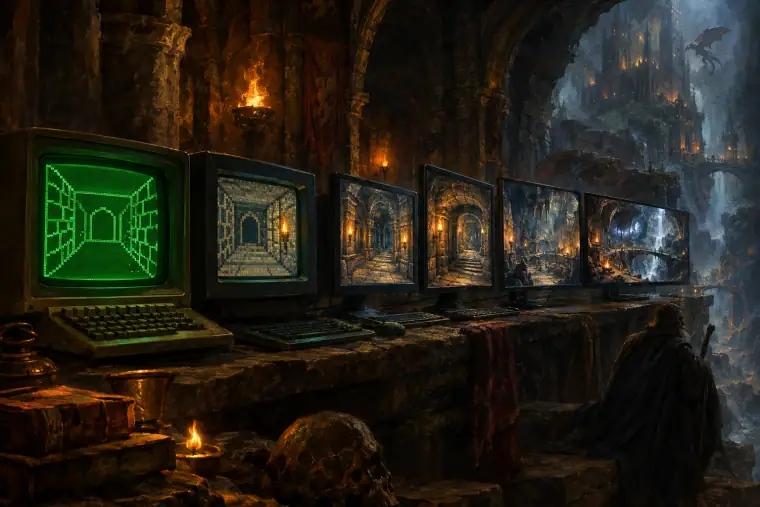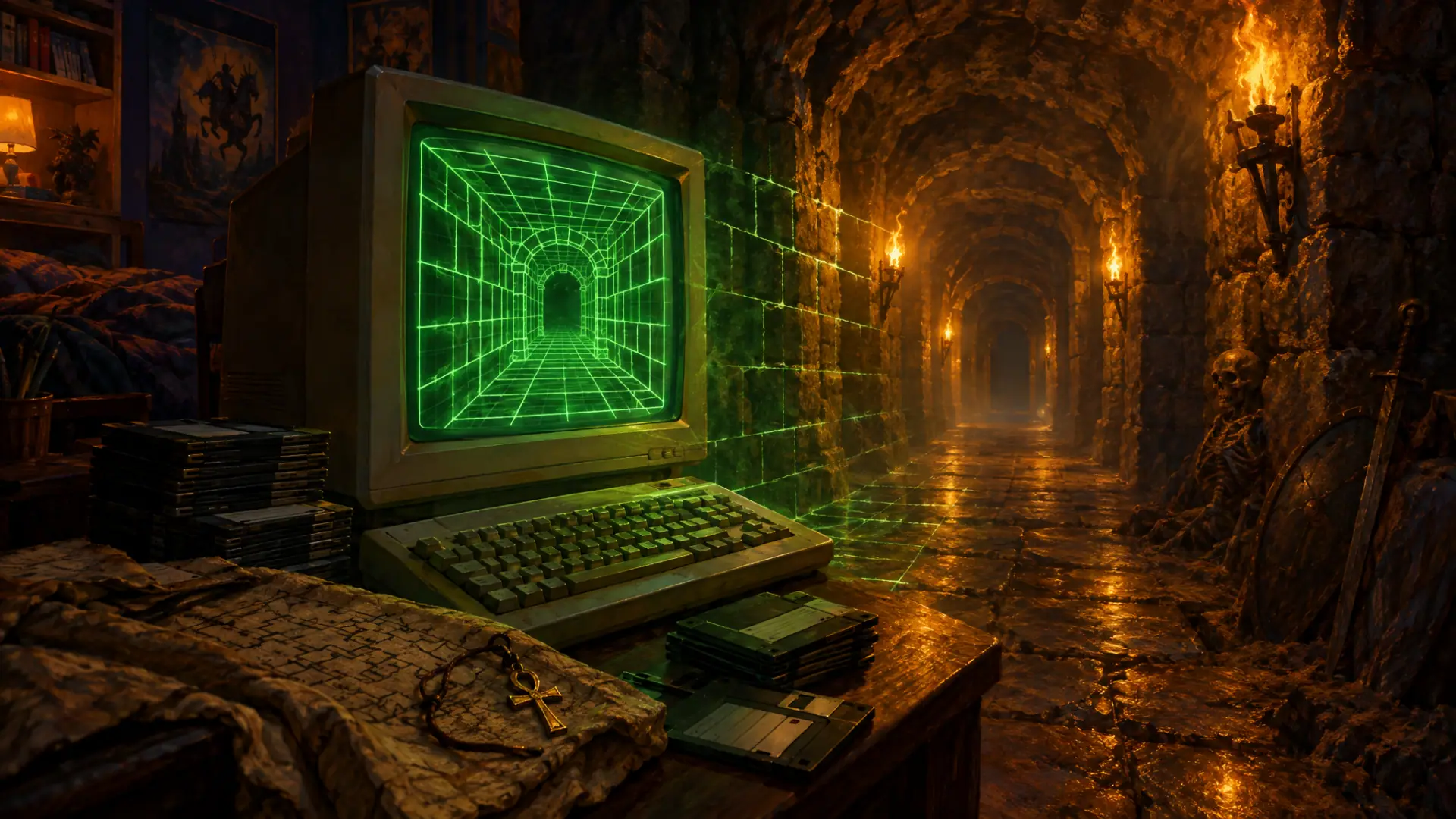
Garriott's Ultima games defined the Western computer RPG, gave gaming the avatar and a moral system built on virtues, and led to Ultima Online, the world that popularized the term MMORPG.
Life
Richard Allen Garriott was born on July 4, 1961, in Cambridge, England, to American parents, Helen and Owen Garriott, who had been high-school sweethearts in Enid, Oklahoma. When he was about two months old the family returned to the United States, and he grew up in Nassau Bay, Texas, near NASA's spaceflight center outside Houston. His father was selected as one of NASA's first scientist-astronauts in 1965 and flew on Skylab in 1973 and on the Space Shuttle in 1983. Richard assumed he would follow; at 13 he learned that his eyesight would disqualify him from NASA's astronaut corps, and his ambition turned inward, toward worlds he could build himself.
The materials were at hand. He was a devoted reader of The Lord of the Rings and a player of Dungeons & Dragons, hosting weekly sessions at his parents' house, and it was his first D&D friends who dubbed him "British" because of his birthplace. At Clear Creek High School, which offered only a single semester of BASIC, he talked the school into letting him design his own programming course, and on its teletype terminal he wrote fantasy games, by his later estimate 28 of them, stored on spools of paper tape. At the University of Texas at Austin he fenced and joined the Society for Creative Anachronism, the medieval re-enactment society whose pageantry would color his games and his home.
Work
In the summer of 1979 Garriott took a job at a ComputerLand store near Houston and met the Apple II. Its color graphics inspired him to add a first-person, wire-frame perspective to the dungeons of the game he had been developing for years under the working title DND. The store's owner encouraged him to sell it, so he spent $200 printing manuals and cover sheets, drawn by his mother, and sold the game, now called Akalabeth: World of Doom, in Ziploc bags. He sold only a handful in the store, but one copy reached California Pacific Computer Company, which republished it in 1980 and suggested crediting the author as "Lord British." Garriott has said it sold about 30,000 copies, earning him $5 apiece. Historians differ on whether the Ziploc edition appeared in 1979 or, as Jimmy Maher argues, in 1980. The last monster on its quest list was a Balrog / Balor, borrowed from Tolkien.
Its successor established the saga. Ultima (1981), published by California Pacific with cover art by Denis Loubet, whom Garriott had discovered on a visit to Steve Jackson Games, combined an overhead world map with first-person dungeons and a science-fiction twist. Ultima II (1982) went to Sierra On-Line, the only publisher that would include a cloth map in the box; a dispute over royalties on its PC port convinced the Garriotts to publish themselves. In 1983 Richard, his brother Robert, their father Owen and programmer Chuck Bueche founded Origin Systems, whose first release was Ultima III: Exodus (1983), with its party of four adventurers and tactical combat. Origin also published Autoduel (1985), a computer version of Steve Jackson Games' Car Wars, on which Garriott worked as a designer.
Then Garriott changed what an RPG could be about. Wanting a game in which the hero's conduct mattered as much as victory, he built Ultima IV: Quest of the Avatar (1985) around eight virtues, such as honesty, compassion and valor, that the player had to embody to win. Because he wanted the player, not a fictional hero, to be judged, he called the player's character the Avatar, taking the Hindu term for a god's earthly manifestation; the word became the standard name for a player's on-screen self. Lord British himself now ruled the kingdom of Britannia from his castle, and Garriott appeared in public in his robes and crown.
Origin grew into one of the great studios of the era, producing Ultima VII: The Black Gate (1992), whose living, simulated world remains a touchstone of open-ended design, and publishing Blue Sky Productions' Ultima Underworld (1992), the first-person dungeon that pointed toward immersive 3D games. In September 1992 Garriott sold Origin to Electronic Arts, in a stock deal reported at about $35 million (some accounts give $30 million). With producer Starr Long and lead designer Raph Koster, he then championed Ultima Online (1997), a persistent graphical world for thousands of simultaneous players, and he is often credited with popularizing the term "massively multiplayer online role-playing game." During a 1997 beta test a player killed Lord British himself, an episode recounted in The Assassination of Lord British. The series' eleven main installments, all supervised by Garriott, ended with Ultima IX: Ascension in 1999.
When EA cancelled Origin's new projects in 1999 and 2000, Garriott resigned and in April 2000 formed Destination Games with his brother and Long. The company partnered with Korea's NCSoft, where Garriott produced MMOs and led its Austin studio. Its science-fiction shooter-RPG Tabula Rasa (2007) struggled after seven years of development and closed in February 2009. Garriott left NCSoft in late 2008; the company said he had departed voluntarily, and in 2010 a Texas jury awarded him $28 million after finding that it had mishandled his exit, a judgment affirmed on appeal in 2011. His next company, Portalarium, founded in 2009, crowdfunded Shroud of the Avatar: Forsaken Virtues on Kickstarter in 2013 as a spiritual successor to Ultima; it launched in 2018 to mixed reviews, and its assets were sold in 2019 to Catnip Games, after which Garriott was no longer involved.
Britannia Manor and the frontier
Garriott lived out his fantasies in architecture. His home on a hill outside Austin, named Britannia Manor after Lord British's castle, was a medieval fancy of secret passages, hidden rooms, armor and swords, with an observatory built on a separate structure to keep vibrations from spoiling long-exposure astrophotographs. It displayed his collections, from fossils and automatons to a Russian spacesuit, and appeared on MTV Cribs. Every other year from 1988 to 1994 he turned the grounds into a free, elaborately staged haunted house run like a live roleplaying game: parties of guests had to solve clues, climb, crawl and row their way through while costumed volunteers grabbed and chased them. People camped outside for as long as two weeks to get free invitations. The house was sold in 2014 and demolished by its new owner in 2016.
Garriott's other obsession was his childhood one. After selling Origin he invested in Space Adventures and bought a ticket to become the first private citizen in orbit, but losses after the dot-com crash forced him to sell the seat, and the first tourist flight went to Dennis Tito in 2001. Rebuilding his fortune, he paid another deposit, had a liver hemangioma surgically removed so that he could pass the medical examination, and trained in Russia for a year. On October 12, 2008, he launched from Baikonur aboard Soyuz TMA-13, at a reported cost of $30 million, and returned twelve days later aboard Soyuz TMA-12, with his father watching both the launch and the landing. He became the first child of an American astronaut to fly in space. On the International Space Station he photographed Earth to compare with his father's 1973 Skylab images, talked with schoolchildren by amateur radio, left a geocache, performed magic tricks and filmed Apogee of Fear, a short science-fiction film written by Tracy Hickman and widely described as the first fiction film shot entirely in space. He also secretly left a laminated card bearing some of the ashes of Star Trek actor James Doohan aboard the station, a fact revealed only in 2020.
Legacy
Garriott's influence on the Western Computer RPGs (CRPG) is hard to overstate. Ultima's overhead worlds and first-person dungeons shaped how Western RPGs looked; its sequels taught players to expect sprawling, reactive worlds; and Ultima IV made moral choice a design goal, a line that runs through later games from Baldur's Gate to The Witcher 3: Wild Hunt. In Japan, Yuji Horii cited Ultima as an inspiration for Dragon Quest, and Hironobu Sakaguchi drew on it for Final Fantasy. Ultima Online helped turn the text MUDs (Multi-User Dungeons) tradition into the graphical MMORPGs.
He was the ninth inductee into the Academy of Interactive Arts and Sciences Hall of Fame in 2006 and received the Game Developers Choice Lifetime Achievement Award the same year. He co-founded the Zero Gravity Corporation, helped start the Challenger Center for Space Science Education in 1986, and in 2017 published a memoir, Explore/Create. He is often cited as an inspiration for James Halliday, the game-designer creator of the virtual world in Ernest Cline's Ready Player One. The boy who could not be an astronaut became a game designer, and the game designer became an astronaut, a Moon-rover owner and an ocean-floor explorer: Lord British took his quest well beyond Britannia.
Marginalia
- Born July 4, 1961, in Cambridge, England, to astronaut Owen Garriott; high-school D&D friends nicknamed him "British" for his birthplace.
- By his own account Akalabeth sold about 30,000 copies at $5 each to him, earning $150,000, a figure he said was three times his father's astronaut salary.
- Ultima II (1982) went to Sierra On-Line because it was the only publisher willing to box it with a printed cloth map.
- Ultima IV (1985) borrowed the Sanskrit word avatar for the player's in-game self, and the term stuck across the industry.
- Science-fiction author Tracy Hickman wrote the screenplay for Apogee of Fear, the short film Garriott shot aboard the International Space Station in 2008.
- In 1993 he bought the Soviet Lunokhod 2 rover and Luna 21 lander, still on the Moon, at a Sotheby's auction for $68,500.
- In February 2021 he dived to the bottom of the Mariana Trench, the year he was elected president of The Explorers Club.
Quick answers
- Who is Richard Garriott?
- The astronaut's son who sold his first RPG in Ziploc bags, ruled Britannia as Lord British through the Ultima series, built a castle with secret passages outside Austin, and in 2008 paid his own way to the space station.
- When was Richard Garriott born?
- Richard Garriott was born in 1961 in Cambridge, England.
- What is Richard Garriott known for?
- Richard Garriott is best known for Akalabeth: World of Doom, Ultima, Ultima III: Exodus, Ultima IV: Quest of the Avatar, Ultima VII: The Black Gate and Ultima Online.
- Why does Richard Garriott matter to fantasy and games?
- Garriott's Ultima games defined the Western computer RPG, gave gaming the avatar and a moral system built on virtues, and led to Ultima Online, the world that popularized the term MMORPG.