MMORPGs turned the MUD into a mass medium and a business, and at World of Warcraft's peak put more than 12 million paying subscribers in a single fantasy world. They made online community, virtual economies and games-as-a-service central to modern gaming.
Hallmarks
- A persistent world that keeps running, and changing, when you log off
- Thousands of players sharing each server, with hundreds of thousands or millions across the game
- Character progression by levels, gear and skills, with an endgame beyond the level cap
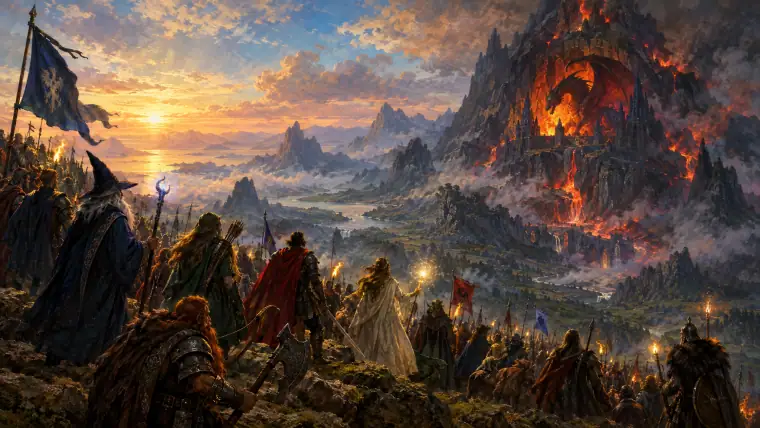
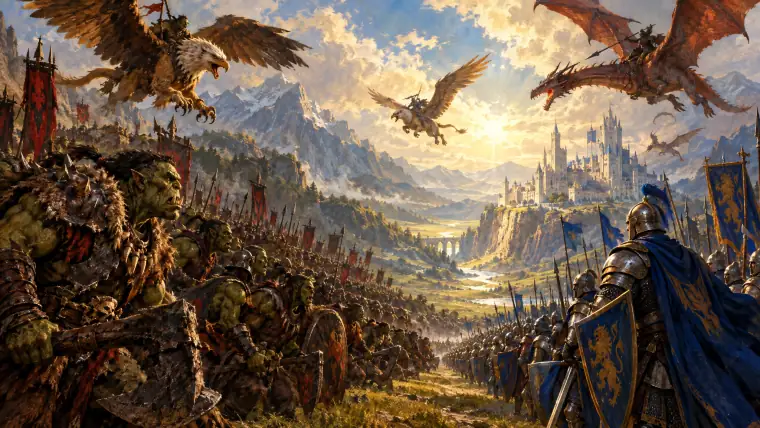
- Guilds, group roles and raids that require coordinated teams
- Player economies, trade and crafting, often spilling into real-money markets
- A live service sustained by subscriptions, expansions or microtransactions
What it is
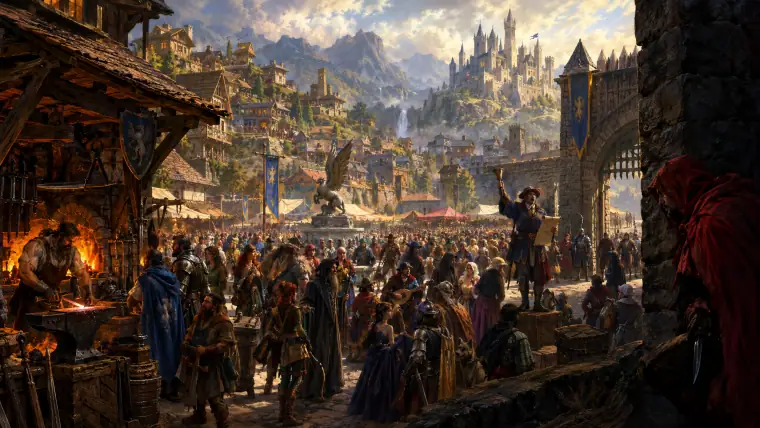
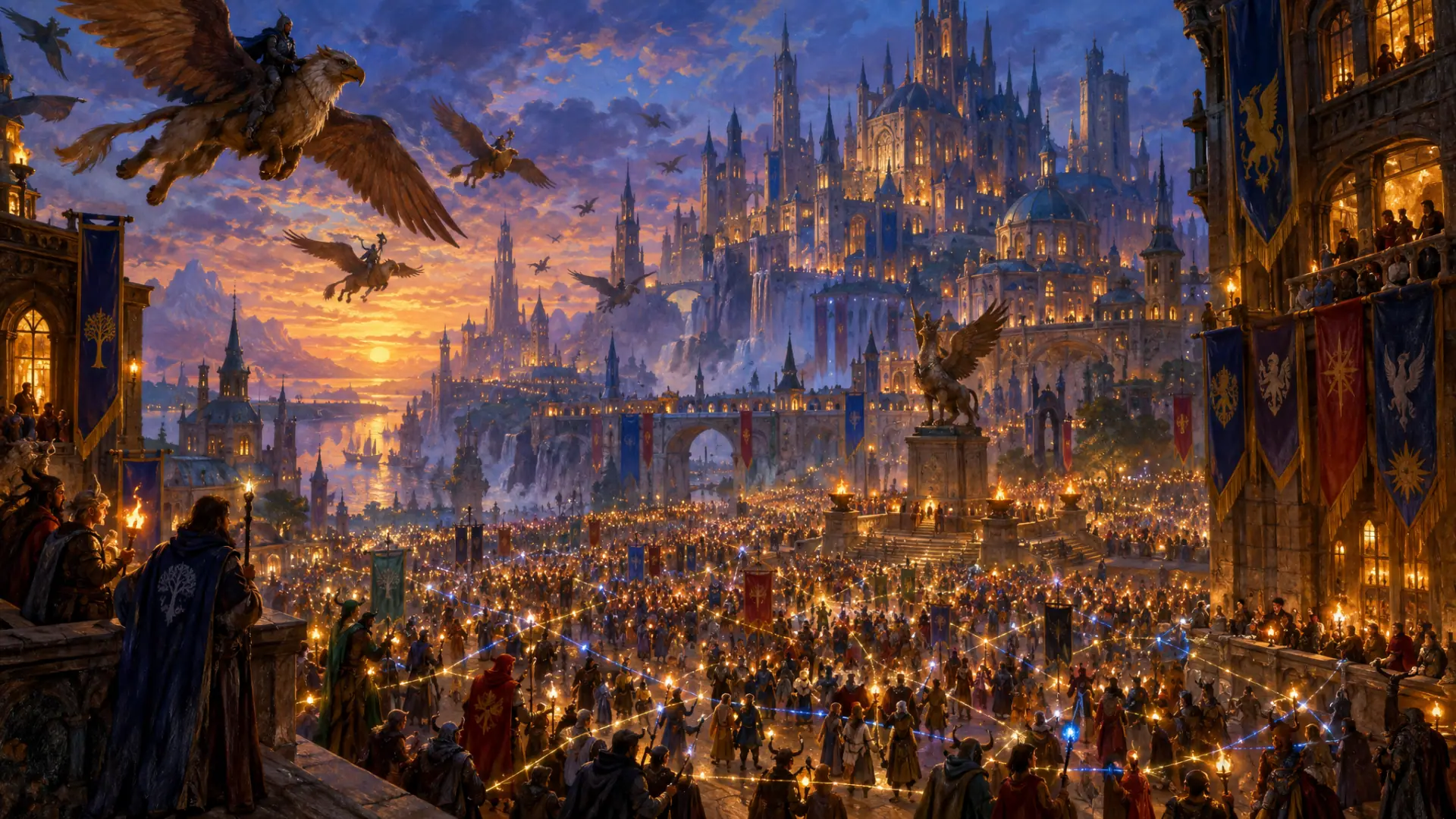
A massively multiplayer online role-playing game is a graphical role-playing world hosted on a publisher's servers and shared by thousands of players at once. You make a character, and you level it through quests and combat as in any computer RPG. But the orc you are fighting may be contested by a stranger, the sword you want is sold by another player, and the dungeon at the end requires twenty or forty people who have agreed on a Tuesday night. The world is persistent: it existed before you logged in and carries on after you leave.
The genre's hallmarks are social machinery as much as rules. Guilds organize players into standing communities. Group content assigns roles, the so-called holy trinity of tank, healer and damage dealer, glued together by the logic of Aggro. Instanced dungeons and raids give each group a private copy of a challenge. Economies of crafted goods and Loot & loot tables emerge, and with them gold farmers and real-money trading. The business model is continuous: monthly subscriptions, expansions or, increasingly, free-to-play with microtransactions.
Origins
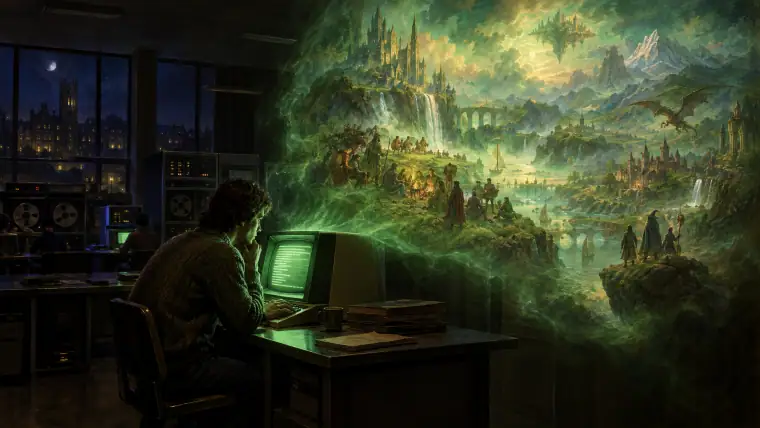
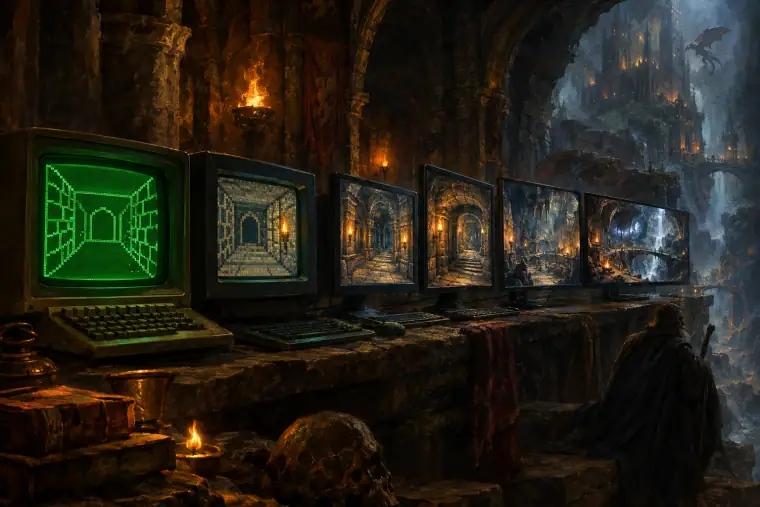
The MMORPG is the graphical child of the MUD. From MUD1 (1978) onward, text worlds had shown that strangers would inhabit a shared fantasy for years, and the PLATO game Avatar had put parties into a graphical dungeon. Commercial online services then gave the idea a price tag. In 1991 AOL launched Neverwinter Nights, built by Stormfront on SSI's Gold Box engine and set in the Forgotten Realms, generally credited as the first graphical online RPG. It ran until 1997.
When the internet opened to commercial traffic in the mid-1990s, the scale changed. Archetype Interactive's Meridian 59 (1996), a first-person 3D world published by 3DO, proved players would pay a flat monthly fee. In South Korea, Nexus: The Kingdom of the Winds (1996) began an equally important lineage. Then in 1997 Origin released Ultima Online, Richard Garriott's Britannia made shared, designed by Raph Koster and produced by Starr Long. It passed 100,000 subscribers within months and is the game most often credited with popularizing the form. The acronym MMORPG is usually credited to Garriott in this period, though accounts of Meridian 59's development say the phrase "massively multiplayer" took shape at 3DO a little earlier; before these coinages, such games were simply graphical MUDs.
Evolution
In 1998 NCSoft's Lineage, designed by Jake Song, rode Korea's PC-bang internet cafes to millions of subscribers. In 1999 Verant's EverQuest, co-designed by DikuMUD veteran Brad McQuaid, and Turbine's Asheron's Call brought fully 3D worlds to the West. EverQuest codified the genre's grammar of camped spawns, corpse runs, class roles and raids, and earned the nickname "EverCrack." Dark Age of Camelot (2001) organized PvP into realm-versus-realm war; Final Fantasy XI (2002) brought the form to consoles.
Blizzard's World of Warcraft (2004), with Rob Pardo as lead designer, made the MMORPG a mainstream entertainment. It smoothed away EverQuest's punishments, added a steady trail of quests and made instanced dungeons the heart of the endgame. It peaked at 12 million subscribers in October 2010 and generated its own folklore, from the Corrupted Blood plague to Leeroy Jenkins. Rivals chased it with licensed worlds such as The Lord of the Rings Online (2007) and The Elder Scrolls Online (2014); Guild Wars (2005) dropped the monthly fee altogether.
Business models then fractured. RuneScape ran in a web browser with free play and paid membership; Korean games pioneered free-to-play with item sales. Square Enix's Final Fantasy XIV failed at launch in 2010, was rebuilt and relaunched as A Realm Reborn in 2013, and became one of the genre's great comebacks. The genre's ideas, from daily quests to seasonal content, now run through gacha and live-service RPGs and online action RPGs.
How to tell it apart
MMORPG vs MUD. Same family tree, different branch. MUDs are text worlds, usually free and hobbyist, hosting dozens or hundreds of players; MMORPGs are graphical, corporately run and built for tens of thousands per server cluster and millions overall. Many MMORPG designers learned their trade in MUDs.
Massively multiplayer vs single-player. A single-player CRPG such as Baldur's Gate exists for one player and pauses at will; its story centers on you. In an MMORPG the world does not pause, the villain is killed every night by a different raid, and your story is written in relation to other people.
MMORPG vs online co-op RPG. Diablo II on Battle.net or BioWare's Neverwinter Nights (2002) let small groups play together, but each game session is a private, temporary space. An MMORPG's world is persistent and shared by everyone on the server.
MMORPG vs gacha and live-service RPGs. Mobile gacha games share the MMO's endless updates and monetization, but players mostly progress alone, meeting others through leaderboards, guild perks and borrowed characters rather than a shared, walkable world.
Where to start
- Ultima Online (1997): the sandbox that popularized the genre and exposed its problems, from player killing to the death of Lord British.
- EverQuest (1999): the template for group roles, raids and the grind.
- World of Warcraft (2004): the genre at mass scale and still the reference point.
- Final Fantasy XIV: A Realm Reborn (2013): a story-rich modern example and a lesson in rebuilding a failed launch.
- Old School RuneScape: the browser-born MMO preserved in its 2007 form.
- For theory, Richard Bartle's 1996 player-types paper and his book Designing Virtual Worlds (2003).
Marginalia
- Before 'MMORPG' caught on, games like EverQuest were simply called 'graphical MUDs.'
- Neverwinter Nights on AOL (1991) held 50 players per server at launch and 500 by 1995.
- Ultima Online's team reportedly expected about 15,000 subscribers; it passed 100,000 within roughly six months.
- Economist Edward Castronova's 2001 study put EverQuest's Norrath, measured by GNP per capita, between Russia and Bulgaria.
- World of Warcraft peaked at 12 million subscribers in October 2010.
- Final Fantasy XI (2002) was the first MMORPG to let PlayStation 2 and Windows players share a world.
- Lineage reported more than three million subscribers at its peak, most of them in South Korea.
Quick answers
- What is MMORPGs?
- The massively multiplayer online role-playing game: a graphical world shared by thousands at once, where a guild, a raid schedule and a virtual economy can matter as much as the story.
- What are the hallmarks of MMORPGs?
- A persistent world that keeps running, and changing, when you log off; Thousands of players sharing each server, with hundreds of thousands or millions across the game; Character progression by levels, gear and skills, with an endgame beyond the level cap; Guilds, group roles and raids that require coordinated teams; Player economies, trade and crafting, often spilling into real-money markets; A live service sustained by subscriptions, expansions or microtransactions.
- When did MMORPGs emerge?
- 1991 (first graphical online RPG); named c. 1997.
- Where does the name “MMORPGs” come from?
- The term MMORPG is commonly credited to Richard Garriott around the launch of Ultima Online (1997); earlier games were called graphical MUDs.
- What are the key works of MMORPGs?
- Neverwinter Nights, Meridian 59, Ultima Online, Lineage, EverQuest, World of Warcraft, RuneScape and Final Fantasy XIV.