PLATO is where the computer RPG was born: students translated Dungeons & Dragons into software there in 1975, and its dungeon games anticipated the dungeon crawler, the roguelike, the MUD and the MMO.
What happened
PLATO (Programmed Logic for Automatic Teaching Operations) began in 1960 at the University of Illinois at Urbana-Champaign as an experiment in computer-assisted instruction, running on the university's ILLIAC I. Its guiding engineer was Donald Bitzer, later called the "father of PLATO." PLATO II in 1961 let two students use it at once, an early instance of time-sharing. PLATO III, built on a Control Data CDC 1604, added the TUTOR programming language, devised in 1967 by the graduate student Paul Tenczar, so that almost anyone could write a lesson.
The leap came in 1972 with PLATO IV. Its terminals had Bitzer's orange plasma display, a 512 by 512 dot bitmap that held its own image, plus a touch-sensitive screen, all for about $12,000 a unit. Control Data Corporation licensed the system commercially, and by the late 1970s several thousand terminals across the world were connected to about a dozen networked mainframes. The university and CDC intended PLATO for teaching Latin, chemistry, and arithmetic. Its users, many of them students with late-night access, turned it into something else: an online society. PLATO had message boards (Notes, 1973), real-time chat (Talkomatic, 1973), instant messaging, screen sharing, and, above all, games.
Space combat came first, with multiplayer titles such as Empire and Spasim. Then, in 1974 and 1975, Dungeons & Dragons reached Illinois. Within months, programmers were trying to put it on PLATO. An early attempt, m199h, was quickly deleted. In late 1975 Reginald "Rusty" Rutherford, who had been playing D&D since earlier that year, spent four to six weeks writing pedit5, a single-player crawl through a one-level dungeon of 40 to 50 rooms with randomly generated monsters and treasure, Hit points, levels, and Experience points. He stored it in the fifth program slot belonging to the Population and Energy group, which gave the game its name. Administrators, who regarded it as a waste of computing time, deleted it; Rutherford restored it.
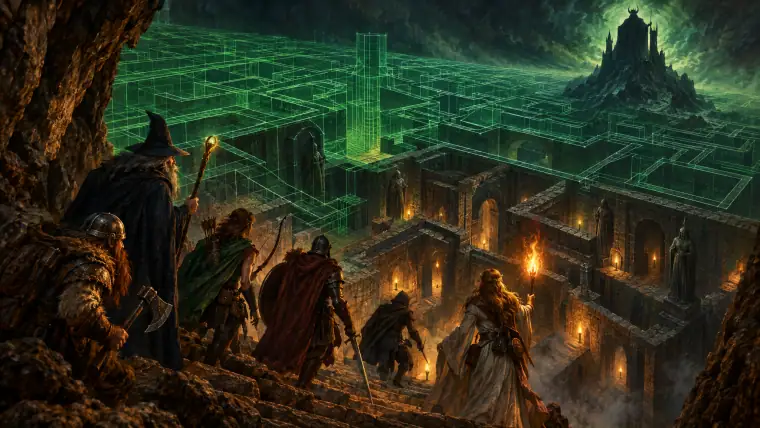
At almost the same moment Gary Whisenhunt and Ray Wood of Southern Illinois University were writing dnd, a multilevel dungeon in search of a grail and an orb, guarded at the end of each level by powerful monsters, including a golden Dragon. It is credited as the first game with what players would later call bosses. Dirk and Flint Pellett expanded it for another decade. Others followed. Moria, begun in 1975 or 1976 by Kevet Duncombe and Jim Battin, put up to ten players into a first-person wireframe dungeon. Oubliette (1977), by Jim Schwaiger with John Gaby and Bancherd DeLong, offered a first-person dungeon beneath a town with shops and a tavern, and was so hard that players had to band together. Avatar, begun around 1976 by the junior-high students Bruce Maggs and Andrew Shapira and joined by David Sides, launched in 1979 as a graphical, cooperative, multiplayer dungeon built explicitly to outdo Oubliette.
Why it mattered
PLATO is where the Western Computer RPGs (CRPG) began. Within a year of D&D's publication, students had translated its core ideas, the Character class, the Dungeon crawl, leveling, random loot, into code, and discovered what computers could add: automatic bookkeeping, persistence, and other players on other terminals. Almost every later branch of the genre has a PLATO ancestor. Oubliette and Moria's first-person corridors lead to Wizardry: Proving Grounds of the Mad Overlord (1981), whose resemblance to Oubliette was so close that Schwaiger later said he "could not find any meaningful difference" between the two. dnd was ported to other minicomputers by Daniel Lawrence, and it belongs to the same wave of university dungeon games that later produced Rogue and the Roguelikes. And Avatar's shared, persistent dungeon anticipated the MUDs (Multi-User Dungeons) and, eventually, the MMORPGs, even though MUD1 was invented independently in England in 1978.
PLATO also mattered socially. It was one of the first places where people formed friendships, rivalries, and romances through a screen, where they kept characters alive across sessions and argued about game balance on message boards. Its Notes system is often cited as an inspiration for later groupware such as Lotus Notes. The culture of Online Worlds: From MUD1 to World of Warcraft had a rehearsal here.
Legacy
CDC spent heavily promoting PLATO as a commercial education product, with mixed success, and sold the trademark in 1989, after which the system continued as CYBIS and NovaNET; the last production PLATO system ran until 2006. The games survived. Volunteers built Cyber1, an emulated PLATO system where pedit5, dnd, Moria, Oubliette, and Avatar can still be played, and historians such as Brian Dear, in The Friendly Orange Glow (2017), have restored PLATO to its place in computing history. Donald Bitzer died in December 2024, at 90.
For this museum, PLATO marks the moment the tabletop hobby of Gygax and Arneson first leapt to the screen. The chapter of Mainframes to Microcomputers: the First Computer RPGs begins here, in a university lab where students spent their nights hunting treasure in dungeons that officially did not exist.
Marginalia
- PLATO first ran in 1960 on the University of Illinois's ILLIAC I computer; PLATO II (1961) served two users at once.
- The PLATO IV terminal of 1972 had a 512×512 orange plasma display and a touch panel, and cost about $12,000.
- pedit5 took its name from the fifth program slot of the university's Population and Energy group, where Rusty Rutherford hid it.
- dnd, by Gary Whisenhunt and Ray Wood, is credited as the first video game with what would later be called bosses.
- System administrators repeatedly deleted pedit5 for wasting resources; Rutherford kept restoring it.
- The designer of Oubliette later said he 'could not find any meaningful difference' between Wizardry and his game.
- Avatar was begun around 1976 by Bruce Maggs and Andrew Shapira, who were junior high school students at the time.
Quick answers
- What was PLATO?
- A University of Illinois teaching computer whose glowing orange plasma screens hosted the first online communities, and, within a year of D&D's release, the first computer role-playing games.
- When did PLATO happen?
- 1960 – 2006.
- Why did PLATO matter?
- PLATO is where the computer RPG was born: students translated Dungeons & Dragons into software there in 1975, and its dungeon games anticipated the dungeon crawler, the roguelike, the MUD and the MMO.