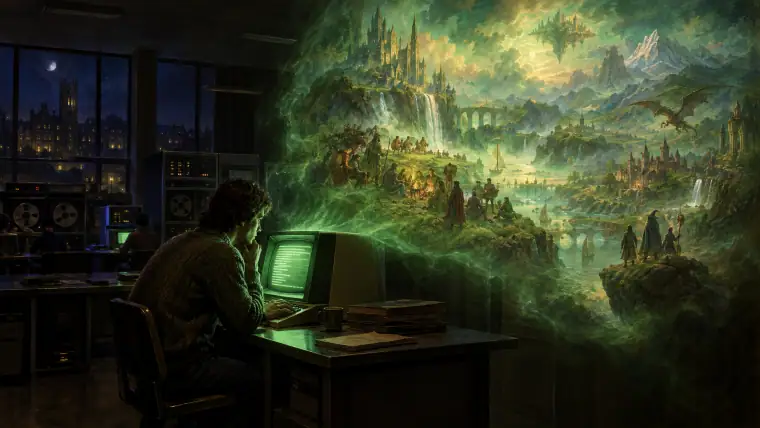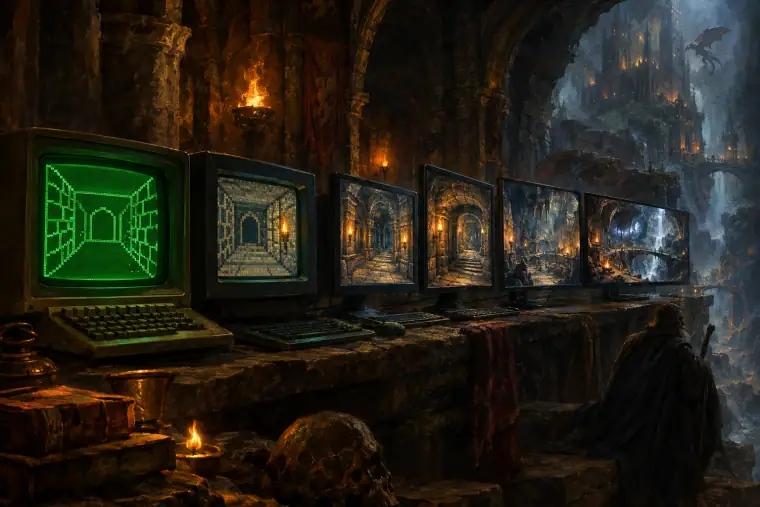
Door games were the first online games for ordinary home-computer owners, pioneering daily turn limits, persistent shared worlds, shareware sales and player communities that later shaped MUDs, browser games and MMOs.
What happened
In the winter of 1978, with Chicago snowed under by the Great Blizzard, two members of a local computer club, Ward Christensen and Randy Suess, used the time to build a computerized version of the club's cork notice board. Their Computerized Bulletin Board System, CBBS, went online on February 16, 1978: one computer, one modem, one phone line, one caller at a time. Over the next decade, as cheap modems such as the Hayes Smartmodem arrived and the IBM PC spread, tens of thousands of hobbyist "sysops" ran their own boards from home. By 1994 InfoWorld estimated there were 60,000 BBSes serving 17 million users in the United States alone.
Most boards were local, because calls were billed by distance, and most offered the same things: message bases, file libraries, and games. The games ran as "doors." A door was an external program that the BBS software handed a caller off to, passing along who they were in a small "dropfile" and taking them back when they quit. Because only a few callers could be on at once, door games were typically asynchronous: each player got a fixed ration of turns per day, and the shared world, with its rankings, messages, and rivalries, advanced as everyone logged in over the following days and weeks.
The genre's grand strategy classic began in 1984, when Chris Sherrick wrote Trade Wars, mixing the space-trading of Star Trader with Risk and Hunt the Wumpus. Freely shared, it was endlessly modified by sysops until Gary Martin rewrote it as Trade Wars 2001 in 1986 and then as the standalone TradeWars 2002, released in June 1991, with its Ferrengi raiders and ANSI-art "movies." Solar Realms Elite, Barren Realms Elite, Usurper, Operation: Overkill, and trivia games such as Pyroto Mountain filled out the menus.
The best-loved fantasy door was Legend of the Red Dragon, or LORD, written in Pascal by Seth Robinson in 1989 for his own board. A red Dragon is terrorizing a village; players fight monsters in the forest for Experience points, defeat their master at Turgon's Warrior Training to level up, and eventually hunt the dragon itself. Around that loop Robinson built a small society: the bard Seth Able and the barmaid Violet at the inn, daily flirting and marriage between players, random forest events, player-versus-player attacks, and in-game mail. Robinson sold it as shareware: unregistered copies stopped players at level six. LORD sold seven copies in its first year and about 30,000 over the next seven, entirely by word of mouth, and many boards had active LORD communities by 1993. Third-party "In-Game Modules" extended it, and InterBBS leagues let players on different boards compete in the same game.
Why it mattered
Door games were the first online games that ordinary teenagers with a home computer and a phone line could play. Where PLATO had required a university terminal and MUD1 an academic network account, a BBS needed only a modem and a local call, and so the culture of Online Worlds: From MUD1 to World of Warcraft leaked out of campuses and into bedrooms across North America and beyond.
They also invented, or at least popularized, design patterns that recur throughout later online games. The turns-per-day ration, which also helped keep a single phone line from being monopolized, anticipated the energy timers of browser and mobile games. Persistent rankings, in-game mail, marriages, and player-versus-player ambushes all appeared in LORD years before the graphical MMO. And door authors pioneered the independent online-game business: shareware sold directly to sysops, registration codes, and word-of-mouth marketing. Many of these games descended from Play-by-Mail Games and email-based games, and they sat alongside commercial services such as the AOL Neverwinter Nights, which charged by the hour for similar experiences.
Legacy
Cheap dial-up internet access and web browsers crashed the BBS market from late 1994 onward, and tens of thousands of boards disappeared. The best door games moved with their players. TradeWars gained a standalone game server; LORD was sold in 1998 to Metropolis Gameport, and a free web-based homage, Legend of the Green Dragon, spread in the 2000s. More than a thousand boards still run over Telnet, and services such as BBSlink let sysops offer classic doors hosted remotely. Robinson's sequel LORD II: New World (1992) even had real-time multiplayer and a top-down view reminiscent of the Roguelikes.
Jason Scott's BBS: The Documentary (2005) preserved the scene's memories on film. Much of what later MUDs, browser games, and MMORPGs offered had been tried on these boards first. For a generation of players, the first online world was one where you waited overnight for your turns to reset.
Marginalia
- The first public dial-up BBS, Ward Christensen and Randy Suess's CBBS in Chicago, went online on February 16, 1978.
- A 'door' was a hand-off: the BBS software passed a caller to an external program, often via a small 'dropfile,' then took them back.
- Legend of the Red Dragon sold only seven copies in its first year, then about 30,000 over the next seven through word of mouth.
- In LORD, unregistered copies let players advance only to level six; sysops had to pay to unlock the rest.
- InfoWorld estimated 60,000 BBSes serving 17 million users in the United States in 1994.
- Gary Martin and John Pritchett sold more than 28,000 registrations of TradeWars 2002 between 1990 and 2025.
Quick answers
- What was BBS Door Games?
- Before the web, hobbyists ran dial-up bulletin boards from spare bedrooms, and their users logged in each night to spend a ration of turns slaying dragons, trading across galaxies and flirting at the inn.
- When did BBS Door Games happen?
- 1980s – 1990s.
- Why did BBS Door Games matter?
- Door games were the first online games for ordinary home-computer owners, pioneering daily turn limits, persistent shared worlds, shareware sales and player communities that later shaped MUDs, browser games and MMOs.