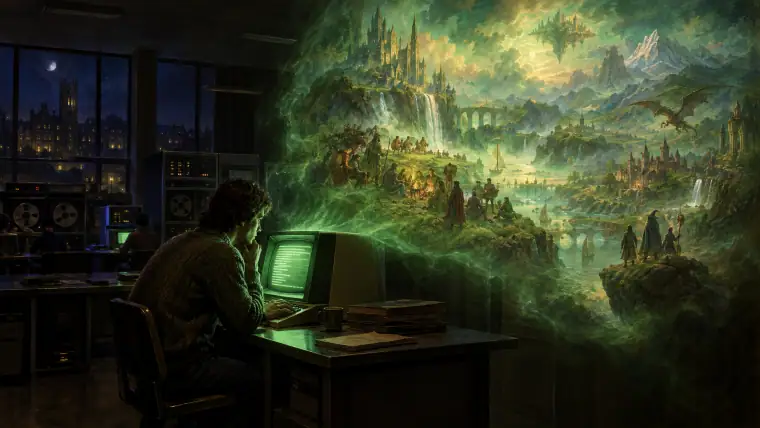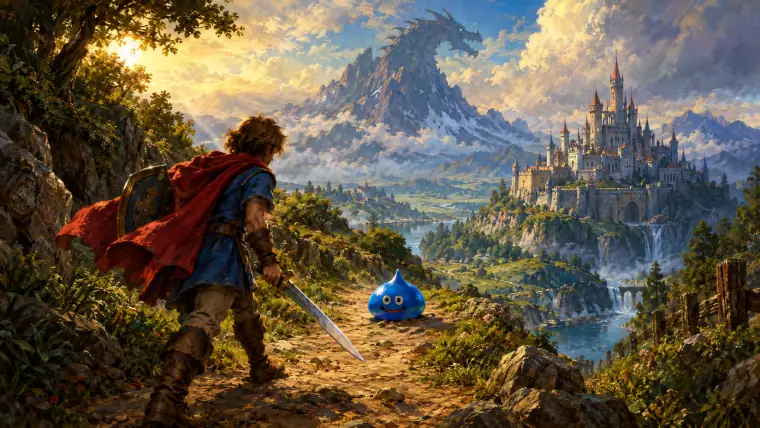
LORD is the best-known BBS door game, a shared, persistent, turn-limited fantasy world that thousands of players visited one phone call at a time — a homemade bridge between the single-player CRPG and online worlds.
Overview
Legend of the Red Dragon, known to a generation of modem users as LORD, is a text-based role-playing game released in 1989 by Robinson Technologies for bulletin board systems. It is the most famous of the BBS door games: programs that a bulletin board's operator, or sysop, could launch for callers, turning a single-line hobby computer into a small shared world.
The premise fits on a postcard. A red dragon is ravaging a village, and every player is a newcomer who wants to be the one to kill it. Each real-world day brings a limited number of turns: fights in the forest, duels with other players, visits to the Inn and the bank. Over weeks, the village's callers level up, bicker on the message boards, marry each other, and race to be the first to slay the dragon.
Origins
LORD was created by Seth Able Robinson, who ran his own bulletin board and wanted something to bring callers back. According to histories of the game, he did not have access to established door games such as Trade Wars, so he wrote his own. His list of works records the original 1989 version as a game for the TAG BBS software on the Amiga, followed by the MS-DOS door version that spread across the BBS world. The first release offered only chatting and flirting; over time Robinson added features he had seen work in other games, such as a fixed number of turns per day and random events, until LORD became a mixture of action and romance.
It was meant to run only on Robinson's own board, but other sysops asked to buy it, and word of mouth did the rest. Robinson sold it as shareware: callers could play up to level six, but advancing to level seven required the sysop to register the game, and many players sent in money for exactly that purpose. By 1993, many BBSs had active communities of LORD players.
How it plays
Everything happens in menus of colored text. In the forest, players fight monsters for gold and experience; when they have enough experience, they challenge their master at Turgon's Warrior Training to advance a level. Each new level brings stronger enemies and a tougher master, until the player defeats Turgon himself to reach level 12, the last, and can go hunting for the Red Dragon. Characters follow one of three skill paths — Death Knight, Mystical or Thieving — and can eventually master all three.
The forest is full of random events: gems and gold, a man or maiden in distress, an old hag, fairies bathing in a hidden garden, and the mysterious Olivia. At the Inn, Violet the barmaid and Seth Able the bard hold court; a song from Seth once a day can double a player's bank balance or grant extra fights. Players can flirt with Violet or Seth, or send flirts to one another by in-game mail, from a wink to a marriage proposal, with consequences that grew more mature as Robinson revised the game.
The social layer is what made LORD special. Players could attack each other — the ancestor of the player killer of later online worlds — and on multi-line boards they could even fight in real time. Message boards inside the game carried taunts, boasts and alliances. Third-party programmers wrote "In-Game Modules" (IGMs) that bolted new locations and events onto the village; some were balanced, others were loopholes. A planned IGM called Wizardstone never appeared, but it left its mark in the game's Olivia event and its blackjack table.
Reception & impact
LORD became the defining door game of the early 1990s. By one account it sold only seven copies in its first year, then climbed to about 30,000 through word of mouth over the next seven. A Gamasutra history of the computer RPG remembered it as highly playable and memorable, with colorful text and humor, and The Escapist highlighted its handling of sexuality.
Robinson followed it in 1992 with Legend of the Red Dragon II: New World, a real-time multiplayer sequel in which players moved a character around ANSI-drawn maps, and wrote Tournament LORD for MBBS/Worldgroup systems; a Wildcat! version, WT-LORD, came from other programmers. As the internet drew users away from dial-up boards and toward MUDs and the web, Robinson released version 4.00a in 1998 and sold his door games to Metropolis Gameport, which hired Michael Preslar in 2001 to continue development. Version 4.07, from 2006, remained the latest release.
Legacy
LORD's rhythm — a handful of turns a day, a persistent world shared with neighbors, a long race toward a single goal — prefigures the daily-login habits of online and browser games, and Robinson's own company later described its style as in many ways a predecessor of the MMORPG. The unauthorized, open-source web game Legend of the Green Dragon borrowed its name and spirit for the browser age. Robinson carried the idea of player-made modules into his 1997 game Dink Smallwood, whose "D-Mods" descend directly from LORD's IGMs. For many who grew up with a modem, the Inn, Violet and the Red Dragon were their first taste of online worlds — alongside contemporaries like MUD1's descendants and AOL's Neverwinter Nights.
Marginalia
- Seth Able Robinson created LORD in 1989 to give callers a reason to keep coming back to his own bulletin board system.
- The bard at the Inn, Seth Able, is named after Robinson himself.
- The first version had only the chatting and flirting systems; combat, daily turn limits and random events came later.
- Shareware registration let players advance to level six; reaching level seven required the sysop to register the game.
- By one account it sold only seven copies in its first year before word of mouth pushed sales to about 30,000 over the next seven years.
- Robinson sold LORD, its 1992 sequel and his other door games to Metropolis Gameport in 1998.
Quick answers
- When was Legend of the Red Dragon first released?
- Legend of the Red Dragon was first released in 1989 (BBS door game).
- What kind of work is Legend of the Red Dragon?
- Legend of the Red Dragon is a computer RPG in the Western Computer RPGs (CRPG) tradition, released for Amiga BBS (TAG), MS-DOS BBS door, Windows, OS/2, MBBS/Worldgroup (Tournament LORD) and Wildcat! BBS (WT-LORD).
- Why is Legend of the Red Dragon important?
- LORD is the best-known BBS door game, a shared, persistent, turn-limited fantasy world that thousands of players visited one phone call at a time — a homemade bridge between the single-player CRPG and online worlds.