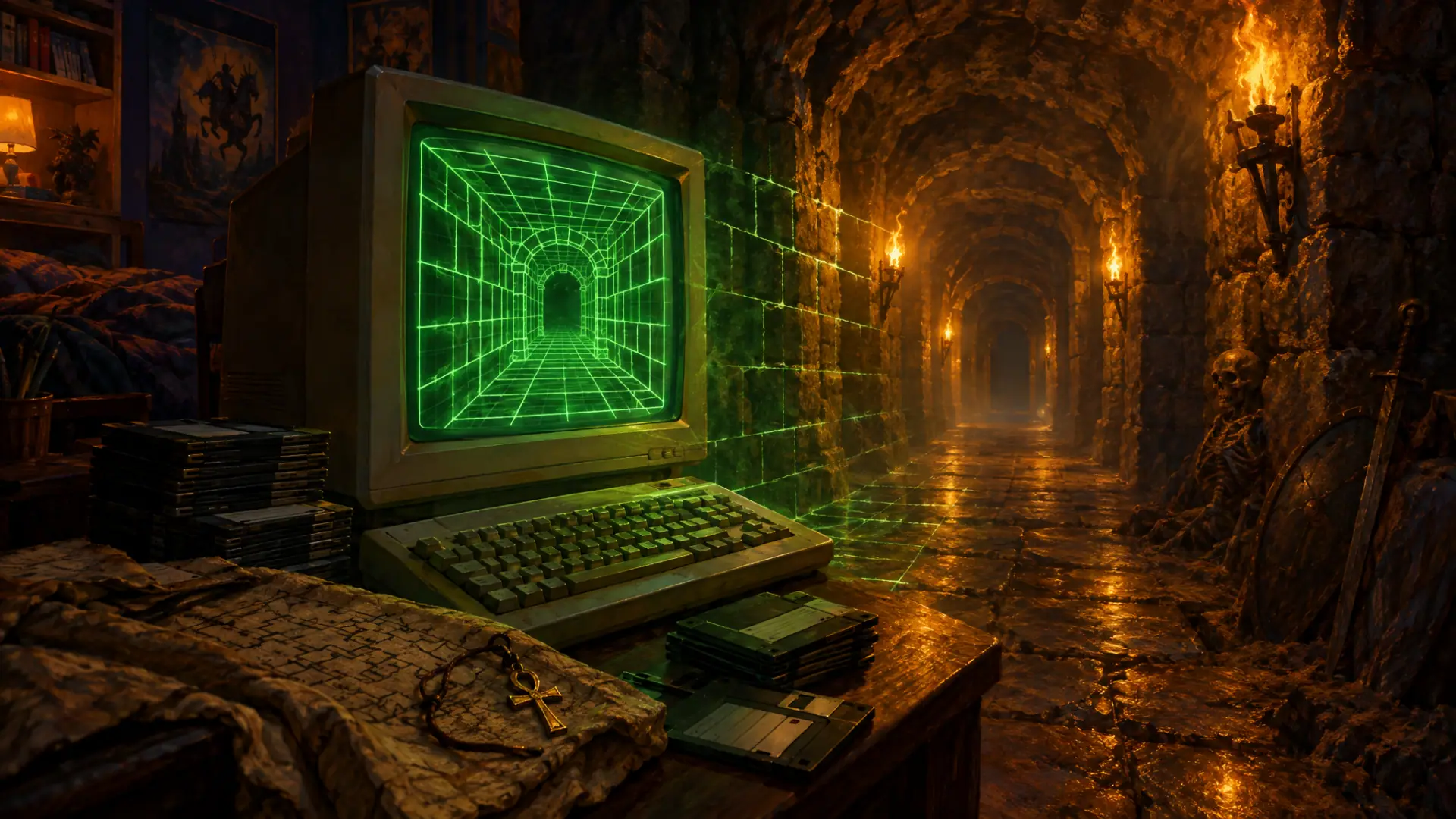
How D&D leapt into software: university dungeons on PLATO, text caves, Lord British's Apple II empire, Wizardry's mazes, Rogue's random depths, the Gold Box, and 1992's first texture-mapped 3D dungeon.
The terminals at the University of Illinois in 1975 glowed orange. They were plasma panels, flat, bright, and touch-sensitive, connected to a mainframe that served hundreds of users at once. The PLATO network had been built to teach chemistry and languages. Its users, mostly students with more curiosity than supervision, also used it to play. A year after Dungeons & Dragons appeared, some of them sat at those orange screens and tried to make the machine run the dungeon. Tabletop gaming at the time was pushing toward rules and settings, a story told in The Tabletop Golden Age & the Satanic Panic. The computer RPG began here, with a different aim: getting a machine to play referee.
Orange glow: the PLATO dungeons
One of the earliest known examples is pedit5, written in 1975 by Rusty Rutherford at Illinois. He built it in a few weeks in late 1975 in the fifth of his group's program slots, which gave it its name. When administrators deleted it for wasting resources, he restored it. A single adventurer went down into a dungeon of rooms and corridors, fought monsters drawn in PLATO's character graphics, collected treasure, and gained experience. The idea spread quickly. At Southern Illinois University, Gary Whisenhunt and Ray Wood wrote dnd the same year and added something pedit5 lacked: a goal, a treasure at the bottom of the dungeon guarded by a Dragon. Others followed. Oubliette (1977) let several players form a The party. Moria (begun around 1975–76) and Avatar (1979) pushed toward multiplayer, first-person mazes that thousands of PLATO users played over the next decade.
These games set the basic grammar of the genre: stats rolled at creation, hit points depleted in combat, levels gained through grinding, and loot carried back to town. They borrowed D&D's numbers wholesale, because the numbers were what a computer could handle. The acting, arguing, and improvising that happen around a table couldn't be programmed. What could be programmed was the arithmetic of danger and reward, and the computer RPG has depended on that arithmetic ever since.
Caves and kingdoms of text
A second lineage began underground in Kentucky. Will Crowther was a programmer at Bolt Beranek and Newman, a caver, and a D&D player. Around 1975–76 he wrote a text simulation of Mammoth Cave's Bedquilt section for his daughters. In 1977 Don Woods, a Stanford graduate student, found it and expanded it into Colossal Cave Adventure, adding a roving pirate, a dragon, and more high-fantasy touches to Crowther's axe-wielding dwarves and magic words. Players typed commands such as GO NORTH and GET LAMP, and the game answered in prose. Adventure spread across the ARPANET and absorbed time on university computers everywhere.
At MIT, Tim Anderson, Marc Blank, Bruce Daniels, and Dave Lebling answered it with Zork (1977–79). It had a far better parser, a Great Underground Empire full of jokes, and the grue that eats players who wander in the dark. They founded Infocom in 1979 and sold Zork I commercially from 1980. Interactive fiction became its own art form, but its influence on RPGs was large. It showed that a computer world could have places, with descriptions, secrets, and a sense of geography, and not just a grid of corridors. At Sierra On-Line, Roberta Williams added pictures to the text adventure and, with King's Quest (1984), built for IBM's PCjr, created the animated graphic adventure. Sierra's Hero's Quest (1989, later renamed Quest for Glory) combined the adventure game with RPG character statistics.
Lord British and the Apple II
The microcomputer made the computer dungeon private and portable. In the late 1970s Richard Garriott, a Houston teenager whose father, Owen, was a NASA astronaut, learned to program on a school teletype and played D&D. Because he was born in England, friends nicknamed him "Lord British." In 1979, on an Apple II, he wrote Akalabeth: World of Doom. It combined a top-down overworld with first-person wireframe dungeons, and he packaged it himself in Ziploc bags for the computer store where he worked. The publisher California Pacific picked it up in 1980. Ultima followed in June 1981 and expanded the idea to a whole world, with towns, castles, and, strangely, a space-shooter section. Ultima II (1982) was published by Sierra. For Ultima III: Exodus (1983), Garriott founded his own company, Origin Systems, with his brother Robert, his father, and Chuck Bueche. Exodus introduced a party of four and tactical combat screens, and it sold well enough to establish the new company.
In 1979 Automated Simulations' Dunjonquest: Temple of Apshai had already sold a boxed dungeon with printed room descriptions to read aloud. But the most important rival to Ultima arrived in September 1981. Wizardry: Proving Grounds of the Mad Overlord, by Andrew Greenberg and Robert Woodhead for Sir-Tech, took the PLATO dungeons, especially Oubliette, and put them on the Apple II. It offered a party of six, alignments and classes, elite classes such as the samurai, lord, and ninja, and a ten-level maze the player had to map on graph paper. Death was harsh: a slain character's body was recovered and taken to the temple, and resurrection might fail and leave only ashes. Wizardry sold 24,000 copies by June 1982, 200,000 in its first three years, and reportedly more than half a million by 1989. It also went abroad. In Japan, Wizardry and Ultima became cult favorites among PC users, and a writer named Yuji Horii took note, as the chapter The Japanese Line: Console RPGs tells.
Randomness and death: the roguelike
Some of the most influential work of this period was never sold at all. Around 1980, at the University of California, Santa Cruz, Michael Toy and Glenn Wichman wrote Rogue. It drew its dungeon in ASCII characters on a text terminal: the player was an @ sign, monsters were letters, and every level was generated fresh by procedural generation. Ken Arnold later joined the project, and when Rogue was distributed with BSD Unix it spread across campus computers throughout the country. The game didn't allow reloading: permadeath was the rule, and each death ended the run. Jay Fenlason's Hack (1982) extended the idea, and in July 1987 a group of programmers communicating over Usenet released NetHack, one of the earliest games developed collaboratively over the internet. It has been maintained by volunteers ever since.
The roguelike stayed a hobbyist form for decades. Its ideas persisted: dungeons generated rather than authored, item identification as a puzzle, and death as part of the design rather than a failure state. They later spread into Diablo, into Dwarf Fortress, and into the independent "roguelite" games of the 2010s.
The party in the maze
By the mid-1980s the Apple II, Commodore 64, and IBM PC formed a real market, and publishers competed hard for it. Electronic Arts, founded in 1982 and presenting its developers as artists on its album-style packaging, published The Bard's Tale in 1985. It came from Interplay, the small studio Brian Fargo had co-founded in 1983 with Rebecca Heineman and others. Designed and programmed by Michael Cranford, it placed a party of six in the town of Skara Brae, with animated monster portraits and a bard whose songs worked as spells. It was Wizardry made friendlier, and it sold strongly. Heineman led The Bard's Tale III (1988) and later the lesser-known Dragon Wars (1989).
Jon Van Caneghem founded New World Computing and released Might and Magic Book One in 1986, a huge world he had largely programmed himself, with a twist ending that turned out to be science fiction. The series would run for decades and branch into the strategy game Heroes of Might and Magic. Critics later named this style of game after its most common screen: a party moving through first-person corridors as a single unit, which they called the blobber, the classic dungeon crawler.
The boxes themselves became part of the experience. Origin packed its games with cloth maps, metal ankhs, and in-world manuals, and Ultima II shipped with a cloth map of its world. Players called these extras "feelies," a term borrowed from Infocom. Magazines such as Computer Gaming World, founded by Russell Sipe in 1981, reviewed each release in long columns. The magazine's adventure columnist, who wrote under the name Scorpia, became a guide for players stuck in a dungeon. Hint books, printed maps, and telephone hint lines grew into a side business. The makers learned that players valued the feeling of a real world beyond the screen, and that feeling had to be carried by manuals and maps as much as by code, since the machines could draw so little.
Not every important game fit the fantasy mold. In 1988 Interplay and Electronic Arts released Wasteland, a party-based RPG set in the American Southwest after a nuclear war, whose world permanently kept the changes the player made. Its designers applied tabletop thinking about consequences to the computer. Nearly a decade later Interplay would draw on it for Fallout, and in 2012 Fargo would return to it on Kickstarter, as later chapters tell. SSI, meanwhile, published Winston Douglas Wood's Phantasie (1985), with its town-and-dungeon structure and six-character parties, and the Commodore 64 became the machine on which much of the decade's RPG audience first played.
In December 1987 FTL Games changed the formula with Dungeon Master for the Atari ST. It ran in real time, so monsters came at the player whether or not they were ready. The player moved items with the mouse, cast spells by combining runes, and trained skills by using them. It became one of the ST's best-selling programs and showed that the dungeon could be made to feel physically present. Arcades offered their own simplified version. Atari Games' Gauntlet (1985) let four players fight through the same dungeon for coins, and its announcer's lines about the warrior's food became famous.
Virtue and the Avatar
In September 1985 Garriott did something no RPG had done before. Ultima IV: Quest of the Avatar had no villain to defeat. Instead the player had to become an example of eight virtues (Honesty, Compassion, Valor, Justice, Sacrifice, Honor, Spirituality, and Humility), and the game quietly tracked how the player behaved. Stealing from a blind shopkeeper counted against the player. Boasting counted against them too. Garriott had received letters accusing his games of promoting evil during the moral panic described in The Tabletop Golden Age & the Satanic Panic, and he later said he wanted the game to make players think about their own conduct. The character was no longer an anonymous adventurer but the Avatar, meant to stand for the player. The idea that an RPG could have an ethical design, and not just a quest, ran from here to the BioWare morality systems of the 2000s and beyond.
Ultima V (1988) and Ultima VI (1990) filled Britannia with schedules and politics, and residents who kept to daily routines. By the end of the decade Origin's slogan was "We create worlds," and the claim was largely justified.
Gold Box and beholders
TSR had so far licensed D&D only for a few simple electronic games, such as Mattel's handheld and Intellivision cartridges of the early 1980s. In 1987 Strategic Simulations, Inc., a wargame publisher, won the license for official AD&D computer games. The first result, Pool of Radiance (June 1988), was set in the Forgotten Realms and implemented the rules closely enough that tabletop players recognized their armor class and saving throws. SSI sold more than 260,000 copies in North America. The engine and its gold-colored boxes became the basis of the "Gold Box" family, which by the early 1990s included sequels, Dragonlance games, and science-fiction spin-offs. They were turn-based and tactical, and they made the grid-based turn-based combat of the tabletop the standard for serious computer RPGs.
In 1991 Westwood Associates, soon renamed Westwood Studios, made Eye of the Beholder for SSI, a real-time first-person dungeon in the manner of Dungeon Master, set beneath Waterdeep. The same year the Gold Box engine went online. Neverwinter Nights, built by Don Daglow's Beyond Software for SSI and America Online, let players connected by modem share a graphical Forgotten Realms city. By 1997 it had 115,000 players. At the other end of the phone line, bulletin-board systems carried door games, such as Seth Robinson's Legend of the Red Dragon (1989), which rationed each player a few turns per day. The online story that began there is told in Online Worlds: From MUD1 to World of Warcraft.
1992: the Stygian Abyss
Two games from Origin in 1992 marked the end of the period. In March a small New England studio, Blue Sky Productions, which soon became Looking Glass Technologies, released Ultima Underworld: The Stygian Abyss, published by Origin. Paul Neurath and Doug Church's team built a dungeon with texture-mapped walls, sloping floors, and free mouse-look, a continuous 3D space that the player could explore from the inside. It came out two months before Wolfenstein 3D and was more ambitious. In April Ultima VII: The Black Gate delivered the most detailed Britannia yet. Its world was fully interactive, and its antagonist, the Guardian, taunted the player from beyond the screen. That September, Electronic Arts bought Origin Systems.
Those two games defined the CRPG's two main directions for the next thirty years. One was the systemic, simulated world that the player enters in first person, which would lead to The Elder Scrolls: Arena (1994), Morrowind, and the immersive sims. The other was the richly authored world viewed from above, which would lead to the Black Isle and BioWare games. The acquisition showed the business direction as well: the independent Apple II studios were being absorbed by large publishers.
What came next
While Americans mapped mazes on graph paper, Wizardry and Ultima had crossed the Pacific. There, a magazine writer, a manga artist, and a television composer would turn the computer RPG into something new: brighter, more linear, designed for a game controller, and eventually for the whole world. That story is told in The Japanese Line: Console RPGs.