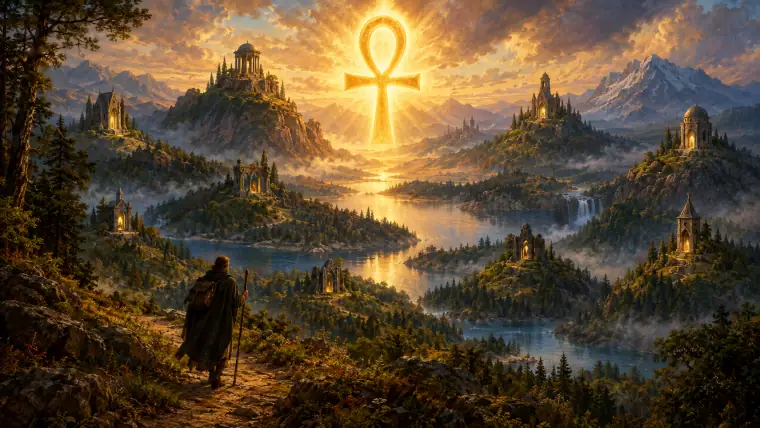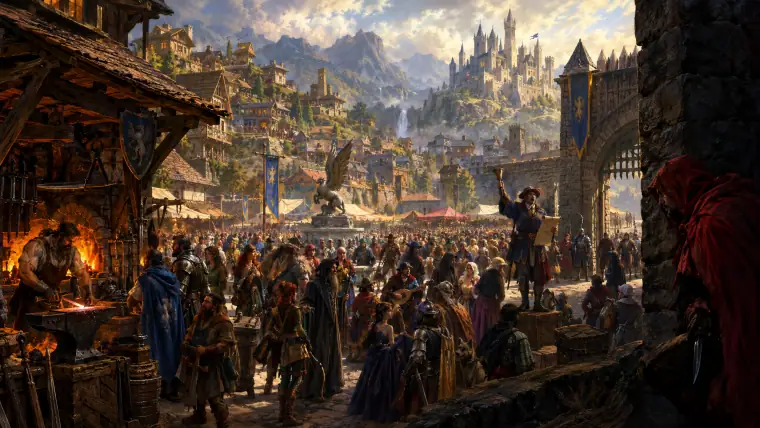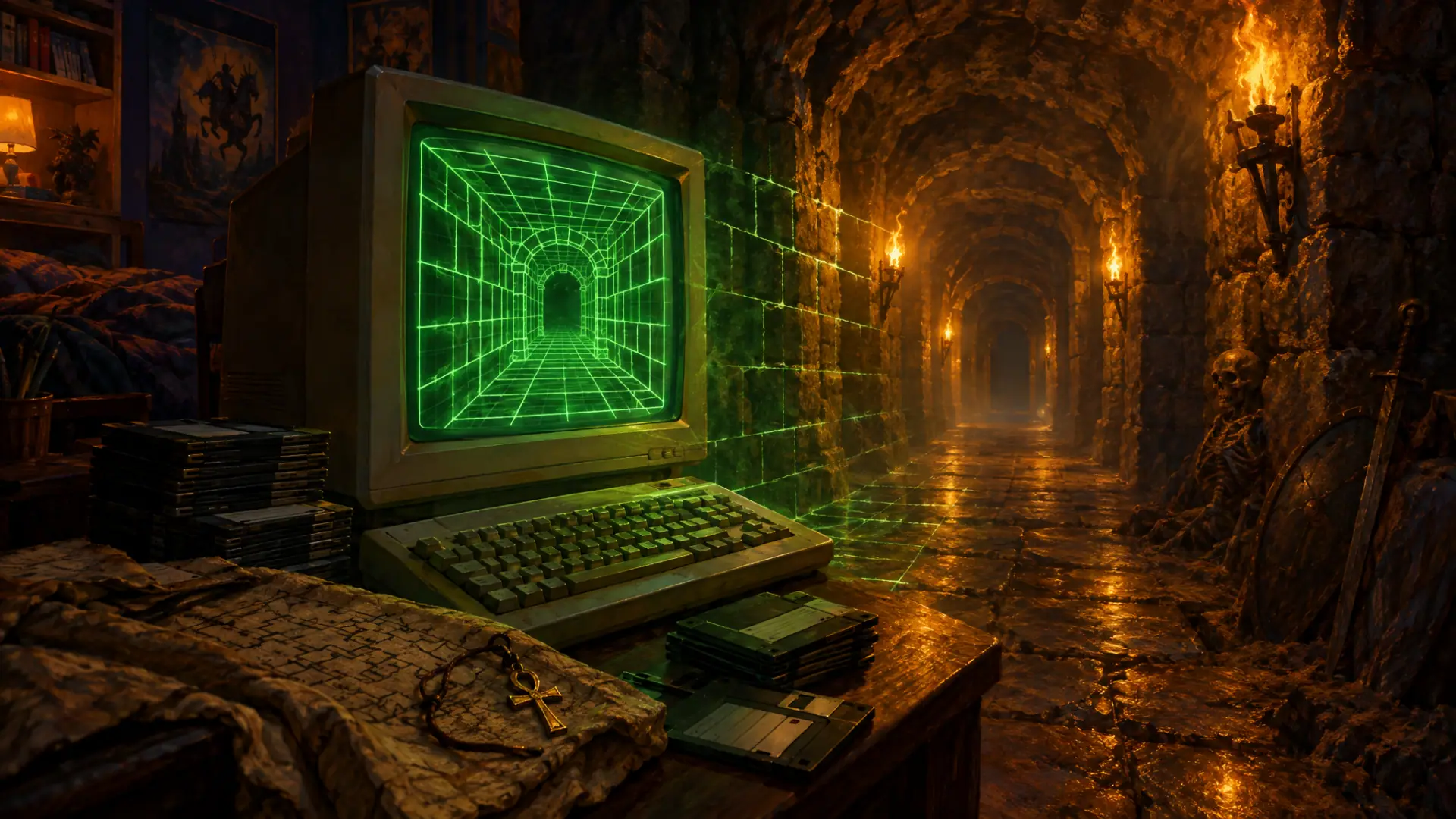
The Black Gate turned the Ultima series toward a seamless, fully interactive, real-time world with a mature story about a manipulative religious movement, setting a standard for open-world RPG simulation that still earns it places on all-time lists.
Overview
Ultima VII: The Black Gate is a role-playing game designed by Richard Garriott and published by Origin Systems for MS-DOS on April 17, 1992. The Avatar returns to Britannia to find that two hundred years have passed, that a blacksmith has been ritually murdered in the city of Trinsic, and that a benevolent-seeming movement called the Fellowship has spread across the land with the blessing of Lord British himself.
It is often ranked the high point of the Ultima series. Garriott has called it "the most masterfully executed" Ultima and has named it, with Ultima IV, as his own favorite. Its ambition lay less in any single innovation than in the density of its world: nearly everything in Britannia could be picked up, moved, used or combined, and the land's people went about daily lives whether the Avatar watched or not.
Origins
Ultima VII was the first game for which Garriott planned ahead, laying out a trilogy that would end with Ultima IX. It was also shaped by Origin's rivalry with Electronic Arts. Origin's slogan was "We Create Worlds"; the game's antagonist, the Guardian, is a "Destroyer of Worlds," whose three evil Generators take the forms of the cube, sphere and tetrahedron in EA's logo of the day, and two of the story's murderers are named Elizabeth and Abraham. Within months of release, on September 25, 1992, Electronic Arts acquired Origin.
The Fellowship was inspired by Scientology. Garriott also cited the action RPG Times of Lore and FTL's Dungeon Master as influences. The team included lead programmer Ken Demarest, artist Jeff Dee — who had started at TSR as its youngest artist — and writer Raymond Benson, who later wrote James Bond novels. Under the hood it ran on a custom DOS extender called "Voodoo," which was incompatible with standard DPMI extenders.
How it plays
The game dropped the familiar Ultima screen of tiles, text and command icons. The world now filled the whole display, drawn at an angle for a pseudo-isometric look, and movement was no longer tied to a visible grid; objects could be stacked, even into makeshift stairs. It was the first Ultima driven entirely by the mouse. Items were dragged and dropped, and containers, books and character inventories opened as floating windows called "gumps," a term and interface later carried into Ultima VIII, Ultima IX and Ultima Online.
Time ran continuously, and combat happened in real time, with each companion in the party steered by AI according to a chosen stance — a system that spared the player micromanaging up to eight characters, at the cost of occasional self-defeating moves. Conversation used mouse-selected keywords that appeared only once the Avatar had actually learned about a subject. The Avatar and companions had to eat, could get drunk, and could bake bread, forge swords, play instruments or paint a self-portrait. The world was also morally reactive: theft and murder did not break the game, but companions who witnessed too much could leave or even turn on the Avatar.
The investigation leads across Britannia — to Minoc, Yew, Moonglow, Buccaneer's Den and a ruined Skara Brae run by a lich — and gradually reveals that the Fellowship is preparing a black moongate through which the Guardian can enter the world during an astronomical alignment.
Reception & impact
Critics admired the ambition and flinched at the demands. Computer Gaming World's Scorpia praised its "first-class" graphics, sound and realism and its "engrossing" story but criticized slowness, bugs and combat; her colleague Charles Ardai argued that it was "not more of the same" and called its plot the best in the series. The magazine nominated it as 1992's Role-Playing Game of the Year, an award that went instead to Origin's other spring release, Ultima Underworld. The Forge of Virtue expansion followed in September 1992, returning the Avatar to the Isle of Fire of Ultima III to destroy the last remnant of Exodus. PC Gamer placed the game on its "50 Best Games Ever" list in 1997 and ranked it tenth among the best PC games of all time in 2011.
Legacy
Ultima VII Part Two: Serpent Isle (1993), with its own Silver Seed expansion, continued the story as Batlin fled Britannia. A heavily cut-down action adaptation for the Super NES, Ultima: The Black Gate, reached Japan and North America in November 1994; it replaced the party with a lone Avatar and the murders with kidnappings to meet Nintendo's content rules. Fans later rebuilt the engine as Exult, an open-source recreation that runs the original data on modern systems and lets modders take the game apart. The Black Gate's idea of a world that simulates daily life, rewards curiosity and remembers what the player did is echoed in the open-world RPGs that followed, from The Elder Scrolls onward.
Marginalia
- The villainous Guardian's three Generators take the shapes of Electronic Arts' logo of the time — a cube, a sphere and a tetrahedron; EA bought Origin that September.
- Two murderers in the story, Elizabeth and Abraham, carry the initials E and A.
- Origin's slogan was 'We Create Worlds'; the Guardian is styled a 'Destroyer of Worlds.'
- The game reportedly cost $1 million to develop.
- Its end credits advertised a soundtrack CD that did not exist yet; Serpent Isle's credits joked 'Soundtrack CD NOT available from Origin, so don't ask!'
- The box included a cloth map of Britannia, a Fellowship medallion and a demo disk for Ultima Underworld.
- The SNES version had to fit into one megabyte, against the PC original's roughly 20, and swapped the murders for kidnappings.
Quick answers
- When was Ultima VII: The Black Gate first released?
- Ultima VII: The Black Gate was first released in April 1992 (MS-DOS); SNES adaptation 1994.
- Who created Ultima VII: The Black Gate?
- Ultima VII: The Black Gate was made by Richard Garriott (designer).
- Who published or developed Ultima VII: The Black Gate?
- Origin Systems.
- What kind of work is Ultima VII: The Black Gate?
- Ultima VII: The Black Gate is a computer RPG in the Western Computer RPGs (CRPG) and Open-World RPGs tradition, released for MS-DOS and SNES (as Ultima: The Black Gate, 1994).
- Why is Ultima VII: The Black Gate important?
- The Black Gate turned the Ultima series toward a seamless, fully interactive, real-time world with a mature story about a manipulative religious movement, setting a standard for open-world RPG simulation that still earns it places on all-time lists.