Howard directed or produced the Elder Scrolls games that carried the open-world RPG from a PC niche to the center of popular culture, and championed the modding communities that keep those worlds alive.
Life
Todd Andrew Howard grew up in Lower Macungie Township, in Pennsylvania's Lehigh Valley; published sources give his birth year variously as 1970 and 1971. He was drawn to computers and games from a very young age, and the role-playing games of the early 1980s left the deepest mark: he has named Wizardry and Ultima III: Exodus as inspirations for the games he would later make. He graduated from Emmaus High School in 1989 and went to the College of William & Mary in Williamsburg, Virginia, where he majored in business, which he later said looked like the easiest path through college, while taking computer classes for credit. He earned his Bachelor of Business Administration in 1993.
His route into the industry is a small legend of persistence. During the holiday break of his senior year he bought Wayne Gretzky Hockey, made by Bethesda Softworks of Rockville, Maryland, a company whose offices he passed on his commute. On Martin Luther King Jr. Day he walked in and asked for a job. He was told to finish school first; after graduating he tried again and was turned down for lack of openings. He took a job with a smaller game company in Yorktown, Virginia, which sent him to trade shows such as the Consumer Electronics Show, where he kept approaching Bethesda. In 1994 the company finally hired him as a producer.
Work
Howard's first Bethesda credit was as producer and designer of The Terminator: Future Shock (1995), followed by Skynet and additional design on The Elder Scrolls II: Daggerfall, both in 1996, the latter under Julian LeFay. He was project leader for the first time on the action-adventure spin-off The Elder Scrolls Adventures: Redguard (1998).
In 2000 he was appointed project leader and designer of The Elder Scrolls III: Morrowind. Where Daggerfall had been generated by algorithm, Morrowind was built by hand: a single strange island of giant mushrooms, silt striders and ash storms, rich with political factions and deliberately alien to generic fantasy. Released in 2002 for Windows and for Microsoft's Xbox, it won Game of the Year awards and brought the series to console players. Crucially, it shipped with the Construction Set, the same editing tools the developers used, turning players into Homebrew world-builders and launching the modding culture that has sustained Bethesda's games ever since. Howard has consistently said he does not understand why more developers do not allow mods.
He led The Elder Scrolls IV: Oblivion (2006) as executive producer. Set in Tamriel's temperate heartland, it traded Morrowind's strangeness for a more classic, welcoming fantasy and a new level of visual ambition; Howard later acknowledged that in doing so the team "sacrificed some of what made Morrowind special: the wonder of discovery." Oblivion was an enormous success, and it also produced one of the era's rating controversies, recounted in The Oblivion ESRB Re-rating. Howard then directed Fallout 3 (2008), reviving the post-apocalyptic RPG series Bethesda had acquired from Interplay.
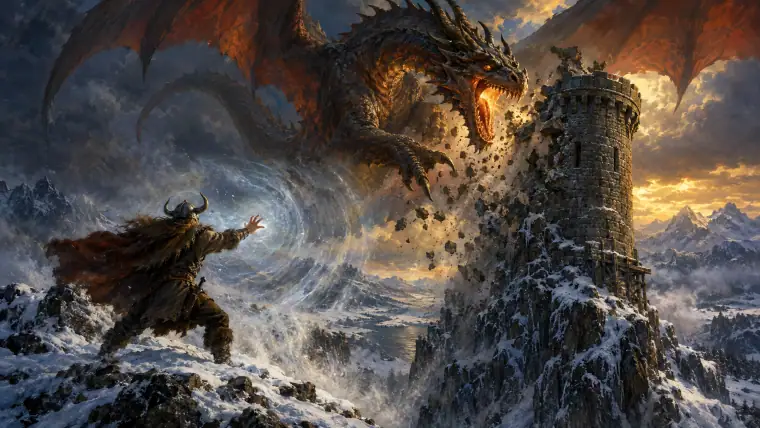
The Elder Scrolls V: Skyrim, released in November 2011 with Howard as game director, became the series' defining work: a snowbound Nordic province of dragons, shouts and radiant quests that sold across PCs and consoles for more than a decade and was re-released on hardware after hardware. He went on to direct Fallout 4 (2015); to produce Fallout 76 (2018), a multiplayer entry heavily criticized at launch; to lead Bethesda's space RPG Starfield (2023); and to serve as executive producer of MachineGames' Indiana Jones and the Great Circle.
Legacy
Howard's games describe their own philosophy: Bethesda's aim, he has said, is to let people "live another life, in another world." Under his leadership the Open-World RPGs pioneered by LeFay's Arena and Daggerfall became a mainstream blockbuster form, with Skyrim among the best-selling games of its generation, and the modding tools shipped since Morrowind made players co-authors of those worlds.
He is also one of the most recognizable faces in games, honored with a GDC Lifetime Achievement Award, D.I.C.E. awards for outstanding achievement in game direction in 2012 and 2016, a place on IGN's 2013 list of the top 100 game creators, and induction into the AIAS Hall of Fame in 2017. The popularity of his games has turned him, and some of his stage quotes, into affectionate internet memes, as have Skyrim's many re-releases. Criticism of Fallout 76 and of bugs in Bethesda's sprawling games is part of the record too. But from Daggerfall's credits to Skyrim's mountains, Howard is the figure most responsible for turning the sprawling Western RPG into shared popular culture.
Marginalia
- He cites Wizardry: Proving Grounds of the Mad Overlord and Ultima III: Exodus as early inspirations, and has named Ultima VII: The Black Gate one of his personal favorites.
- Bethesda turned him down twice, once while he was still a student and again after he graduated, before hiring him in 1994.
- His first Bethesda credit was as producer of The Terminator: Future Shock (1995).
- He was project leader on The Elder Scrolls III: Morrowind (2002) and led The Elder Scrolls V: Skyrim (2011) as game director.
- At the 2012 D.I.C.E. Summit he quipped that if install base really mattered, "we'd all make board games, because there are a lot of tables."
- He was inducted into the Academy of Interactive Arts & Sciences Hall of Fame in 2017.
Quick answers
- Who is Todd Howard?
- The Pennsylvania business major who talked his way into Bethesda in 1994 and went on to lead Morrowind, Oblivion, Skyrim and Fallout, making the vast open-world RPG a mass-market blockbuster.
- What is Todd Howard known for?
- Todd Howard is best known for The Elder Scrolls III: Morrowind, The Elder Scrolls IV: Oblivion and The Elder Scrolls V: Skyrim.
- Why does Todd Howard matter to fantasy and games?
- Howard directed or produced the Elder Scrolls games that carried the open-world RPG from a PC niche to the center of popular culture, and championed the modding communities that keep those worlds alive.