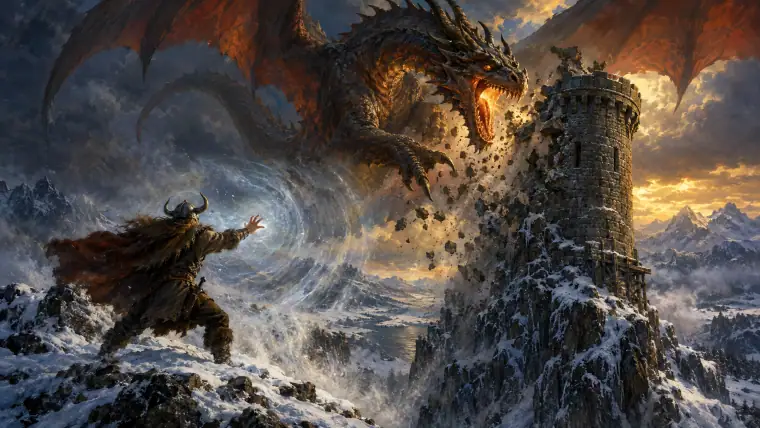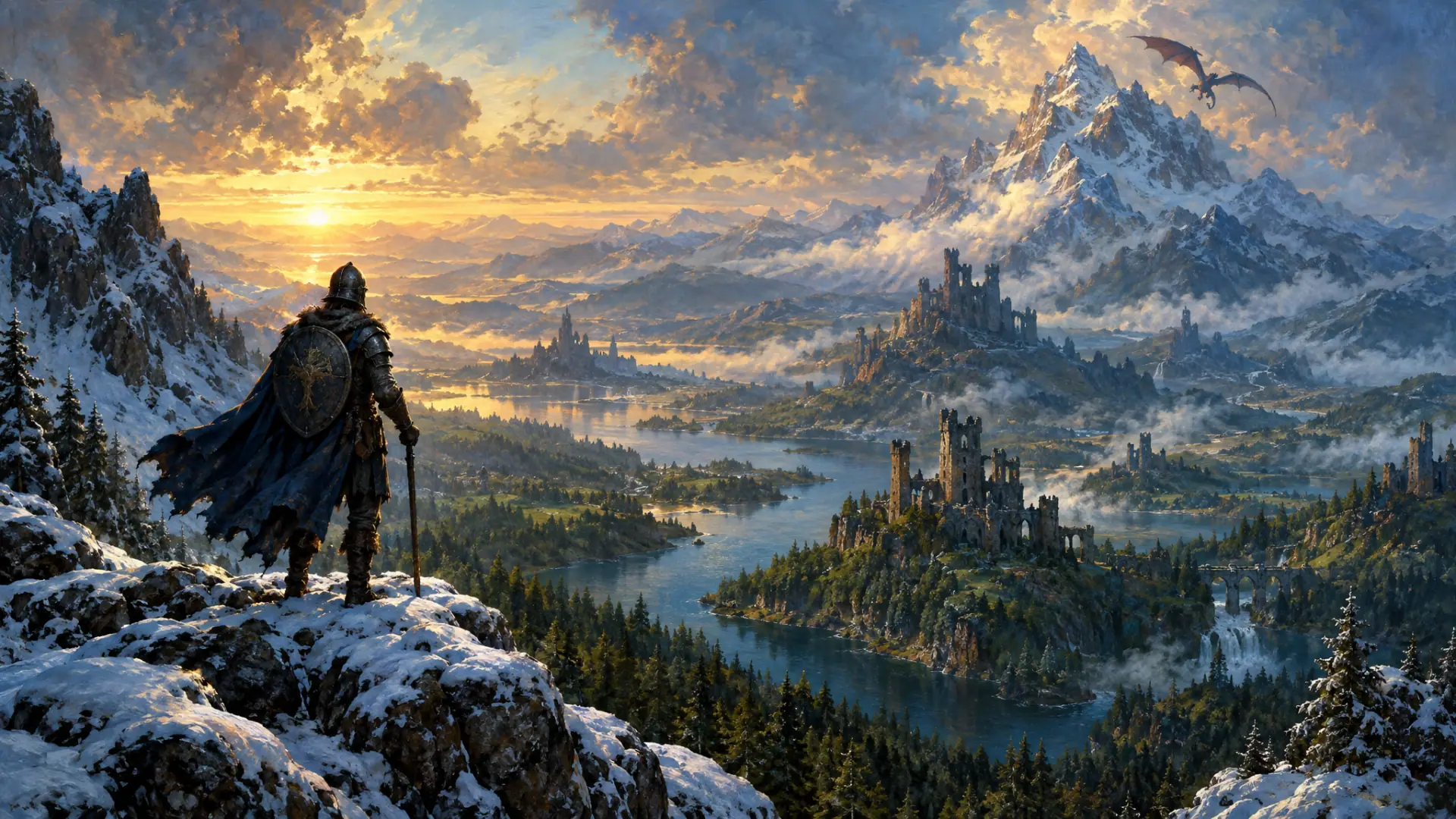
Morrowind traded Daggerfall's procedural vastness for a strange, hand-built world, reached a mass audience on Xbox, and shipped with the tools players used to remake it; it set the template for every Bethesda open world that followed.
Overview
A prisoner wakes in the hold of a ship. Someone called Jiub asks their name, the boat docks at the swamp village of Seyda Neen, and a clerk processes their release on the Emperor's orders. Beyond the census office lies Vvardenfell, an island of ash storms, giant mushroom towers, stilt-legged silt striders and a volcano, Red Mountain, where a god-in-waiting named Dagoth Ur dreams. The Elder Scrolls III: Morrowind, released for Windows on May 1, 2002 and for the Xbox on June 7, 2002, is one of the strangest settings ever put at the center of a best-seller, and it made Bethesda one of the most important RPG studios in the world.
Origins
The idea of a game set in the Dunmer homeland of Morrowind dates to the development of Daggerfall, but Bethesda shelved it in 1997. When work resumed in 1998, after the spin-off Redguard, it was led by Todd Howard, and the team made a decisive break with its predecessors. Instead of generating a continent, they would build one island by hand. They abandoned the in-house XnGine for NetImmerse, a licensed Direct3D engine with skeletal animation and 32-bit textures, and Bethesda tripled its staff; about forty developers put close to a hundred man-years into the game.
Ken Rolston, the lead designer, arrived with a background in tabletop RPG design and argued for a "free-form" game in which the main quest could be ignored indefinitely. The writers built a culture drawn from ancient Egyptian, Japanese and Middle Eastern models rather than the medieval Europe of most fantasy, with warring Great Houses, a living tribunal of god-kings, and a slavery economy the player could fight or profit from. The result was an unusually dense piece of Worldbuilding, full of contradictory in-game histories and heresies; more than three hundred books are shelved around the island.
How it plays
As in Daggerfall, skills improve through use: swinging a sword trains Long Blade, wearing heavy armor trains Heavy Armor, and reading certain books grants a point. A character's chosen major and minor skills drive leveling, and a birthsign adds starting powers. Combat is first-person or third-person, with hits determined by hidden dice rolls, a feature many new players found baffling. There is no map-click fast travel; players use silt striders, boats, Mages Guild teleporters and spells, or walk. Quest guidance is minimal, delivered through hyperlinked dialogue topics and a journal widely criticized as a muddle until the first expansion reorganized it.
The world rewards wandering. Players can join one of three Great Houses, Hlaalu, Redoran or Telvanni, alongside guilds, temples and criminal syndicates, and the main quest, in which the player may prove to be the Nerevarine, the reincarnation of a legendary hero, unfolds in a "partially ordered" way that tolerates huge detours. The island's airborne cliff racers became one of gaming's most notorious nuisances.
Reception & impact
Morrowind scored 89 on Metacritic for PC and 87 for Xbox. It won GameSpy's PC RPG of the Year and several IGN awards, though it lost GameSpot's and the Academy of Interactive Arts & Sciences' RPG prizes to BioWare's Neverwinter Nights. On the Xbox it was the best-selling RPG of 2002 and remained in the console's top ten a year after launch, company shared only with Halo. Two expansions followed: Tribunal (November 2002), set in the walled city of Mournhold, and Bloodmoon (June 2003), which added the snowbound island of Solstheim and werewolves; both were bundled in a Game of the Year Edition in October 2003. The game passed four million copies by August 2005.
The PC release shipped with the Elder Scrolls Construction Set, the same editor Bethesda's designers used, and players took it up in extraordinary numbers, producing new quests, homes, races, graphical overhauls and bug fixes. The console success and the modding scene became the two engines of Bethesda's later fortunes.
Legacy
Morrowind fixed Bethesda's method: a handcrafted, densely written open world, released on PC and console at once, opened to modders. Oblivion and Skyrim refined that recipe into some of the best-selling games of their generations, and The Elder Scrolls Online later returned to Vvardenfell. Many players still regard Morrowind as the series' most imaginative world. Fans maintain it through OpenMW, an open-source reimplementation of its engine, and through Skywind, a volunteer effort to rebuild the island in Skyrim's technology.
Marginalia
- Bethesda first conceived Morrowind during Daggerfall's development but shelved it in 1997, then revived it after Redguard in 1998.
- The PC version shipped with The Elder Scrolls Construction Set, the tool Bethesda itself used, launching a vast modding community.
- Its culture draws on ancient Egyptian, Japanese and Middle Eastern sources rather than medieval Europe.
- The game contains more than 300 in-game books, roughly six novels' worth of text.
- It was the best-selling RPG on the Xbox in 2002.
- Lead designer Ken Rolston came to Bethesda from tabletop RPG design and pushed a 'free-form' approach.
- The fan-built OpenMW engine, and the Skywind project to rebuild the game in Skyrim's engine, keep it alive.
Quick answers
- When was The Elder Scrolls III: Morrowind first released?
- The Elder Scrolls III: Morrowind was first released in 2002 (Windows, Xbox).
- Who created The Elder Scrolls III: Morrowind?
- The Elder Scrolls III: Morrowind was made by Todd Howard (game director & project leader).
- Who published or developed The Elder Scrolls III: Morrowind?
- Bethesda Softworks.
- What kind of work is The Elder Scrolls III: Morrowind?
- The Elder Scrolls III: Morrowind is a computer RPG in the Open-World RPGs and Western Computer RPGs (CRPG) tradition, released for Windows and Xbox.
- Why is The Elder Scrolls III: Morrowind important?
- Morrowind traded Daggerfall's procedural vastness for a strange, hand-built world, reached a mass audience on Xbox, and shipped with the tools players used to remake it; it set the template for every Bethesda open world that followed.