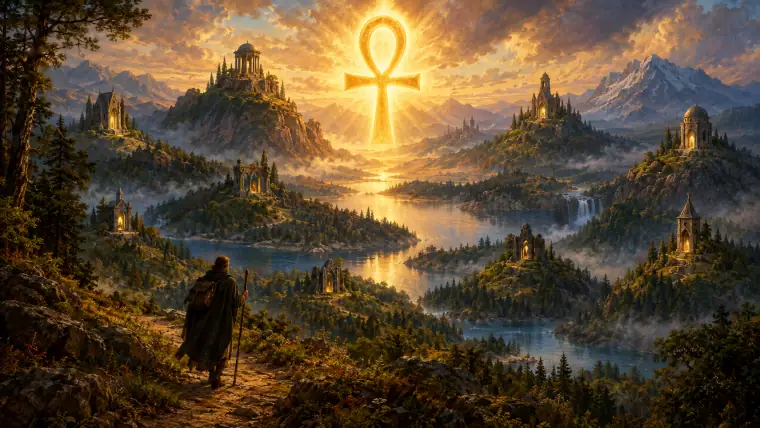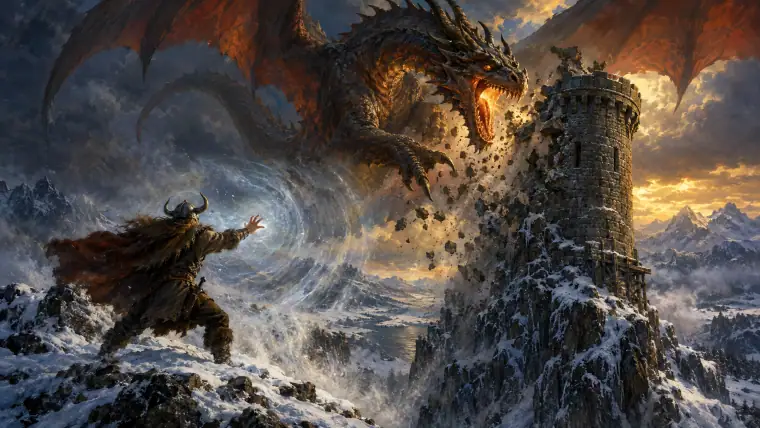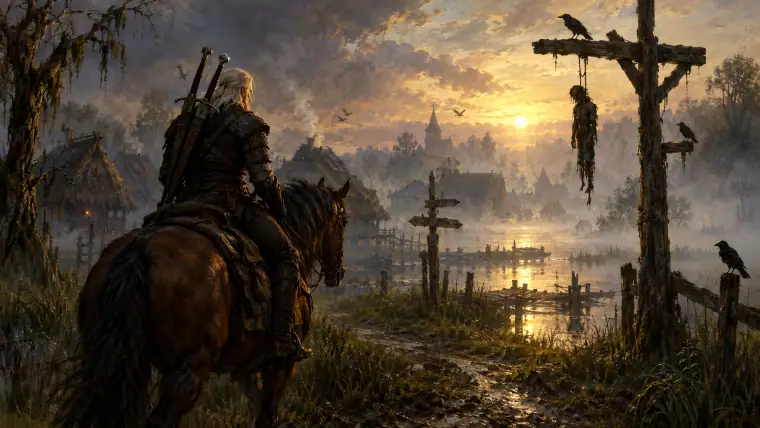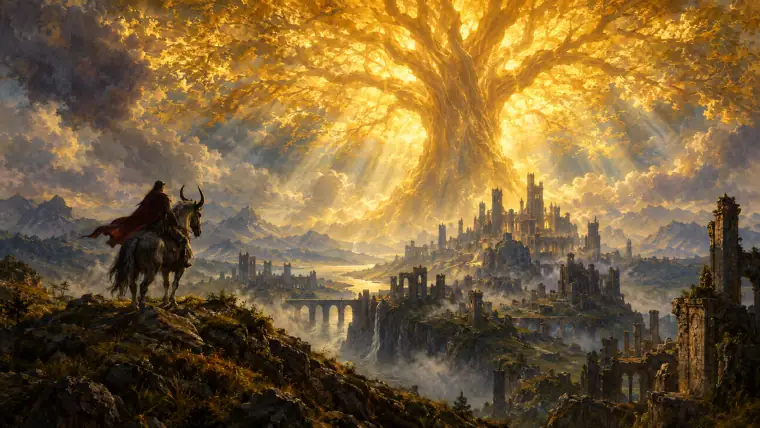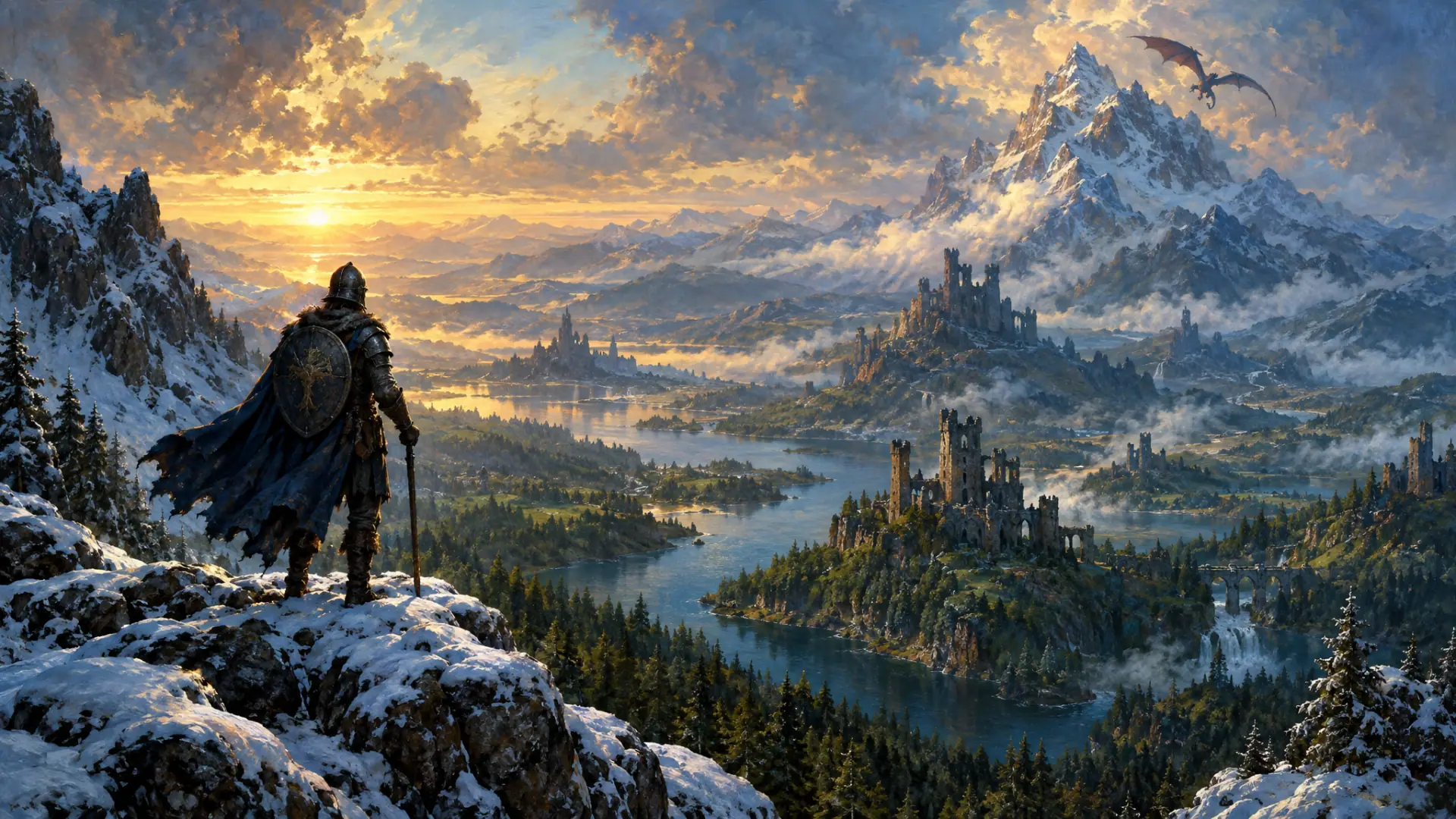
The open-world RPG turned the tabletop game master's promise, that you can go anywhere, into software. It produced some of the best-selling games ever made and much of the modding culture around them.
Hallmarks
- A large, continuous world the player may cross in almost any order
- A main quest that can be ignored for side quests, guilds and wandering
- Systemic simulation: day-night cycles, schedules, crime, economies
- Discovery as reward: ruins, caves and stories found off the road
- Character building through open-ended skills rather than a fixed path
- Long lifespans extended by expansions and player modding
What it is
An open-world RPG gives the player a territory rather than a path. There is a story, usually urgent, but you may ignore it for dozens of hours: joining a thieves' guild, following a river to see where it goes, hunting a dragon glimpsed on a ridge. The world is continuous and mostly unlocked from early on. It is populated by systems, not just scripts: day and night, shopkeepers who close, guards who remember crimes, weather, wildlife. The pleasure is autonomy. Players choose not only what to do but in what order and in what manner, and they build a character through skills and choices rather than a fixed class path. The ancestor is the tabletop Sandbox, in which the Game Master lets players wander off the adventure's edge.
Origins
Historians disagree about the first open world, because they disagree about how open is open. For RPGs, most accounts begin with Richard Garriott's Ultima (1981). It had a free-roaming overworld of continents, towns and dungeons, inspired by Dungeons & Dragons. Early Ultima maps lacked a single scale, so a town was an icon you stepped into, a convention the first Dragon Quest games adopted. In Japan, T&E Soft's Hydlide (1984) rewarded exploration of an open field. Nintendo's The Legend of Zelda (1986) dropped players into Hyrule with a sword and almost no instructions. Outside the RPG, Elite (1984) showed how much space a procedural universe could offer.
Evolution
The Ultima games deepened the simulation. Ultima V (1988) gave townsfolk daily schedules. Ultima VII (1992) built a continuous Britannia full of objects that could be picked up, baked or stolen. Bethesda, with Julian LeFay among the early leads, took the idea to extremes. Arena (1994) spanned the continent of Tamriel. Daggerfall (1996) used Procedural generation to fill a realm of about 209,000 square kilometers with thousands of places. It was vast, buggy and almost unmappable.
Morrowind (2002) traded procedural size for a handcrafted alien island. It shipped with the construction kit that launched a modding culture. Piranha Bytes' Gothic (2001) showed a smaller, denser alternative from Germany. Oblivion (2006) added full voice acting and Radiant AI. Todd Howard's Skyrim (2011) became the form's mass-market peak, with more than 60 million units sold by 2023, by Howard's count. CD Projekt Red, co-founded by Marcin Iwiński, answered with The Witcher 3: Wild Hunt (2015). Its side quests were written with the care of main plots. The Legend of Zelda: Breath of the Wild (2017) rebuilt the open world around physics and chemistry, rewarding experiment over checklists. FromSoftware's Elden Ring (2022) combined Soulslikes combat with a world that offered almost no guidance, and sold 30 million copies by April 2025.
Japanese developers took the open world in other directions. Monolith Soft's Xenoblade series built enormous landscapes around a story that is still largely linear. Pokémon Scarlet and Violet (2022) brought the Monster-Collecting RPGs into an open region explored at will. miHoYo's Genshin Impact (2020) combined open-world action with gacha monetization and became a global commercial phenomenon. It showed that the form could also serve as a live-service platform, updated for years.
Success produced its own clichés. Critics mocked the map crowded with icons and the tower you climb to reveal the next batch, a mechanic nicknamed the "Ubisoft tower" after the Assassin's Creed series. Players now judge open worlds by how much they reward curiosity, not by acreage.
How to tell it apart
Open-world vs. linear or hub-based RPG. A linear RPG, typical of the JRPG tradition, moves the player through a planned sequence of places. A hub-based CRPG such as Baldur's Gate or Dragon Age: Origins offers a choice of regions, but each is a bounded map reached by fast travel. An open world is one continuous space, and its geography is itself the content.
Open-world vs. Sandbox. The terms overlap and are often used interchangeably. Strictly, "sandbox" stresses freedom to shape and play with systems, while "open world" stresses freedom of movement. Skyrim is both. A game can have a wide map yet a rigid story, or a small map full of systemic toys.
Open-world RPG vs. MMORPGs. Both offer huge worlds. But an MMORPG's world is persistent and shared with thousands of other players and continues without you. A single-player open world waits for you, reacts only to you, and can be modded, saved and reloaded.
Open-world RPG vs. open-world action game. Grand Theft Auto shares the geography, but not the character building. The RPG version keeps stats, skills and Loot & loot tables at its center.
Where to start
- Ultima VII: The Black Gate (1992): the living-world simulation, decades early.
- Morrowind (2002): strange, handcrafted and endlessly modded.
- Skyrim (2011): the genre's mass-market standard.
- The Witcher 3: Wild Hunt (2015): the open world as a storytelling medium.
- Elden Ring (2022): exploration with no quest markers at all.
Marginalia
- Ultima (1981) had a free-roaming overworld inspired by D&D. Its maps lacked a single scale, so towns appeared as icons.
- Daggerfall's procedurally generated map covers about 209,000 square kilometers, comparable to Great Britain.
- Oblivion's 'Radiant AI' gave characters general goals, such as eating at a set time, and left them to work out how, instead of scripting each one.
- Todd Howard said Skyrim had sold more than 60 million units by June 2023.
- Elden Ring sold 30 million copies by April 2025, one of the best-selling video games of all time.
- Critics saw Breath of the Wild (2017) as a turning point for open-world design. Nintendo called its approach 'open-air'.
Quick answers
- What is Open-World RPGs?
- See that mountain? You can climb it: the RPG as a whole country to wander, from Ultima's tiled continents to Daggerfall's procedural Britain-sized realm, Skyrim and Elden Ring.
- What are the hallmarks of Open-World RPGs?
- A large, continuous world the player may cross in almost any order; A main quest that can be ignored for side quests, guilds and wandering; Systemic simulation: day-night cycles, schedules, crime, economies; Discovery as reward: ruins, caves and stories found off the road; Character building through open-ended skills rather than a fixed path; Long lifespans extended by expansions and player modding.
- When did Open-World RPGs emerge?
- Ultima (1981) and Hydlide (1984); Elder Scrolls from 1994.
- What are the key works of Open-World RPGs?
- Ultima, Hydlide, The Legend of Zelda, Ultima VII: The Black Gate, The Elder Scrolls: Arena, The Elder Scrolls II: Daggerfall, The Elder Scrolls III: Morrowind and The Elder Scrolls IV: Oblivion.