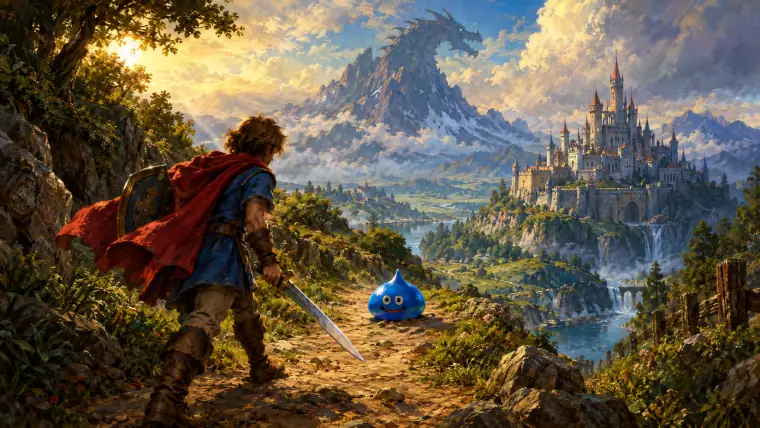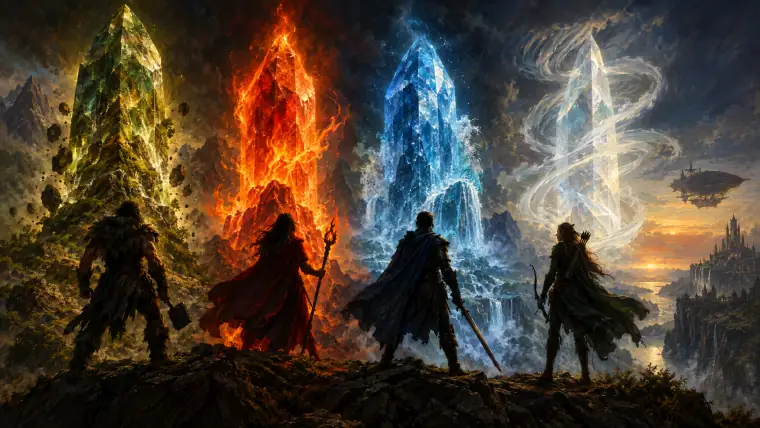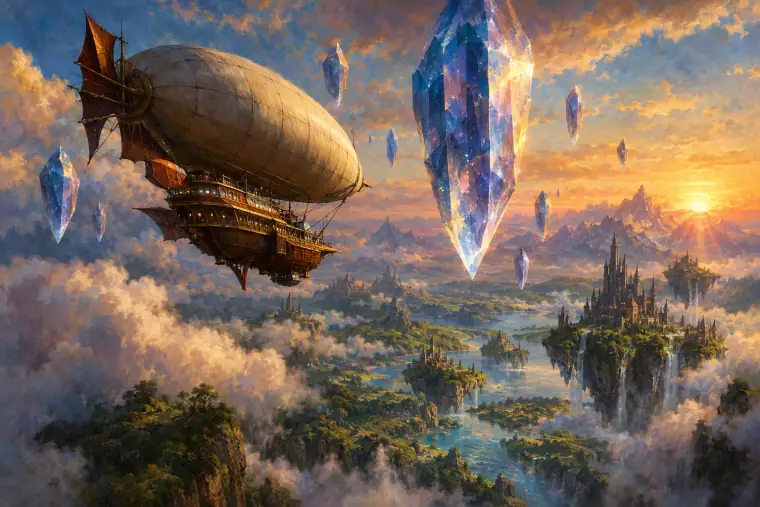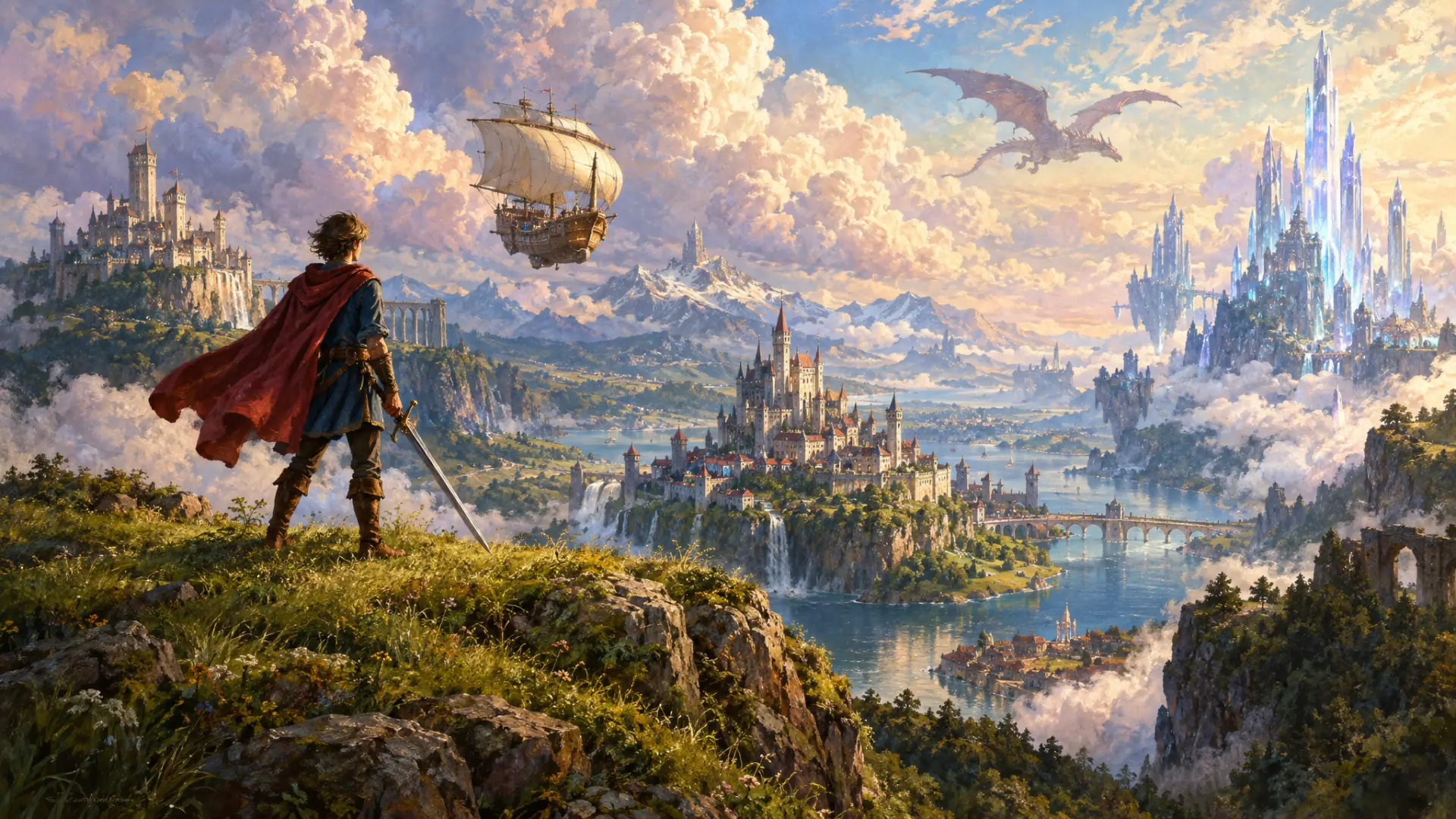
The Japanese RPG turned a niche American computer genre into a mass-market console form, made role-playing a national pastime in Japan, and, from Final Fantasy VII onward, carried the RPG to tens of millions of players who never touched a PC.
Hallmarks
- A fixed, named protagonist and cast rather than a party built from scratch
- Menu-driven turn-based or timed battles, often against random encounters
- A tightly authored, largely linear story delivered through character drama
- Anime- and manga-influenced art direction and a strong musical identity
- Accessible rules that hide the dice and put progression on a visible curve
- A world map linking towns, dungeons and set-piece revelations
What it is
A Japanese RPG, or JRPG, is a role-playing video game in the tradition that Japanese developers built on home computers and, above all, on the Nintendo Famicom in the mid-1980s. Its signature is a pre-written hero and cast, a story told in authored chapters, battles fought through menus rather than on a map, and progression you can feel: Experience points, new spells, a stronger The party. Where the Western Western Computer RPGs (CRPG) typically asks you to invent a character and loose them on a simulated world, the JRPG casts you as someone specific, such as Cecil, Terra, Cloud or Crono, and asks you to live through their story.
The label is geographic, but it has come to describe a style more than a passport. Critics use it for games whose presentation, as a 2015 GameSpot feature put it, mimics the design sensibilities of anime and manga, and for Western homages that borrow those conventions. Many Japanese creators dislike the term. Tetsuya Nomura has said RPGs should simply be called role-playing games, and in 2023 Final Fantasy XVI producer Naoki Yoshida told the YouTube channel SkillUp he was uneasy with the negative associations the label had historically carried.
Origins
The genre began as an import. American Wizardry and the Ultima series were popular among Japanese computer owners in the early 1980s, and local studios answered them. Koei's The Dragon and Princess appeared in 1982. In 1984 Henk Rogers, a Dutch-born programmer living in Yokohama, released The Black Onyx, which taught many Japanese players what Hit points were, while Nihon Falcom's Dragon Slayer and T&E Soft's Hydlide pushed toward real-time action.
The console form was fixed by Yuji Horii. Having discovered Wizardry, he and programmer Koichi Nakamura combined its first-person battle screens with Ultima's top-down overworld, stripped the statistics down for children and newcomers, and hired manga star Akira Toriyama to draw the monsters and pop composer Koichi Sugiyama to score it. Enix released Dragon Quest in 1986. It started slowly, then caught fire, and by 1988 Dragon Quest III sold more than a million cartridges in its first day, with reports of nearly 300 students picked up for truancy while queuing. A lasting legend holds that the government then banned weekday launches; in fact Enix itself moved later releases to weekends.
Rivals followed within weeks of each other. Square's Final Fantasy, Hironobu Sakaguchi's make-or-break project with music by Nobuo Uematsu and art by Yoshitaka Amano, arrived on December 18, 1987; Sega's Phantasy Star, co-designed by Rieko Kodama, followed two days later with a heroine, a science-fantasy setting and 3D dungeons.
Evolution
The 16-bit years were the genre's classical age. Final Fantasy IV (1991) introduced the Active Time Battle system, in which every combatant acts on a running clock; designer Hiroyuki Ito took the idea from watching Formula One cars pass one another at different speeds. Final Fantasy VI (1994) turned an ensemble cast into an opera, and Chrono Trigger (1995) united the Dragon Quest and Final Fantasy creators in one "Dream Team" production. Parallel branches split off: Secret of Mana fused party RPG and real-time Action RPGs & Hack-and-Slash; Fire Emblem set the pattern for the grid-based Tactical & Strategy RPGs; and in 1996 Pokémon Red and Green made the Monster-Collecting RPGs a global phenomenon.
The move to CD changed the scale. Final Fantasy VII (1997) spent heavily on prerendered backgrounds, full-motion video and Western television advertising, sold millions outside Japan, and made the JRPG a mainstream genre in North America and Europe. Online play arrived with Final Fantasy XI (2002) and later Final Fantasy XIV.
The HD console generation was rougher. Rising budgets, a shrinking Japanese console market and the success of Western open worlds left many commentators declaring the JRPG in decline in the late 2000s, and "JRPG" itself was sometimes used as shorthand for linear corridors and grinding. Recovery came through handhelds, PC releases on Steam, and games that refined rather than abandoned the form: the Persona series, Xenoblade Chronicles, Octopath Traveler, Dragon Quest XI. Mobile gacha RPGs became the most lucrative branch of all. And the style became international: Sandfall Interactive's turn-based Clair Obscur: Expedition 33 (2025), made in Montpellier and citing Final Fantasy and Persona as influences, won Game of the Year at The Game Awards 2025.
How to tell it apart
JRPG versus CRPG. The clearest line runs through authorship of the hero. A Western Western Computer RPGs (CRPG) such as Baldur's Gate or Skyrim typically starts with character creation and treats the story as something the player's choices bend; a JRPG usually hands you a defined protagonist and a plot that moves forward whatever you do. CRPGs lean toward simulation, open exploration and exposed rules inherited from Dungeons & Dragons; JRPGs toward curated pacing, spectacle and characters. Art direction differs too: darker, older, more "realistic" in the West; brighter and anime-influenced in Japan. None of this is absolute. Dragon Quest lets you name a silent hero, Final Fantasy lets you pick classes, and many Western games tell fixed stories. As the games historian Jeremy Parish has noted, the obsession with the divide can be artificial.
JRPG versus its own offshoots. A Tactical & Strategy RPGs moves units across a grid map; a JRPG battle is usually a static tableau of menus. An Action RPGs & Hack-and-Slash such as The Legend of Zelda or Elden Ring puts combat under direct reflex control. A Monster-Collecting RPGs makes recruiting the party the whole game. The JRPG proper sits in the middle of this family: story first, turn-by-turn battles, a party you meet rather than build.
Where to start
- Dragon Quest (1986) or its remakes: the template in its purest form.
- Final Fantasy VI (1994): ensemble drama at the 16-bit peak.
- Chrono Trigger (1995): the most concentrated classic, with multiple endings and no random battles.
- Final Fantasy VII (1997): the game that took the genre global.
- Phantasy Star (1987): Sega's science-fantasy alternative.
- Clair Obscur: Expedition 33 (2025): proof that the style now belongs to the world.
Marginalia
- Dragon Quest (1986) grafted Wizardry's first-person battles onto Ultima's overhead map, creating the template for the console RPG.
- Dragon Quest III sold more than a million cartridges in Japan on its first day, February 10, 1988.
- The idea that Japan outlawed weekday Dragon Quest launches is a myth; Enix chose to move later releases to weekends.
- The Active Time Battle system debuted in Final Fantasy IV (1991); designer Hiroyuki Ito was inspired by watching a Formula One race.
- Phantasy Star reached Western shelves in 1988, ahead of both Dragon Quest and Final Fantasy.
- Tetsuya Nomura has argued that RPGs should not be classified by country of origin at all.
- The French-made Clair Obscur: Expedition 33, openly modeled on JRPGs, won Game of the Year at The Game Awards 2025.
Quick answers
- What is Japanese RPGs (JRPG)?
- The console role-playing tradition Japan built out of Wizardry and Ultima: fixed heroes, menu battles, sweeping authored stories, and some of the most beloved music in games.
- What are the hallmarks of Japanese RPGs (JRPG)?
- A fixed, named protagonist and cast rather than a party built from scratch; Menu-driven turn-based or timed battles, often against random encounters; A tightly authored, largely linear story delivered through character drama; Anime- and manga-influenced art direction and a strong musical identity; Accessible rules that hide the dice and put progression on a visible curve; A world map linking towns, dungeons and set-piece revelations.
- When did Japanese RPGs (JRPG) emerge?
- Mid-1980s Japanese home computers and the Famicom.
- What are the key works of Japanese RPGs (JRPG)?
- Dragon Quest, Final Fantasy, Phantasy Star, Final Fantasy VI, Chrono Trigger, Final Fantasy VII, Pokémon Red and Green and The Black Onyx.