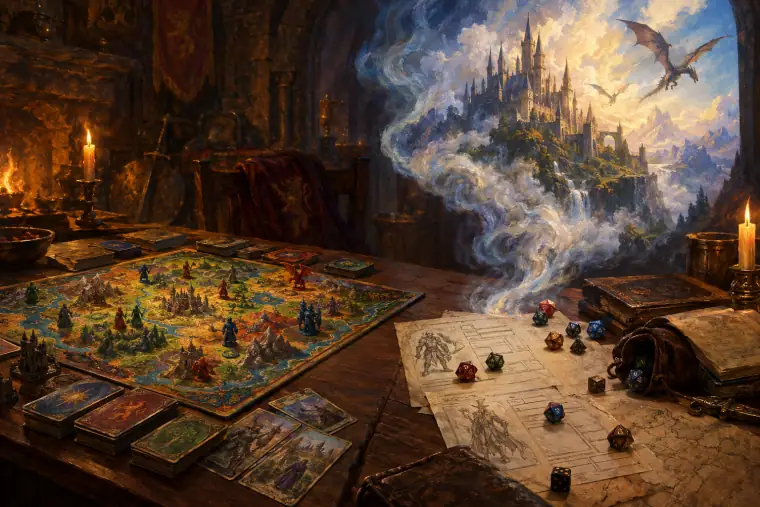
The tactical RPG reunited role-playing with its miniature-wargame roots, gave both Japanese consoles and Western PCs one of their most durable genres, and shaped how modern CRPGs from XCOM to Baldur's Gate 3 stage combat.
Hallmarks
- Battles fought on a grid or map, where position, terrain and facing matter
- Individual units that level up, specialize and persist from battle to battle
- Turn-based phases or speed-ordered initiative rather than menu tableaux
- Losses that stick: fallen units may be gone for good
- A campaign that alternates story, recruitment and set-piece battles
- Class or job systems that turn army-building into a puzzle
What it is
A tactical RPG, also called a strategy RPG and in Japan a "simulation RPG," is a role-playing game whose battles are fought as small-scale war games. Instead of lining the party up for an exchange of menu commands, the player moves each character across a map of squares or hexes, weighing reach, terrain, height, flanking and the enemy's next turn. Around those battles sits a role-playing campaign: named characters with personalities and classes, Experience points earned in the field, equipment to buy, recruits to court, and a story that carries the army from one engagement to the next.
The genre's emotional engine is persistence. A soldier who survives ten battles becomes a veteran the player knows by name, and in many tactical RPGs a soldier who falls is gone for good. That combination of the wargamer's board and the role-player's attachment is what the form is about.
Origins
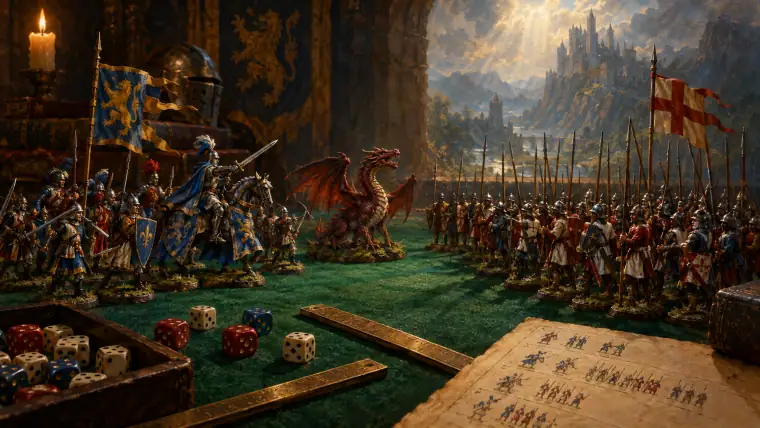
In a sense the tactical RPG is a homecoming. Role-playing itself grew out of miniature wargames such as Chainmail, where individual figures maneuvered on a tabletop, and early Dungeons & Dragons combat was often played with miniatures on a grid. Computer designers rediscovered that lineage separately on both sides of the Pacific.
In Japan the precursors came early. Koei's The Dragon and Princess (1982) cut from exploration to a tactical battle screen after random encounters, and Koji Sumii's Bokosuka Wars (1983), for the Sharp X1, blended strategy and role-playing so directly that it is credited with laying the genre's foundations. Kure Software Koubou's Silver Ghost (1988) added more tactical depth on the PC-8801.
The form was codified by Shouzou Kaga and Intelligent Systems with Fire Emblem: Shadow Dragon and the Blade of Light, released by Nintendo for the Famicom on April 20, 1990. Prince Marth's army crossed a grid map turn by turn, each unit a distinct character, and anyone who fell in battle stayed dead. Sales were slow until word of mouth spread, but the game set the template that Japanese tactical RPGs still follow.
In the West the parallel root was the PC war game and the licensed D&D game. SSI, a wargame publisher, built Pool of Radiance (1988) around a turn-based combat grid for its Gold Box engine, and Julian Gollop, designer of Rebelstar and Laser Squad (1988), led the design of Mythos Games' UFO: Enemy Unknown, sold in North America as X-COM: UFO Defense (1994). Its soldiers grew stronger through use and, once killed, were replaced with raw recruits, so every mission carried the weight of Permadeath.
Evolution
The 16-bit and 32-bit consoles made Japan the genre's heartland. Sega's Shining Force (1992) gave it a warmer, more console-RPG feel; Quest's Ogre Battle: March of the Black Queen (1993) and Tactics Ogre: Let Us Cling Together (1995) added moral alignment, branching politics and isometric terrain. Yasumi Matsuno then took Quest veterans to Square for Final Fantasy Tactics (1997): three-dimensional isometric battlefields, a deep job system, a speed-driven "Charge Time" initiative, and a story of class war in the kingdom of Ivalice. It sold almost 1.24 million copies in Japan in 1997 and is widely credited with bringing the genre to North American players. Nippon Ichi's Disgaea series later built a devoted Western following on outsized numbers and comic excess.
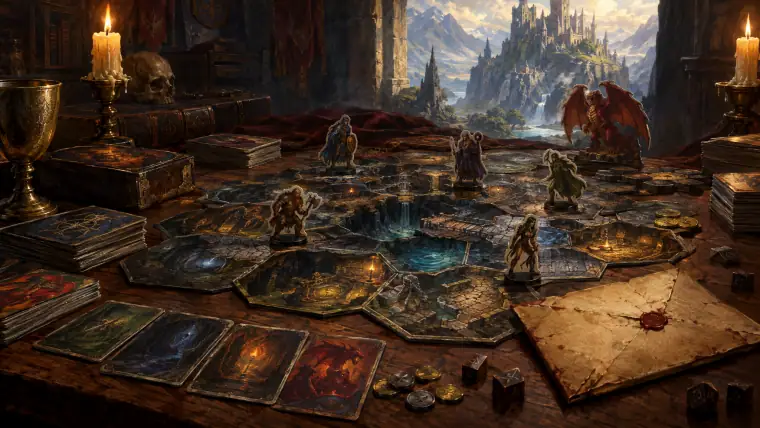
Western PC design took a sterner path. The X-COM line, Sir-Tech's Jagged Alliance (1995) and Jagged Alliance 2 (1999), and Firaxis's 2012 XCOM reboot kept squad tactics, fog of war and loss at the center. Hybrid forms spread: Heroes of Might and Magic (1995) paired map-conquering strategy with RPG heroes; Red Hook's Darkest Dungeon (2016) made stress and madness part of squad management. Most strikingly, turn-based tactical combat moved back into the heart of the Western Western Computer RPGs (CRPG). Larian's Divinity: Original Sin II (2017) and Baldur's Gate 3 (2023) are full CRPGs whose battles play like tactical RPGs, with elevation, surfaces and positioning deciding fights. The circle closed on the tabletop too: Gloomhaven (2017) brought campaign-driven tactical combat back to cardboard.
How to tell it apart
Versus the JRPG. A classic Japanese RPGs (JRPG) battle is a tableau: two lines of combatants trading commands, with no meaningful space between them. A tactical RPG's battle is a map, and where a unit stands matters as much as what it does. JRPGs usually field a small, story-fixed party; tactical RPGs field an army, with more characters than any one battle can use.
Versus the CRPG. A Western Computer RPGs (CRPG) may include tactical combat, as the Gold Box games and Baldur's Gate 3 do, but it wraps that combat in exploration, dialogue and free roaming. A pure tactical RPG is structured as a sequence of battles, with the campaign between them reduced to menus, cutscenes and preparation. Games like Baldur's Gate 3 sit on the border; Final Fantasy Tactics sits squarely inside.
Versus the strategy game and wargame. In a Miniatures & Board Wargames or real-time strategy game, units are expendable counters and the player commands an economy. In a tactical RPG, units are people: they have names, histories and growth, and losing one hurts.
Where to start
- Fire Emblem, ideally a modern entry such as Three Houses (2019), for the Japanese template.
- Final Fantasy Tactics (1997) or its remasters, for the genre at its most ambitious.
- Tactics Ogre: Let Us Cling Together (1995), for branching war-torn politics.
- X-COM: UFO Defense (1994) or XCOM: Enemy Unknown (2012), for the Western squad tradition.
- Divinity: Original Sin II (2017) or Baldur's Gate 3 (2023), for tactical combat inside a full CRPG.
Marginalia
- In Japan the genre is usually called the 'simulation RPG,' abbreviated SRPG.
- Koji Sumii's Bokosuka Wars (1983) is credited with laying the foundations of the genre.
- Fire Emblem (1990) made fallen units stay dead, a rule the series kept as its signature.
- Final Fantasy Tactics sold almost 1.24 million copies in Japan in 1997 and passed 2.4 million worldwide on PlayStation by 2011.
- Its director, Yasumi Matsuno, had come from Quest, where he created the Ogre Battle series.
- In X-COM: UFO Defense (1994), veteran soldiers improved with use and, once killed, were replaced with raw recruits.
- SSI's Pool of Radiance (1988) brought grid-based tactical combat to licensed D&D on home computers.
Quick answers
- What is Tactical & Strategy RPGs?
- The RPG played as a war game: named heroes who grow, die and are remembered, moved square by square across a battlefield where every step and every flank counts.
- What are the hallmarks of Tactical & Strategy RPGs?
- Battles fought on a grid or map, where position, terrain and facing matter; Individual units that level up, specialize and persist from battle to battle; Turn-based phases or speed-ordered initiative rather than menu tableaux; Losses that stick: fallen units may be gone for good; A campaign that alternates story, recruitment and set-piece battles; Class or job systems that turn army-building into a puzzle.
- When did Tactical & Strategy RPGs emerge?
- Precursors 1982–88; codified by Fire Emblem, 1990.
- Where does the name “Tactical & Strategy RPGs” come from?
- Known in Japan as the 'simulation RPG' (SRPG); 'tactical RPG' and 'strategy RPG' are the usual English labels.
- What are the key works of Tactical & Strategy RPGs?
- Fire Emblem: Shadow Dragon and the Blade of Light, Pool of Radiance, Heroes of Might and Magic, Darkest Dungeon, Divinity: Original Sin II, Baldur's Gate 3 and Gloomhaven.