Pool of Radiance put official AD&D on home computers, launched the 'Gold Box' engine behind a dozen SSI role-playing games and AOL's pioneering graphical online RPG, and set the template that Baldur's Gate would inherit a decade later.
Overview
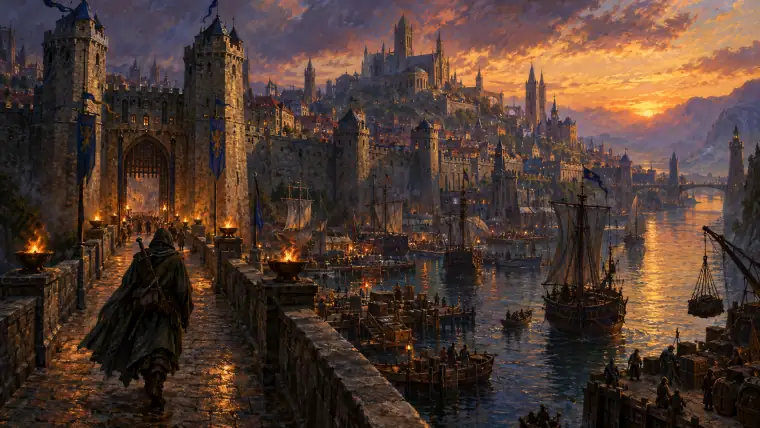
Pool of Radiance is a computer role-playing game developed and published by Strategic Simulations, Inc. (SSI) in June 1988 for the Apple II, Commodore 64 and IBM PC compatibles. It was the first role-playing game to bring the rules of TSR's Advanced Dungeons & Dragons to home computers, and it is set in the Forgotten Realms, in the ruined port city of Phlan on the shore of the Moonsea.
The game gave its name to nothing, and yet its box gave its name to an era. Its engine went on to drive a whole run of SSI titles sold in gold-colored packaging — the "Gold Box" games — and those games, more than any other, taught a generation of players what Armor Class, THAC0, saving throws and memorized spells felt like on a screen.
Origins
In the mid-1980s, having watched the success of Ultima and other computer RPGs, TSR offered the AD&D license to the software industry. Ten companies applied, among them Electronic Arts, Origin Systems and Sierra. SSI, a publisher of computer wargames led by Joel Billings, was smaller and less technically advanced than its rivals, but it won the license in 1987 on the strength of its wargaming pedigree and a pitch for several linked series of games rather than a single quick release. SSI's in-house development staff grew from seven to about 25, including its first full-time computer artists.
TSR took an unusually direct hand. Its own designers — Jim Ward, David "Zeb" Cook, Steve Winter and Mike Breault — wrote the scenario, and a corner of the Realms around Phlan was set aside for SSI. SSI's Special Projects team, led by Chuck Kroegel with George MacDonald as developer, built the engine, taking as its starting point the detailed tactical combat of SSI's earlier Wizard's Crown. Keith Brors and Brad Myers did the original programming on the Apple II and Commodore 64, writing in 6502 assembly for machines with roughly 64 KB of memory. Monster images were adapted straight from the Monster Manual, and the team also worked from Unearthed Arcana and Monster Manual II. The project took about a year and some thirty-five people. The same year, TSR released the tabletop module Ruins of Adventure, which uses the same scenario, plot and characters.
How it plays
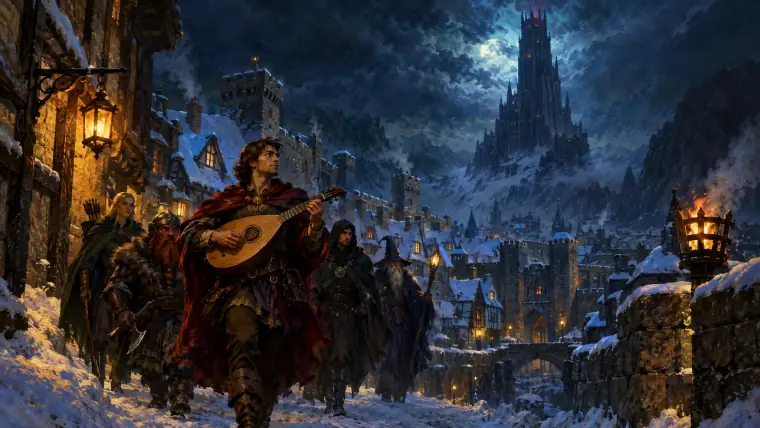
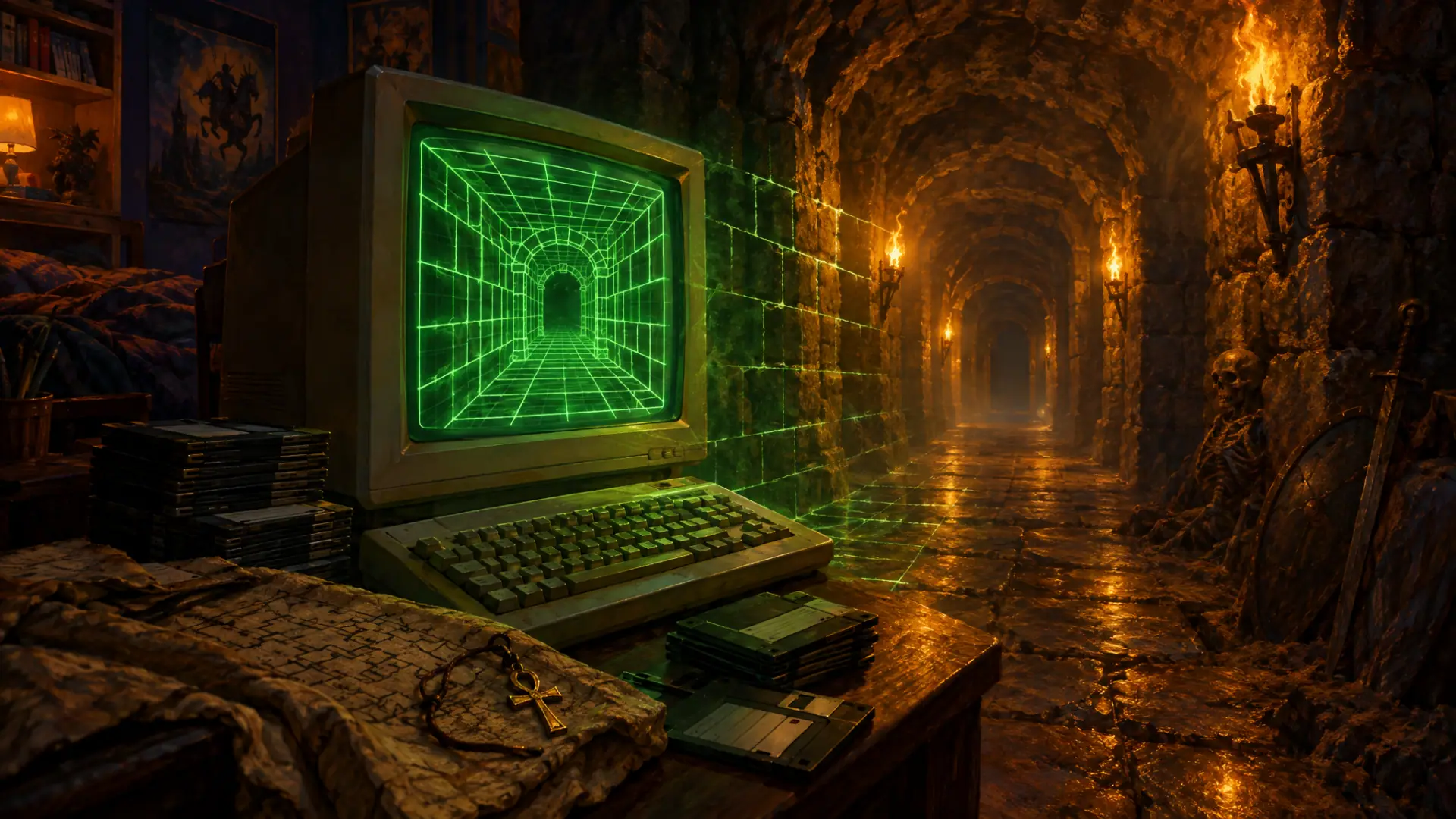
The player rolls up a The party of up to six adventurers, choosing race, sex, class (fighter, cleric, magic-user or thief) and Alignment, with two more slots open for hired NPCs. Non-humans may multi-class. Exploration is shown in a small first-person window in the corner of the screen, in the manner of The Bard's Tale and Might and Magic, surrounded by text and party status.
When a fight begins, the view switches to a top-down tactical map where each character is an icon the player moves and commands round by round. This was the heart of the game: fighters gain extra attacks and can "sweep" through weak foes, thieves back-stab from the right position, and spellcasters must rest and re-memorize their spells each day, a nightly chore that also heals the party. A character who falls below zero hit points must be bandaged by a companion or die. Random encounters follow the patterns of the tabletop encounter tables.
The story is municipal as much as heroic. New Phlan's council hires adventurers to clear the ruins block by block — the slums, Sokol Keep and its undead on Thorn Island — and the campaign spreads out to the wider Moonsea until the party learns that an evil spirit, Tyranthraxus, possessing an ancient dragon, commands the monsters. Copy protection took the form of a code wheel translating Elvish and Dwarvish runes, which also served in some puzzles, and a printed Adventurer's Journal held the clues and flavor text the disks had no room for.
Reception & impact
Pool of Radiance sold 264,536 computer copies in North America, about three times SSI's AD&D action game Heroes of the Lance from the same year, and became by far the company's best-selling game. It won the Origins Award for Best Fantasy or Science Fiction Computer Game of 1988, and Dragon magazine's readers voted it best fantasy role-playing game in the 1989 Beastie Awards, ahead of Ultima V. Critics were not unanimous: Computer Gaming World's preview noted a "sense of deja vu" in a screen that borrowed from several rivals, and reviewers including Scorpia disliked the sheer amount of combat. Ken St. Andre, creator of Tunnels & Trolls, recommended it anyway. Later ports reached the Macintosh (1989), the Amiga (1990), Japan's PC-98 and, in April 1992, the NES.
Legacy
The four-part Forgotten Realms saga continued with Curse of the Azure Bonds (1989), Secret of the Silver Blades (1990) and Pools of Darkness (1991), with characters transferable from game to game. The engine spread to Dragonlance (Champions of Krynn, 1990, and two sequels), to the Savage Frontier games made by Beyond Software (later Stormfront Studios), to two Buck Rogers titles and to Spelljammer. By one count SSI released eleven Gold Box games in four years — a pace that, with an aging engine, wore sales down — capped in 1993 by Forgotten Realms: Unlimited Adventures, a construction kit that let players build their own. The engine also went online: Neverwinter Nights on AOL (1991) was a multiplayer Gold Box game and is often called the first graphical MMORPG.
By then the aging engine had worn thin, and SSI's later AD&D work, including the Westwood-developed Eye of the Beholder, moved in new directions. But the Gold Box idea — faithful D&D rules, a party of six, tactical fights in the Forgotten Realms — resurfaced in BioWare's Baldur's Gate (1998) and lives on in Baldur's Gate 3. The games were re-released on GOG in 2015 and on Steam in 2022.
Marginalia
- SSI, a wargame publisher far smaller than rival bidders such as Electronic Arts and Origin, won TSR's AD&D computer license in 1987.
- SSI sold 264,536 computer copies in North America — its biggest hit to that point; even the hint book outsold every earlier SSI game.
- The copy protection was a two-layer code wheel translating Elvish (Espruar) and Dwarvish (Dethek) runes into English.
- TSR published a tabletop module, Ruins of Adventure (1988), built on the same Phlan scenario, plot and characters.
- It won the Origins Award for Best Fantasy or Science Fiction Computer Game of 1988.
- Tunnels & Trolls designer Ken St. Andre reviewed it for Computer Gaming World and recommended it despite disliking the D&D system.
- The 'Gold Box' nickname comes from the gold-colored boxes most of the series shipped in.
Quick answers
- When was Pool of Radiance first released?
- Pool of Radiance was first released in 1988 (Apple II, Commodore 64, MS-DOS); Gold Box series 1988–1993.
- Who published or developed Pool of Radiance?
- Strategic Simulations, Inc. (SSI) and TSR, Inc..
- What kind of work is Pool of Radiance?
- Pool of Radiance is a computer RPG in the Western Computer RPGs (CRPG) tradition, released for Apple II, Commodore 64, MS-DOS, Macintosh, Amiga, PC-98 and NES.
- Why is Pool of Radiance important?
- Pool of Radiance put official AD&D on home computers, launched the 'Gold Box' engine behind a dozen SSI role-playing games and AOL's pioneering graphical online RPG, and set the template that Baldur's Gate would inherit a decade later.