The blobber turned the tabletop dungeon crawl into the first great computer RPG form. Through Wizardry it also shaped Japan's console RPGs, and it has never quite died.
Hallmarks
- A first-person view down corridors, moving square by square and turning in 90-degree steps
- A party of adventurers moved as a single unit, the 'blob'
- Grid-based mazes built to be mapped, traditionally on graph paper
- Traps, spinners, teleporters, dark zones and secret doors as puzzles
- Attrition: spells, food, light and hit points drain on the way down
- Combat either turn-based through menus or in real time, step by step
What it is
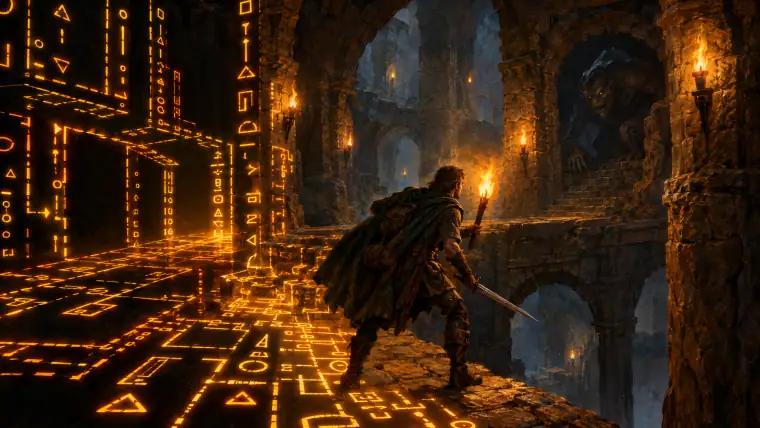
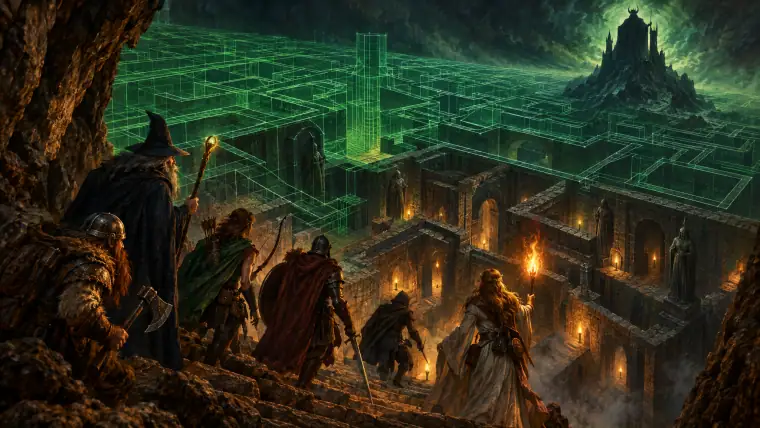
The first-person dungeon crawler shows the world through the party's eyes: a corridor drawn in perspective, a door ahead, a message that something approaches. You move one square at a time and turn in quarter-circles. The whole party, usually four to six characters, occupies a single square and moves as one unit. That is why fans call these games blobbers. The heart of the form is the Dungeon crawl inherited from tabletop Dungeons & Dragons: descend, map, survive, return richer. Its pleasures are cartographic and logistical. You chart the maze, ration spells and light, learn which corridor holds the teleport trap, and inch a little deeper each time.
Origins
The form was invented on the PLATO network at the University of Illinois. The first PLATO dungeons, pedit5 and dnd (1975), were drawn from above. Moria (begun 1975–76, and unrelated to the later roguelike of that name) put players into a first-person wireframe maze. Jim Schwaiger's Oubliette (1977) made the dungeon so dangerous that players had to band together. Avatar (1979) turned that into a cooperative multiplayer crawl that logged more than a million hours.
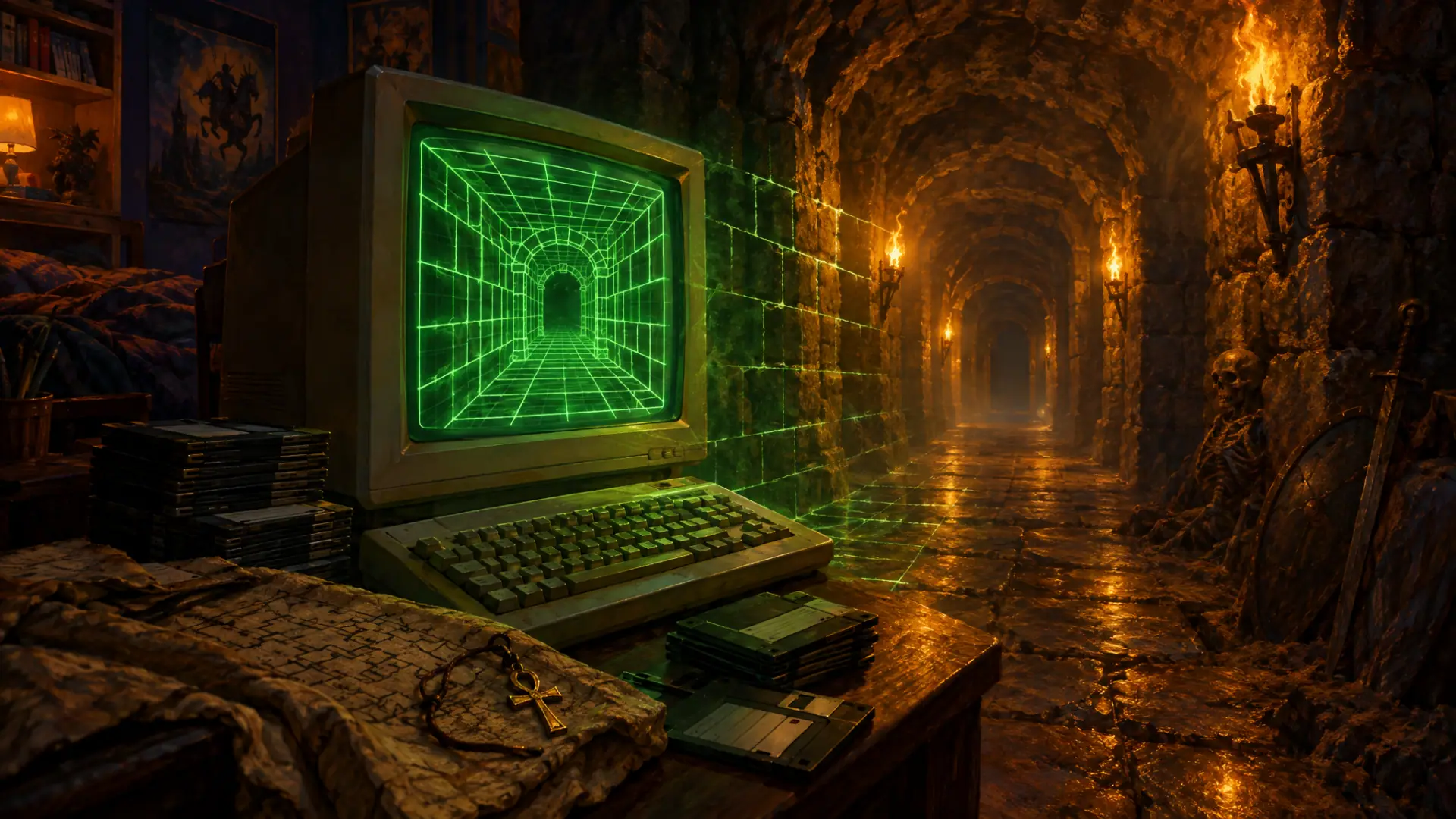
Robert Woodhead was a PLATO alumnus. With Andrew Greenberg he carried the idea to the Apple II as Wizardry: Proving Grounds of the Mad Overlord (1981), published by Sir-Tech. It had six characters, ten levels, menu-driven combat and no automap; the box included graph paper. Wizardry became the model for a generation.
Evolution
The 1980s were the blobber's golden decade. Interplay's The Bard's Tale (1985), designed by Michael Cranford and produced by Brian Fargo, added color, animated monsters and music, and, published by Electronic Arts, it became by one count the best-selling computer RPG of the 1980s, at some 407,000 copies. Jon Van Caneghem's Might and Magic (1986) extended the step-and-turn view from dungeons to a whole outdoor world. In Japan, Henk Rogers's The Black Onyx (1984) brought the same first-person party formula to Japanese computers.
Japan took the form more seriously than America did. Wizardry was ported to Japanese home computers such as the PC-88 and PC-98, and a Famicom version followed in 1987. Japanese studios went on producing Wizardry spin-offs long after the American series ended with Wizardry 8 in 2001. Yuji Horii and Koichi Nakamura built Dragon Quest (1986) by pairing Wizardry's menu combat with Ultima's overhead world. As a result, the turn-based battle screen of the JRPG is, at root, a blobber fight. The monsters face you, your party is implied, and you choose commands from a list.
The craft of a good blobber lies in its level design. The genre developed a vocabulary of spinners that silently turn the party around, teleporters, one-way doors, anti-magic zones and pitch-dark squares. Each one is designed to break the map a careful player is drawing. The mazes of the first Wizardry were each laid out on a 20-by-20 grid, which is why the box shipped with graph paper.
In 1987 FTL's Dungeon Master kept the grid but made the world run in real time. You grabbed objects with the mouse and drew spells from runes while monsters advanced. Westwood's Eye of the Beholder (1991) brought that model to the IBM PC under the AD&D license. The next year, Ultima Underworld (1992) abandoned the grid entirely for free, texture-mapped 3D movement. That change opened the road to the first-person immersive sim and to Bethesda's Elder Scrolls, and it largely ended the blobber's commercial reign.
The form survived in niches. In Japan, Wizardry: Proving Grounds of the Mad Overlord spin-offs and Atlus's Etrian Odyssey (2007) kept it alive; Etrian Odyssey revived hand-mapping on the Nintendo DS touch screen. In the West, the Finnish studio Almost Human's Legend of Grimrock (2012) proved that a faithful real-time grid crawl could still find an audience. In 2024, Digital Eclipse remade Wizardry in 3D.
How to tell it apart
Blobber vs. party-based isometric CRPG. Both are CRPGs about a The party. In a blobber the party is one token, seen from inside, and positioning means front rank and back rank. In Baldur's Gate or Pool of Radiance's tactical combat, each character is a separate figure on a map you view from above, and flanking, spacing and area spells matter.
Blobber vs. Roguelikes. A roguelike is usually a single character, seen from above, in a procedurally generated dungeon with Permadeath. The classic blobber is a party in a hand-built maze meant to be learned and mapped.
Blobber vs. action dungeon crawler. Gauntlet (1985) and Diablo (1996) are dungeon crawls too, but they are overhead, real-time and reflex-driven. They belong to the Action RPGs & Hack-and-Slash.
Blobber vs. board game. The Dungeon-Crawler Board Games, from Dungeon! (1975) to Gloomhaven, plays the same fantasy on a table with miniatures and cards, not a screen.
The label "dungeon crawler" is itself slippery. It can mean the tabletop scenario, any maze-focused game, or, as here, this specific first-person party form.
Where to start
- Wizardry (1981): the source, now accessible through the 2024 remake.
- The Bard's Tale (1985): the most popular blobber of its decade.
- Dungeon Master (1987): the real-time revolution.
- Eye of the Beholder (1991): the AD&D crawl beneath Waterdeep.
- Etrian Odyssey (2007) and Legend of Grimrock (2012): the modern revival, Eastern and Western.
Marginalia
- 'Blobber' comes from the way the whole party moves around the map as one unit, or 'blob'.
- Wizardry's box included graph paper, because the game had no automap and every 20-by-20 level had to be charted by hand.
- Oubliette's designer later said he 'could not find any meaningful difference' between Wizardry and his 1977 PLATO game.
- Dungeon Master (1987) made the crawl run in real time and became the best-selling game ever released for the Atari ST.
- The Bard's Tale made players type four-letter spell codes printed only in the manual.
- Etrian Odyssey (2007) made players draw their own maps again, this time on the Nintendo DS's touch screen.
- Legend of Grimrock (2012), a Dungeon Master homage, was the self-funded debut of a four-person Finnish studio.
Quick answers
- What is First-Person Dungeon Crawlers ('Blobbers')?
- Six adventurers, one square at a time, down a wireframe corridor toward something breathing in the dark: the first-person party crawl that players nicknamed the 'blobber'.
- What are the hallmarks of First-Person Dungeon Crawlers ('Blobbers')?
- A first-person view down corridors, moving square by square and turning in 90-degree steps; A party of adventurers moved as a single unit, the 'blob'; Grid-based mazes built to be mapped, traditionally on graph paper; Traps, spinners, teleporters, dark zones and secret doors as puzzles; Attrition: spells, food, light and hit points drain on the way down; Combat either turn-based through menus or in real time, step by step.
- When did First-Person Dungeon Crawlers ('Blobbers') emerge?
- PLATO's Moria (1975) and Oubliette (1977); Wizardry (1981).
- What are the key works of First-Person Dungeon Crawlers ('Blobbers')?
- Avatar, Wizardry: Proving Grounds of the Mad Overlord, The Black Onyx, The Bard's Tale, Might and Magic Book One, Dungeon Master, Eye of the Beholder and Ultima Underworld: The Stygian Abyss.