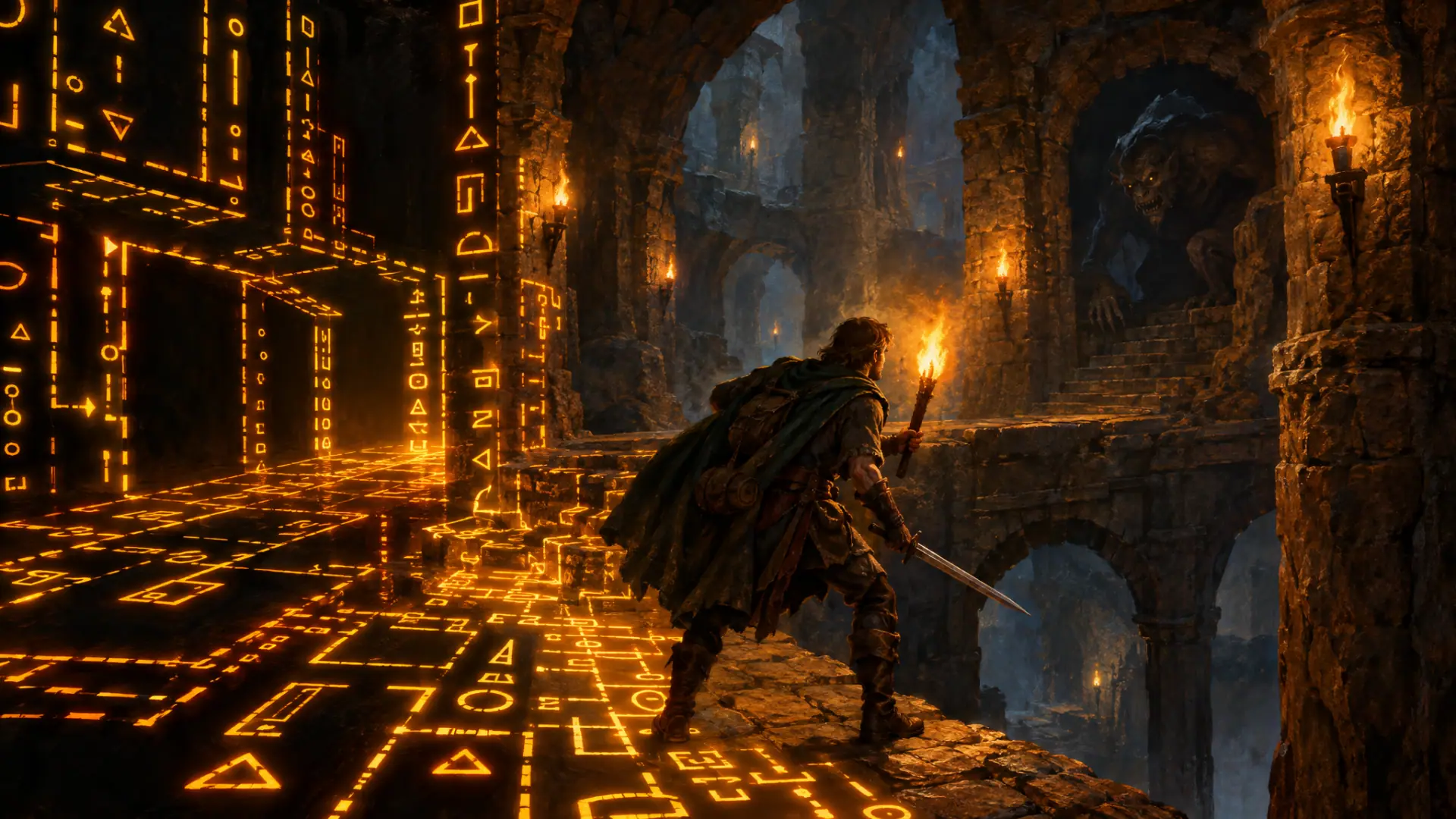
Rogue combined procedural generation, permanent death and turn-based tactical play so compellingly that its descendants are simply called roguelikes, a lineage that runs from Hack and NetHack to Diablo and the modern roguelite.
Overview
A screen of dots, dashes and pound signs; a lone @; a capital K in the corner of a room. In Rogue, created around 1980 by Michael Toy and Glenn Wichman at the University of California, Santa Cruz, the player descends through the Dungeons of Doom, fighting monsters, quaffing unidentified potions and reading unknown scrolls, in search of the Amulet of Yendor at the bottom. Every level is generated anew, every item's nature must be discovered, and death is final. It became a fixture on university Unix systems in the early 1980s, and it gave its name to the Roguelikes, one of the longest-lived genres in games.
Origins
Toy had learned to program by recreating the text-based Star Trek game on whatever machines he could reach, and at UCSC he discovered Colossal Cave Adventure over the ARPANET. There he met Wichman, who had come to Santa Cruz to study game design and had grown up inventing variants of Dungeons & Dragons. The two became roommates and traded homemade adventure games, and both were frustrated that adventures played the same way every time.
The solution arrived with the curses library by Ken Arnold, distributed with Berkeley Unix, which let a program place characters anywhere on a terminal screen. Toy and Wichman realized they could draw a dungeon. Toy, the stronger coder, wrote the game in C; Wichman, the stronger designer, shaped it and named it Rogue, because unlike a D&D party, the hero goes alone. They settled on ASCII symbols: . for floor, + for doors, | and - for walls, and @ for the player, showing where you are "at." Purely random layouts sometimes stranded staircases in unreachable rooms, so they built levels on a three-by-three grid of rooms joined by corridors. Items appeared under descriptions like colors until identified.
Toy later moved to UC Berkeley, where Arnold, frustrated by how inefficiently the game redrew the screen over a modem, joined in to improve both display and generation. Rogue spread through the Berkeley Software Distribution, notably 4.2BSD in 1983, across campuses and research labs, including Bell Labs, where Unix co-creator Ken Thompson was a fan.
How it plays
Rogue is turn-based: nothing moves until you do, so every step can be a considered decision. Twenty-six monster types, one for each capital letter from Aquator to Zombie, grow deadlier with depth. Food runs out, rings and wands must be tested, and a scroll read carelessly might teleport you into danger or curse your armor. You cannot return upward until you hold the Amulet.
Permanent death came from playtesting. The designers wanted players to focus on surviving each moment rather than memorizing a solution. When testers began reloading saved games after every disaster, which the community would come to call save scumming, Toy and Wichman made the save file erase itself when loaded. A high-score table rewarded players for diving deep and returning alive.
Reception & impact
In 1984, around when Toy and Olivetti colleague Jon Lane formed A.I. Design to sell an IBM PC version, Jerry Pournelle made it his Byte "game of the month," calling it "a real time trap." Epyx then funded Macintosh, Amiga, Atari ST and other ports, with Wichman returning to create the graphics. Commercially, however, it flopped: the game had been free on Unix for years, and Epyx pushed it through catalogs rather than stores. Epyx went bankrupt in 1989, and none of the four principal authors grew rich from Rogue.
Its reach was elsewhere. In 1981 four Carnegie Mellon graduate students built Rog-O-Matic, an expert system that played the game and in one 1983 test outscored the university's best human players; it remains a landmark in game-playing AI. The source code was released under a BSD license with 4.3BSD in 1986.
Legacy
Because the original code was closed for years, fans rebuilt the game from scratch, and these reconstructions multiplied: Hack (1982), Moria (1983), and in 1987 NetHack, still developed decades later, followed by Angband and many more. The family's shared traits of procedurally generated dungeons, permadeath, turn-based tactics and hidden item identities came to define the "roguelike," and the @ became its signature. Diablo (1996) began life as a turn-based design in this tradition before becoming real-time, carrying randomized dungeons and loot to millions. Since 2000, games such as Spelunky and The Binding of Isaac have borrowed its permadeath and generation for new forms, often called roguelites. In 2009 PC World ranked Rogue sixth among the greatest PC games, and in 2016 Toy, Wichman and Arnold appeared on stage together for the first time in 30 years at the Roguelike Celebration in San Francisco.
Marginalia
- The Amulet of Yendor is named for 'Rodney' spelled backwards.
- The player is an @ sign because it shows where you're 'at.'
- Each level is built on a three-by-three grid of possible rooms, like a tic-tac-toe board.
- Its creators made save files delete themselves on loading to stop players from 'save scumming.'
- Its movement keys h, j, k and l are borrowed from the vi text editor.
- Dennis Ritchie reportedly joked that Rogue was 'the biggest waste of CPU cycles in history.'
- Rog-O-Matic, a 1981 Carnegie Mellon expert system, learned to beat Rogue and once reached the Amulet on level 26.
Quick answers
- When was Rogue first released?
- Rogue was first released in c. 1980 (Unix); commercial ports 1983–88.
- Who created Rogue?
- Rogue was made by Michael Toy (co-creator & lead programmer) and Glenn Wichman (co-creator & designer).
- What kind of work is Rogue?
- Rogue is a roguelike in the Roguelikes and First-Person Dungeon Crawlers ('Blobbers') tradition, released for Unix (BSD), IBM PC, Macintosh, Amiga, Atari ST, TRS-80 Color Computer, Commodore 64, ZX Spectrum, Amstrad CPC and Nintendo Switch (2024).
- Why is Rogue important?
- Rogue combined procedural generation, permanent death and turn-based tactical play so compellingly that its descendants are simply called roguelikes, a lineage that runs from Hack and NetHack to Diablo and the modern roguelite.