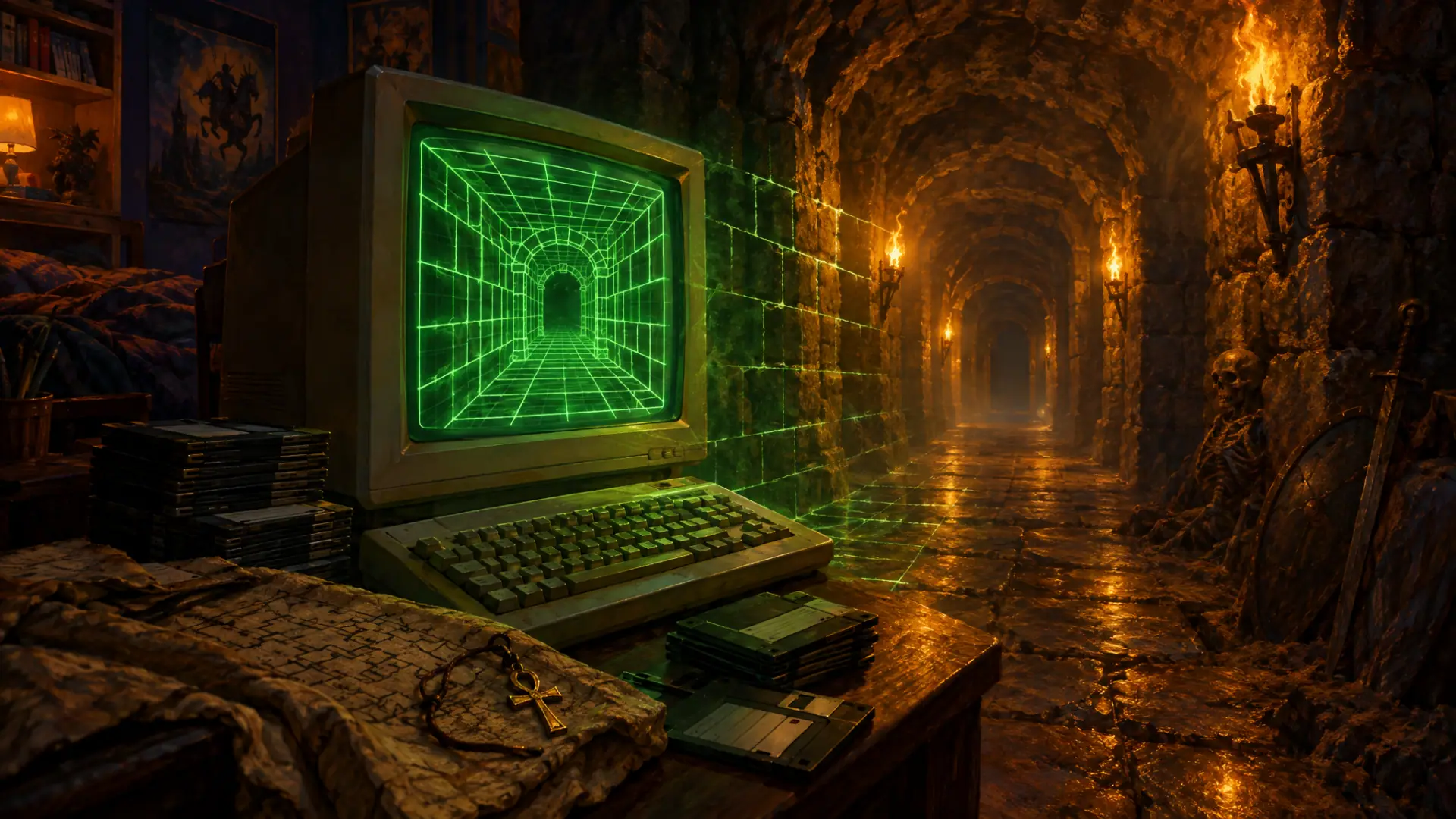
Crowther's 1975–76 program fused real cave geography with the Dungeons & Dragons games he played, creating the first widely known work of interactive fiction and a direct ancestor of Zork, Rogue, MUD1 and the computer RPG.
Magic words should look queer, and yet somehow be pronounceable.
Life
William Crowther was born in 1936 and studied physics at the Massachusetts Institute of Technology, graduating with a B.S. in 1958. At MIT he met and married Patricia Crowther, and joined the MIT Outing Club, whose members were then pushing new routes up the cliffs of the Shawangunks in New York State. Crowther became a notable figure in that climbing scene and is credited with first ascents of several classic routes; he would keep climbing, and teaching beginners with the Appalachian Mountain Club, for decades.
His day job placed him at the birth of the Internet. In the early 1970s he worked at Bolt Beranek and Newman (BBN) in Cambridge, Massachusetts, on the small team that built the Interface Message Processors for the ARPANET, where his work on distributed routing was an important early step in how networks pass messages. In his spare time he and Pat were dedicated cavers with the Cave Research Foundation, mapping Kentucky's Mammoth Cave system. Pat played a key role in the September 1972 expedition that finally connected Mammoth Cave to the Flint Ridge system, and the couple fed their survey data from "muddy little books" into a teletype at home, producing some of the earliest computer-drawn cave maps.
Work
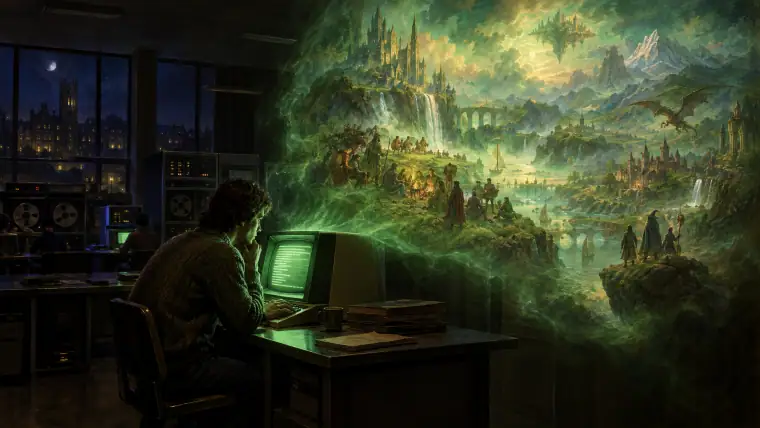
In 1975 the Crowthers divorced, and the caving stopped. Crowther later explained that he missed his daughters, Sandy and Laura, and missed the caves, and that he had also been playing Dungeons & Dragons with friends. So he wrote a program that combined all three: a re-creation "in fantasy" of his caving, a game the girls could enjoy on visits, and a taste of the tabletop sessions he loved. Working in Fortran on BBN's PDP-10, he modeled the underground on a 1975 map of Mammoth's Bedquilt section, including Colossal Cavern, and added a handful of fantasy touches: a crystal bridge, magic words, and axe-throwing dwarves.
His most consequential decision was about the interface. Crowther wanted a game that would not intimidate non-programmers, so instead of formal commands the player typed short English phrases such as GET LAMP or GO NORTH, and the program replied like a wry narrator, much as a Dungeon Master would at the table. The first version, finished in early 1976, had about 700 lines of code and 700 lines of data. Crowther showed it to colleagues, considered it done, and left on a month's vacation; while he was away the game escaped across the ARPANET to universities and companies around the country.
That is how Don Woods, a Stanford graduate student, found it. Woods tracked Crowther down, received his blessing, and in 1977 expanded the game into the 350-point Colossal Cave Adventure that most players came to know. Crowther later said that Woods's fantasy additions improved the game, though his daughters remember him blaming Woods for the puzzles that frustrated them. In 1976 Crowther moved to Xerox PARC, returned to BBN in 1983, and later worked for Cisco after it bought the part of BBN where he worked. He married his second wife, Nancy, in 1980, and eventually settled in upstate New York.
Legacy
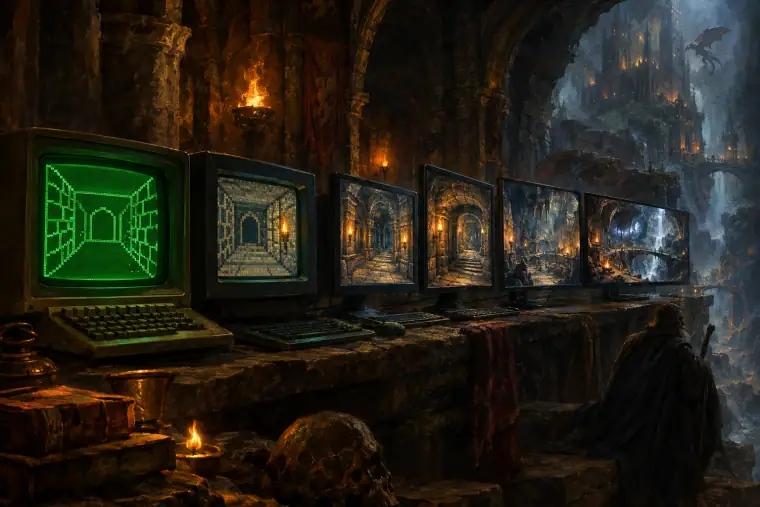
Adventure is the ancestor of whole families of games. Its two-word parser and room-by-room world inspired Zork at MIT, Scott Adams's Adventureland, and Ken and Roberta Williams's Mystery House; the Interactive Fiction & Text Adventures tradition descends directly from it. Its treasure-hunting underworld, wandering monsters and inventory puzzles fed Rogue, whose authors named it as an influence, and MUD1, whose creator was inspired by the Dungeon variant of Zork. Historians of the Western Computer RPGs (CRPG) such as Matt Barton count it as a precursor of the genre for showing how a computer could build a virtual world and let a player explore it. In 2019 the game was inducted into the World Video Game Hall of Fame at The Strong museum.
Crowther never sought fame from it and received almost no money; he and Woods accepted only a nominal payment from The Software Toolworks for endorsing its 1981 commercial release. His legacy is double. As one of the engineers who helped build the ARPANET, he helped create the network that carried his game; as a caver who wanted to share a place he loved with his children, he gave that network one of its first great pieces of shared culture. The phrase from his maze, "You are in a maze of twisty little passages, all alike," is still quoted by programmers who have never seen the cave it describes.
Marginalia
- Crowther was part of the small Bolt Beranek and Newman team that built the ARPANET's Interface Message Processors, the routers of the early Internet.
- He wrote Adventure partly for his two daughters after his divorce, recreating the Bedquilt section of Kentucky's Mammoth Cave in Fortran on a PDP-10.
- His original version ran to roughly 700 lines of code plus 700 lines of data describing 66 rooms and a 193-word vocabulary.
- The magic word XYZZY, added at his sister's request as a shortcut, became a hacker in-joke hidden in countless later programs.
- Crowther's own source code was thought lost until 2005, when it turned up in backups of Don Woods's Stanford account.
- His first wife, Patricia Crowther, helped make the 1972 connection between the Mammoth and Flint Ridge cave systems.
Quick answers
- Who is Will Crowther?
- The BBN network engineer and Kentucky caver who turned his survey maps of Mammoth Cave into Colossal Cave Adventure, the text game that invented the adventure genre and seeded the computer RPG.
- When was Will Crowther born?
- Will Crowther was born in 1936.
- What is Will Crowther known for?
- Will Crowther is best known for Colossal Cave Adventure.
- Why does Will Crowther matter to fantasy and games?
- Crowther's 1975–76 program fused real cave geography with the Dungeons & Dragons games he played, creating the first widely known work of interactive fiction and a direct ancestor of Zork, Rogue, MUD1 and the computer RPG.