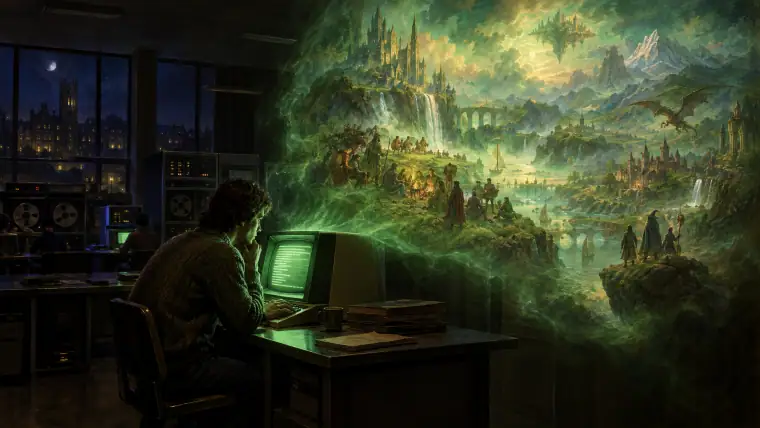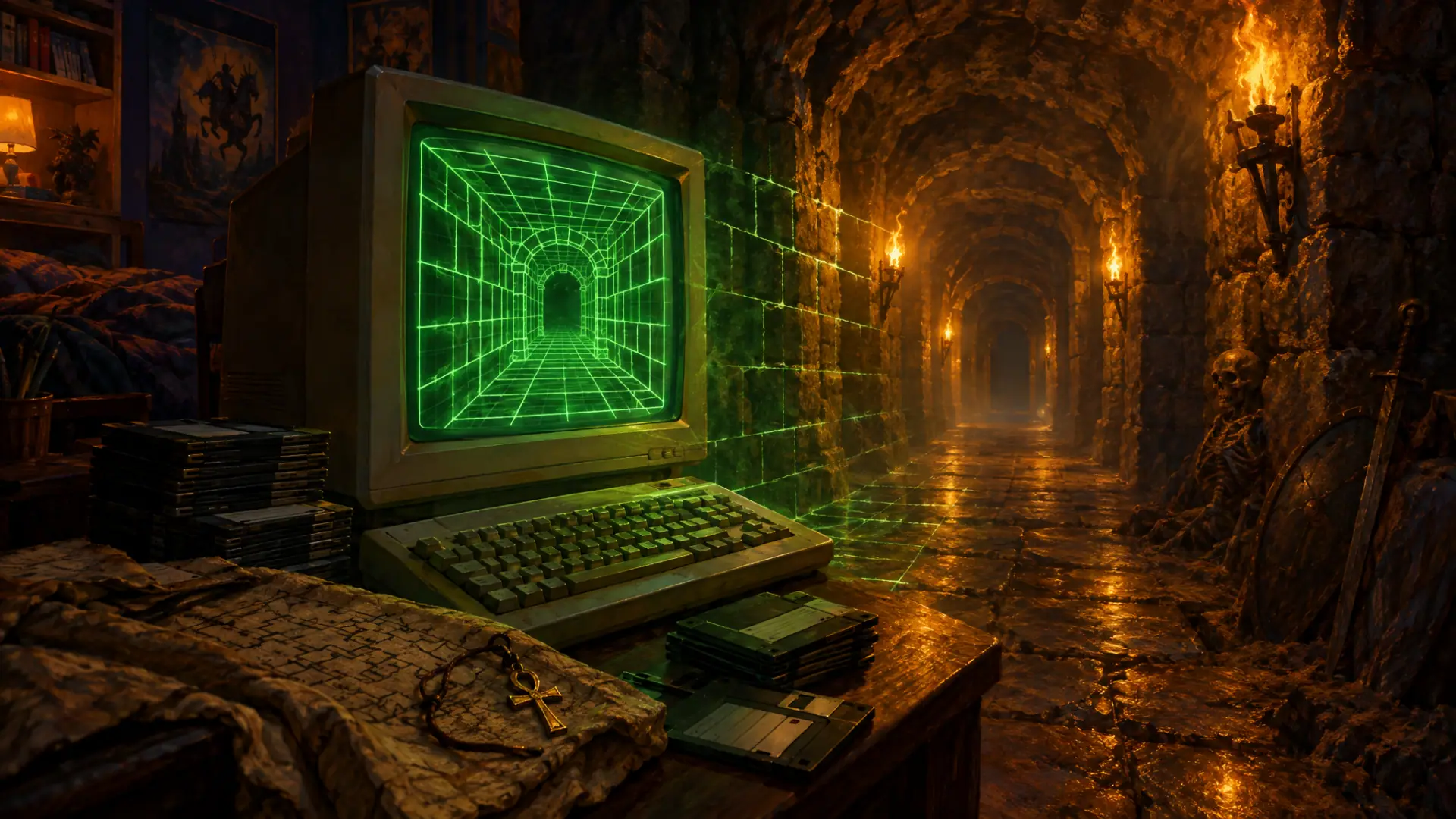
Interactive fiction was the first form in which a computer narrated a world, and it seeded almost everything that followed: the graphic adventure, the roguelike, the MUD and therefore the MMORPG, and much of the RPG's habit of storytelling.
Hallmarks
- A world rendered in prose, read rather than seen
- A parser that accepts typed commands such as GO NORTH or OPEN THE DOOR, or a menu of textual choices
- Puzzles solved by manipulating objects and language
- A second-person voice: 'You are standing in an open field'
- Maps and inventories built in the player's head or notebook
- Wit, atmosphere and authorial voice as primary pleasures
What it is
Interactive fiction, often called the text adventure, is a game told entirely, or almost entirely, in prose. The computer describes a place ("You are standing at the end of a road before a small brick building"), the player types an instruction, and the program answers with what happens. The classic form uses a parser, a piece of software that interprets commands from terse verbs like GET LAMP to full sentences like PUT THE COIN IN THE SLOT, THEN GO WEST. A newer branch, choice-based interactive fiction, replaces typing with clickable links or menus of options.
Its pleasures are those of reading and puzzling at once: an authorial voice, a world held in the imagination, and the satisfaction of finding the right words to make that world respond. Much of it is fantasy, from underground empires and wizard's guilds to Tolkien adaptations, but the form has also carried science fiction, comedy, horror and literary experiment.
Origins
The genre began in a cave. Will Crowther, a programmer at Bolt, Beranek and Newman who worked on the ARPANET, was a caver and a Dungeons & Dragons player, and around 1975–76 he wrote a program that let his daughters explore a version of Kentucky's Mammoth Cave by typing two-word commands. In 1977 Don Woods at Stanford found it, tracked Crowther down, and expanded it with more treasures, puzzles and fantasy elements. Colossal Cave Adventure spread across the network and consumed university computer time.
At MIT, Tim Anderson, Marc Blank, Bruce Daniels and Dave Lebling answered it in 1977 with Zork, whose parser understood full sentences and whose narrator had a sly, sarcastic wit. A Fortran port circulated as Dungeon, and at the University of Essex it inspired Roy Trubshaw to name his multiplayer program MUD, the root of the MUDs (Multi-User Dungeons) and later the MMORPGs. Commercial text adventures arrived in 1978 with Scott Adams's Adventureland, squeezed into the tiny memories of early microcomputers.
Evolution
The commercial golden age belonged to Infocom, founded on June 22, 1979, by members of the MIT group. It split Zork into a trilogy starting with Zork I in 1980, and ran its games on the Z-machine, a virtual machine that let one story ship on more than twenty home computers. Infocom marketed its work as "interactive fiction," packaged it with "feelies" such as maps, coins and letters that also foiled copying, and in 1983 had every one of its ten titles in Softsel's top forty. Its range was wide: the Enchanter trilogy's spellbook magic, Steve Meretzky and Douglas Adams's The Hitchhiker's Guide to the Galaxy (1984), and Beyond Zork (1987), which grafted RPG statistics onto the parser.
Britain built its own scene. Level 9 and Magnetic Scrolls became leading publishers, and Melbourne House's The Hobbit (1982), adapting Tolkien's novel, gave its characters a life of their own, most famously Thorin, who would sit down and start singing about gold. Meanwhile graphics were arriving: Roberta Williams's Mystery House (1980) added pictures to the parser, and King's Quest (1984) let players walk an animated hero through a painted world while still typing commands.
As graphics improved, the commercial market for pure text collapsed. Activision bought Infocom in 1986 and closed it in 1989. But a hobbyist community on Usenet kept the form alive and built free tools: Michael J. Roberts's TADS (1987) and Graham Nelson's Inform (1993), which compiled to Infocom's own Z-machine format. The Interactive Fiction Competition began in 1995, rewarding short, polished games that a judge could finish in two hours, and works such as Adam Cadre's Photopia (1998) and Emily Short's Galatea (2000) pushed the form toward literature.
The 2010s widened the door. Chris Klimas's Twine (2009) let anyone write branching hypertext without programming, fueling personal and experimental work such as Porpentine's howling dogs (2012). Studios such as inkle brought choice-based interactive fiction to phones with 80 Days (2014). Language models later brought parser-style improvisation back in a new form, beginning with AI Dungeon in 2019.
How to tell it apart
Versus the gamebook. A Gamebooks & Interactive Books such as Fighting Fantasy or Choose Your Own Adventure is printed: the reader turns to numbered sections, and any rules or dice are handled by hand. Choice-based IF resembles it closely, but the computer tracks state, hides the structure and can respond to far more variables. Parser IF has no printed equivalent at all.
Versus the graphic adventure. In a graphic adventure like King's Quest or later point-and-click games, the world is shown and the player manipulates it with a cursor. In interactive fiction the world exists in prose, and language itself is the controller.
Versus the MUD and the CRPG. A MUDs (Multi-User Dungeons) is interactive fiction's multiplayer child: text, rooms and parsers, but shared with other people in a persistent world, and usually built around combat and levels. A Western Computer RPGs (CRPG) makes Hit points, classes and statistics central. Classic interactive fiction is usually single-player and puzzle-driven, and your character's power rarely grows; you win by understanding, not by leveling.
Where to start
- Colossal Cave Adventure (1976–77): the origin, still playable.
- Zork I (1980): the Great Underground Empire and its lurking grue.
- The Hitchhiker's Guide to the Galaxy (1984): Infocom at its most audacious.
- Photopia (1998) or Galatea (2000): the hobbyist era turned literary.
- 80 Days (2014): choice-based IF at commercial scale.
Marginalia
- Colossal Cave Adventure was written by Will Crowther around 1975–76 and expanded by Don Woods in 1977.
- Infocom was founded on June 22, 1979, by MIT staff and students, several of whom had written Zork.
- By 1986 Zork I had sold 380,000 copies and the Zork trilogy 680,000.
- Infocom's 'feelies,' physical props packed with each game, doubled as copy protection.
- Activision bought Infocom on June 13, 1986, for $7.5 million and closed it in 1989.
- The annual Interactive Fiction Competition, founded in 1995, asks judges to score each game after at most two hours of play.
- Chris Klimas released Twine, a free tool for choice-based hypertext stories, in 2009.
Quick answers
- What is Interactive Fiction & Text Adventures?
- The game made of words: type a command, read the world's reply. From a caver's ARPANET experiment to Infocom's shelf of classics to today's Twine and IFComp scenes, it is the oldest living form of digital adventure.
- What are the hallmarks of Interactive Fiction & Text Adventures?
- A world rendered in prose, read rather than seen; A parser that accepts typed commands such as GO NORTH or OPEN THE DOOR, or a menu of textual choices; Puzzles solved by manipulating objects and language; A second-person voice: 'You are standing in an open field'; Maps and inventories built in the player's head or notebook; Wit, atmosphere and authorial voice as primary pleasures.
- When did Interactive Fiction & Text Adventures emerge?
- 1975–77, on the ARPANET.
- Where does the name “Interactive Fiction & Text Adventures” come from?
- 'Interactive fiction' was Infocom's preferred label for its games in the 1980s; 'text adventure' descends from Colossal Cave Adventure.
- What are the key works of Interactive Fiction & Text Adventures?
- Colossal Cave Adventure and Zork.