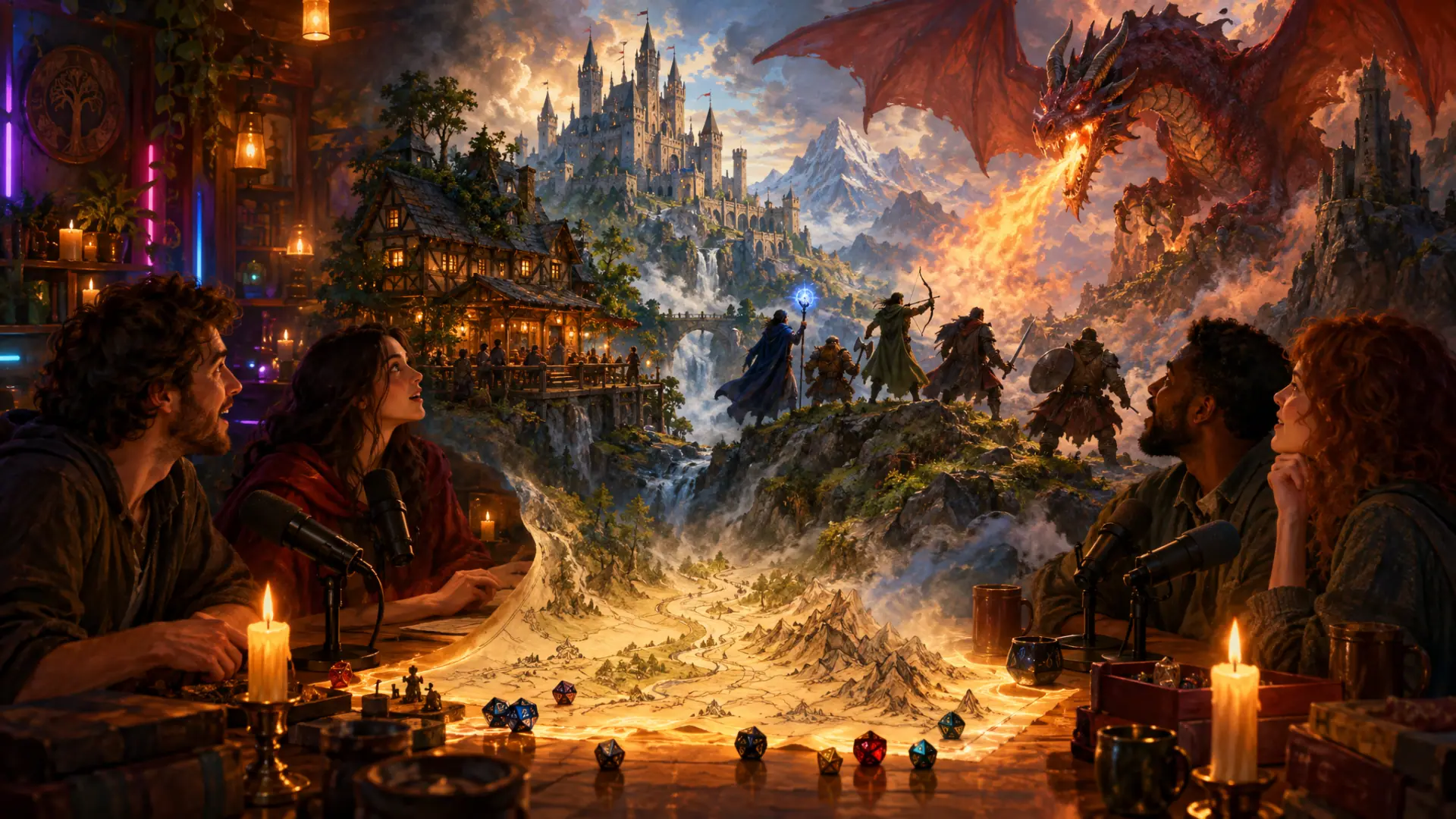
LitRPG is the first literary genre born from video games rather than the other way around, closing a loop that began when D&D borrowed from fantasy novels. Its progression-fantasy cousin turned leveling up into a storytelling engine.
Hallmarks
- Visible game mechanics on the page: stat blocks, levels, skills, loot notifications
- Protagonists who know they are in a game or game-like "System" and play it
- Numerical growth as the core pleasure — leveling, building and optimizing
- Often trapped in virtual worlds or transported into game-like realities
- Progression fantasy: power climbing through a magic system, with or without game UI
- Serialized web publication, huge series, and an audiobook-driven readership
What it is
LitRPG — "literary role-playing game" — is fiction in which the conventions of computer RPGs are part of the reading experience. Its protagonists live in games or in game-like realities and know it: they see stat screens, choose classes, earn Experience points, grind for levels and open Loot & loot tables boxes, and the text shows these numbers on the page. The pleasure is watching a character get stronger through a system the reader can follow, and in seeing how the rules can be exploited.
The term distinguishes these books from ordinary game tie-ins (a Forgotten Realms novel has no stat blocks), from gamebooks (where the reader makes choices), and from interactive fiction. Some writers use "GameLit" for stories set in game worlds without leveling mechanics. Its close cousin, progression fantasy, keeps the steady climb in power but drops the game interface: characters advance through a world's own Hard & soft magic systems, stage by stage.
Origins
Stories of people entering games predate the name. Andre Norton's Quag Keep (1978) sent gamers into Greyhawk as their characters; Larry Niven and Steven Barnes's Dream Park (1981) imagined immersive live-action games. As MMORPGs rose, so did fiction about virtual worlds: Japan's .hack//Sign (2002) and Reki Kawahara's Sword Art Online, a web novel from 2002 to 2008 and a light-novel series from 2009, trapped players inside a deadly VR game. South Korea's The Legendary Moonlight Sculptor ran to more than 50 volumes.
The genre got its name in Russia. In 2012 Dem Mikhailov's Clan Dominance: The Sleepless Ones, set in a fictional sword-and-sorcery game world, appeared on the self-publishing site samizdat.ru and was soon printed. In 2013 the major publisher EKSMO launched a multi-author project, and — according to Magic Dome Books, which translated much Russian LitRPG into English — the term was coined in late 2013 in a brainstorm between writer Vasily Mahanenko, editor Dmitry Malkin and author-editor Alex Bobl.
Evolution
In English the genre grew almost entirely outside traditional publishing: on Kindle self-publishing, on web-serial platforms such as Royal Road, and through audiobooks, whose narrators could perform the stat screens. Serials such as Travis Deverell's He Who Fights With Monsters built huge readerships.
Progression fantasy grew alongside it. Chinese xianxia "cultivation" novels — in which disciples advance through realms of power toward immortality — boomed on web platforms such as Qidian and spread abroad through fan translation in the 2000s; the level-based structure had itself been influenced by 1990s role-playing video games. Western writers such as Will Wight (Cradle) adapted the formula.
The breakout came with Matt Dinniman's Dungeon Crawler Carl, first serialized on Royal Road around 2019–20: a man and his ex-girlfriend's cat must survive a deadly alien game show set in an eighteen-level dungeon beneath the ruined Earth. Satirical and savage, it was acquired with its sequels by Ace Books in 2024, had sold more than 14 million copies of its first eight books by July 2026, and was greenlit for television by Peacock.
East Asian web fiction runs in parallel. South Korean web novels such as Chugong's Solo Leveling, in which a weak hunter gains a private leveling "System," became global hits through webtoon and anime adaptations, and Japanese isekai light novels regularly give their reincarnated heroes status screens. Those streams, the Russian publishers and the English-language web-serial scene now share readers, tropes and translators.
How to tell it apart
- LitRPG vs. Portal Fantasy: many LitRPGs begin with a portal — the isekai "transported into a game world" premise — but the defining feature is the visible system. A portal fantasy without numbers is not LitRPG.
- LitRPG vs. progression fantasy: LitRPG shows the game interface; progression fantasy only needs the climb. Dungeon Crawler Carl is LitRPG; Cradle is progression fantasy.
- vs. tie-in fiction (Shared-World & Tie-In Fiction): a World of Warcraft novel is set in a game's world but is written as ordinary fantasy; LitRPG treats the rules themselves as the subject.
- vs. Gamebooks & Interactive Books: a gamebook makes the reader play; LitRPG makes the character play while the reader watches.
Where to start
- Sword Art Online — the VR-trap forerunner.
- Dungeon Crawler Carl — the genre's crossover hit, especially in audio.
- He Who Fights With Monsters (Travis Deverell) — a popular portal-into-a-System saga.
- Cradle (Will Wight) — the standard entry point for progression fantasy.
Marginalia
- The first Russian novel of the type, Dem Mikhailov's Clan Dominance: The Sleepless Ones, appeared on the self-publishing site samizdat.ru in 2012.
- Russian publisher EKSMO launched a multi-author LitRPG project in 2013 and has run LitRPG competitions since 2014.
- Reki Kawahara first published Sword Art Online as a web novel from 2002 to 2008; the light novels began in 2009.
- Andre Norton's Quag Keep (1978), in which gamers become their characters in Greyhawk, is an early forerunner.
- Matt Dinniman's Dungeon Crawler Carl began on the web-fiction site Royal Road around 2019–20; by July 2026 the first eight books had sold more than 14 million copies.
- Progression fantasy grew partly from Chinese xianxia "cultivation" web novels, which RPGs had influenced with the idea of levels.
Quick answers
- What is LitRPG & Progression Fantasy?
- Novels with character sheets: fiction set in game worlds where stats, levels and loot appear on the page — from Russian LitRPG and Sword Art Online to the runaway success of Dungeon Crawler Carl.
- What are the hallmarks of LitRPG & Progression Fantasy?
- Visible game mechanics on the page: stat blocks, levels, skills, loot notifications; Protagonists who know they are in a game or game-like "System" and play it; Numerical growth as the core pleasure — leveling, building and optimizing; Often trapped in virtual worlds or transported into game-like realities; Progression fantasy: power climbing through a magic system, with or without game UI; Serialized web publication, huge series, and an audiobook-driven readership.
- When did LitRPG & Progression Fantasy emerge?
- Precursors 1978–2009; Russian LitRPG from 2012; English boom from the mid-2010s.
- Where does the name “LitRPG & Progression Fantasy” come from?
- "LitRPG" was coined in late 2013 at Russian publisher EKSMO, in a brainstorm among writer Vasily Mahanenko, editor Dmitry Malkin and author-editor Alex Bobl (per translator Magic Dome Books)
- What are the key works of LitRPG & Progression Fantasy?
- Dungeon Crawler Carl and Sword Art Online.