Portal fantasy is the most natural structure for a reader's first visit to the fantastic, and it mirrors roleplaying itself: ordinary people sitting down at a table and stepping into another world.
Hallmarks
- A protagonist from our world crosses a threshold into another
- A physical gateway: rabbit-hole, wardrobe, mirror, book, door, ride or game
- The newcomer as the reader's proxy, learning the world's rules as we do
- Often a quest the visitor was somehow chosen or summoned to complete
- A pull between staying and going home — and what the return costs
What it is
Portal fantasy is fantasy whose protagonists begin in our world and pass through a gateway into another. The portal can be almost anything — a rabbit-hole, a wardrobe, a mirror, a painting, a book, a door in a wall, an amusement-park ride, a virtual-reality headset — but the structure is constant: a newcomer arrives in a world with its own rules, learns them as the reader does, usually takes up a quest, and must decide at the end whether, and how, to go home.
The critic Farah Mendlesohn, in Rhetorics of Fantasy (2008), made the "portal-quest" one of fantasy's four fundamental modes, alongside immersive, intrusion and liminal fantasy. What defines the portal mode, she argued, is point of view: the story is told by an outsider, so the world must be explained, described and discovered. That makes it the most welcoming door in the genre, and one of the most criticized, since it can turn a fantasy world into a tourist destination.
Origins
Otherworld journeys are ancient — descents to the underworld, voyages to fairy islands, sleepers in fairy hills — but the modern portal fantasy starts with Lewis Carroll's Alice's Adventures in Wonderland (1865), in which a girl follows a rabbit down a hole into a realm with its own absurd logic. L. Frank Baum's The Wonderful Wizard of Oz (1900) sent Dorothy by cyclone; E. Nesbit's The Story of the Amulet (1906) sent children through time; Edgar Rice Burroughs's A Princess of Mars (1912) whisked John Carter to Barsoom.
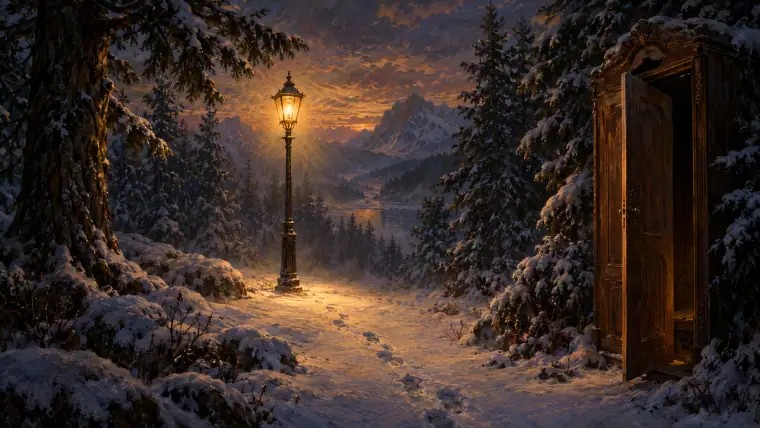
C. S. Lewis fixed the form for generations with The Chronicles of Narnia, opening with The Lion, the Witch and the Wardrobe (1950). Children step from a wartime country house into a land that needs them, then return — changed — to be children again.
Evolution
Adult fantasy used the portal to question its own premises. Poul Anderson's Three Hearts and Three Lions (magazine 1953, book 1961) dropped a modern engineer into the Matter of France, where rules of magic run like physics; D&D later owed it debts including, by most accounts, the paladin and the regenerating Troll. Stephen R. Donaldson's The Chronicles of Thomas Covenant (1977) made its visitor a bitter leper who calls himself the Unbeliever. Michael Ende's The Neverending Story (1979) made the portal a book, and Roger Zelazny's The Chronicles of Amber turned our Earth into just one shadow among infinite worlds.
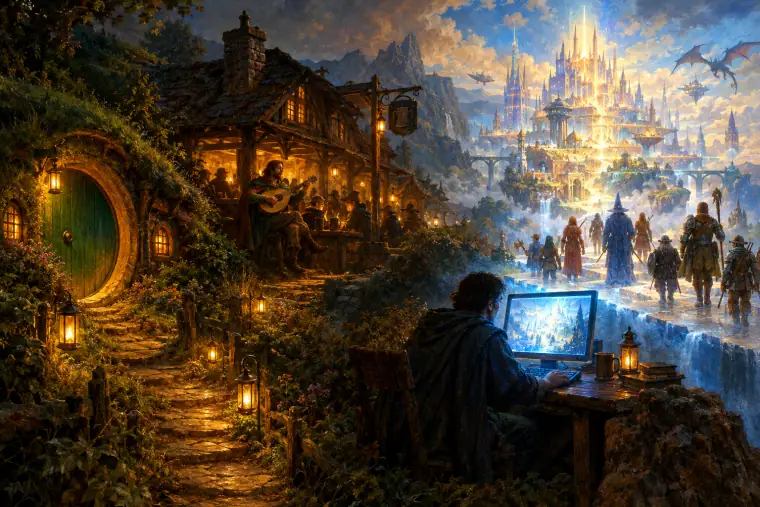
The gaming era gave the portal a new meaning, because roleplaying is itself a portal. Andre Norton's Quag Keep (1978) pulled gamers into Greyhawk; the Dungeons & Dragons (1983–85) sent six kids into the Realm via an amusement-park ride. Jim Henson's Labyrinth (1986) carried a teenager into a goblin kingdom. In Japan, the portal became a juggernaut: isekai stories, in which a modern person is transported or reborn into a game-like world, dominate light novels and anime, and Reki Kawahara's Sword Art Online trapped its players inside a virtual MMO. That game-world variant feeds directly into LitRPG & Progression Fantasy.
The screen made the threshold literal. MGM's The Wizard of Oz (1939) marked Dorothy's crossing by switching from sepia to Technicolor, and later works played with the door itself: J. K. Rowling's Platform 9¾ is a portal hidden in a London railway station, while Stranger Things (2016–25) runs the machine in reverse, with monsters from the Upside Down crossing into a small Indiana town. Critics have noted that portal fantasy has become less fashionable in adult publishing even as isekai thrives.
How to tell it apart
- Portal vs. Low Fantasy: direction of travel. In portal fantasy we go to the magic; in low (intrusion) fantasy the magic comes to us. Narnia is portal; Nesbit's sand-fairy is intrusion.
- vs. High / Epic Fantasy: a high fantasy is immersive — its characters are natives and nothing needs explaining. Put a visitor from Earth in Middle-earth and the same world becomes portal fantasy.
- vs. LitRPG & Progression Fantasy: LitRPG is often a portal story whose other world runs on visible game statistics; the portal is optional, the numbers are not.
- vs. Children's & YA Fantasy: many classic portal fantasies are children's books, but Donaldson, Zelazny and Lev Grossman's The Magicians (2009) are firmly adult.
- vs. Science Fantasy: a science-fiction wormhole or stargate usually leads to another part of the same universe; a fantasy portal leads to a world with different laws.
Where to start
- Alice's Adventures in Wonderland — the rabbit-hole itself.
- The Chronicles of Narnia — The Lion, the Witch and the Wardrobe.
- Three Hearts and Three Lions — the portal novel gamers should read first.
- The Neverending Story — a portal made of a book, about reading.
- Dungeons & Dragons — Saturday-morning portal fantasy from the height of the D&D boom.
Marginalia
- Alice's Adventures in Wonderland (1865) is frequently identified as one of the earliest clear examples of the form.
- In Three Hearts and Three Lions, Poul Anderson sent a WWII-era Danish engineer into a world of Carolingian legend; the novel is often credited as an influence on D&D's paladin and regenerating trolls.
- Andre Norton's Quag Keep (1978), in which gamers are pulled into Greyhawk, was the first novel based on D&D.
- In the Dungeons & Dragons cartoon (1983–85), six children ride an amusement-park ride into the Realm and spend the series trying to get home.
- Stephen R. Donaldson's Thomas Covenant is a leper who refuses to believe the Land is real — a portal hero who rejects the portal.
- Japan's isekai ("another world") stories turned the portal into one of the dominant formulas of light novels and anime.
Quick answers
- What is Portal Fantasy?
- Through the rabbit-hole, the wardrobe or the amusement-park ride: fantasy in which someone from our world steps into another — from Wonderland and Narnia to the D&D cartoon and isekai.
- What are the hallmarks of Portal Fantasy?
- A protagonist from our world crosses a threshold into another; A physical gateway: rabbit-hole, wardrobe, mirror, book, door, ride or game; The newcomer as the reader's proxy, learning the world's rules as we do; Often a quest the visitor was somehow chosen or summoned to complete; A pull between staying and going home — and what the return costs.
- When did Portal Fantasy emerge?
- 1865 (Alice's Adventures in Wonderland) onward.
- Where does the name “Portal Fantasy” come from?
- Critical term; Farah Mendlesohn's Rhetorics of Fantasy (2008) named the "portal-quest" as one of fantasy's four basic modes.
- What are the key works of Portal Fantasy?
- Alice's Adventures in Wonderland, The Chronicles of Narnia, Three Hearts and Three Lions, The Chronicles of Thomas Covenant, The Neverending Story, Labyrinth, Dungeons & Dragons and Sword Art Online.