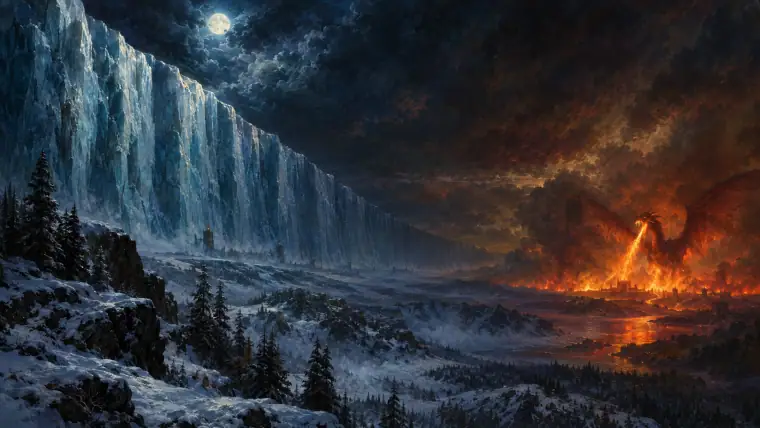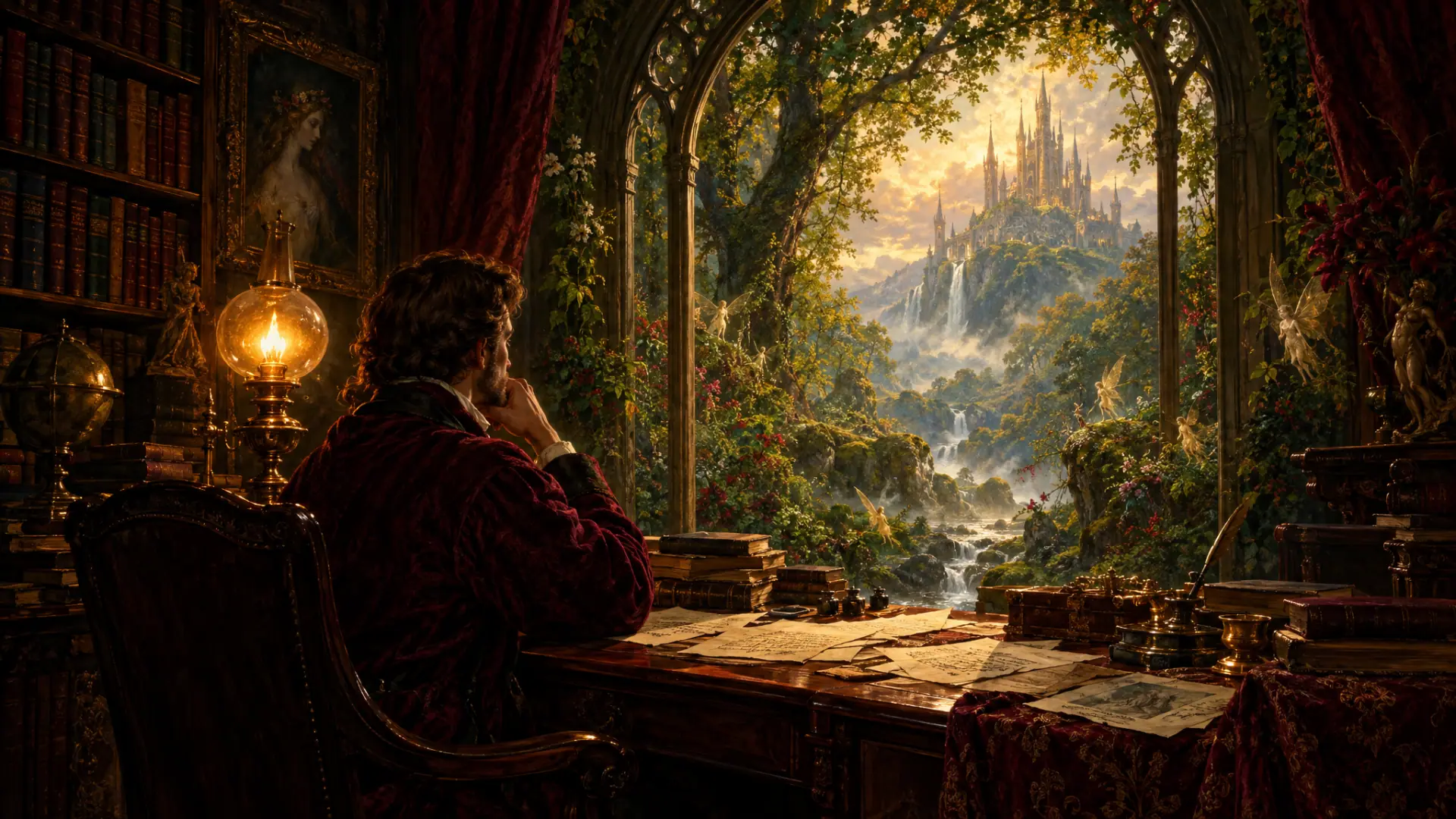
Low fantasy is the necessary opposite of high fantasy in any taxonomy of the genre. Its two meanings — real-world intrusion in criticism, low-magic grit in gaming — explain a great deal of confusion in how readers and players talk about fantasy.
Hallmarks
- Magic intruding on the ordinary, recognizable world rather than an invented one
- Ambiguity: the marvelous may be real, dreamt or psychological
- Everyday characters and domestic settings — a house, a village, a school
- In gaming usage: scarce, dangerous magic and street-level stakes
- Human-scale problems and practical goals rather than destiny
What it is
Low fantasy is fantasy in which magic intrudes on an otherwise normal world — usually our own. Where High / Epic Fantasy builds a complete Secondary world with its own rules, low fantasy begins in a recognizable place, a London house, a Buckinghamshire village, an Indiana suburb, and lets something impossible in. The "low" is a description of setting, not a judgment: it refers to the familiarity of the world, the "primary world" of the reader.
There is a second, separate meaning, and it matters in this museum because it comes from gaming. Roleplaying books and online discussion often use "low fantasy" for invented worlds that are low-magic: gritty, realistic in texture, with rare and dangerous sorcery and ordinary-scale heroes. The two meanings describe different things. A fairy appearing in a modern kitchen is low fantasy in the first sense; a secondary-world war with almost no wizards is low fantasy only in the second.
Origins
Fantasy fiction grew out of the fairy tale in the 19th century, and much of it was intrusive from the start. In the Edwardian era E. Nesbit made the form a staple of children's literature: in Five Children and It (1902) a grumpy sand-fairy grants wishes to a family of ordinary children, with comic and practical consequences. Scholars credit Nesbit with establishing the pattern of magic erupting into the domestic world, and children still read more low fantasy than high.
The mode flourished in parallel with Tolkien. Mary Norton's Borrowers, P. L. Travers's Mary Poppins and much of 20th-century children's fiction work this way, as does Alan Garner's The Weirdstone of Brisingamen (1960), where Cheshire folklore wakes under its young heroes. Susan Cooper's The Dark Is Rising sequence (1965–77) set an ancient war between Light and Dark in the English countryside.
Criticism gave the mode its theory. Tzvetan Todorov's study The Fantastic (1970) described the reader's hesitation between natural and supernatural explanations — exactly the ambiguity low fantasy exploits. In French criticism, le fantastique means the supernatural intruding into everyday life; France has no equivalent tradition of Tolkien-style high fantasy. Farah Mendlesohn's Rhetorics of Fantasy (2008) later named the structure "intrusion fantasy."
Evolution
The intrusion strand fed directly into Urban Fantasy, Dark Fantasy, paranormal romance and much horror. J. K. Rowling's Harry Potter sits on the border: its wizarding world is hidden inside modern Britain, and critics disagree over whether it is low fantasy or a "world-within-a-world" high fantasy. On screen, Stranger Things (2016–25) is textbook low fantasy — and its heroes explain the invading monster using their D&D campaign.
The gaming strand grew separately. Warhammer Fantasy Roleplay (1986) started characters as rat-catchers and grave robbers in a muddy early-modern Empire. GURPS' GURPS Fantasy defines low fantasy as "closer to realistic fiction than to myth," concerned with daily lives and practical goals. In fiction, the label has been attached to George R. R. Martin and Joe Abercrombie, whose secondary worlds minimize magic and non-human peoples in favor of human politics — a usage that overlaps with Grimdark.
Some critics read social meaning into the recent "low fantasy" label. The fantasy writer David Chandler linked the rise of magic-poor, cynical epics to the atmosphere of the war on terror, with its "secret deals" and "vicious reprisals," much as horror fiction had responded to Vietnam a generation earlier.
How to tell it apart
- Low vs. High / Epic Fantasy: the literary test is simple: where does the story happen? Our world with magic added is low; an invented world is high. Harry Potter and His Dark Materials are the classic arguments at the boundary.
- vs. Portal Fantasy: in portal fantasy we go to the magic; in low fantasy the magic comes to us.
- vs. Urban Fantasy: urban fantasy is the modern-city branch of low fantasy, usually with a genre-fiction engine (detectives, hunters, romance).
- vs. Grimdark: in gaming talk the two overlap, but "low fantasy" names the amount of magic and grandeur, while grimdark names the moral tone. A low-magic world can be cozy.
Where to start
- Five Children and It (E. Nesbit, 1902) — the template.
- The Weirdstone of Brisingamen (Alan Garner, 1960) — folklore under the Cheshire hills.
- The Dark Is Rising — The Dark Is Rising (1973), second in the sequence and its heart.
- Stranger Things — low fantasy by way of 1980s D&D.
- Warhammer Fantasy Roleplay — for the gamer's meaning of "low fantasy."
Marginalia
- "Low" refers to the familiarity of the setting, not the quality of the writing.
- In Farah Mendlesohn's Rhetorics of Fantasy (2008), low fantasy corresponds roughly to "intrusion fantasy," in which the fantastic breaks into the known world.
- French literature's le fantastique is largely low fantasy; French criticism has no native tradition equivalent to Tolkien-style high fantasy.
- GURPS Fantasy defines low fantasy as "closer to realistic fiction than to myth," asking what it is like to live in a world of monsters and magic.
- Critics have applied "low fantasy" to George R. R. Martin and Joe Abercrombie because their secondary worlds downplay magic and non-human races.
- Susan Cooper's The Dark Is Rising sequence (1965–77) sets an ancient war of Light and Dark in the English countryside.
Quick answers
- What is Low Fantasy?
- Two genres under one name: magic breaking into our own world, as in E. Nesbit and The Dark Is Rising — and, in gamers' mouths, gritty worlds where magic is rare and a sword wound can kill.
- What are the hallmarks of Low Fantasy?
- Magic intruding on the ordinary, recognizable world rather than an invented one; Ambiguity: the marvelous may be real, dreamt or psychological; Everyday characters and domestic settings — a house, a village, a school; In gaming usage: scarce, dangerous magic and street-level stakes; Human-scale problems and practical goals rather than destiny.
- When did Low Fantasy emerge?
- Edwardian children's fantasy (E. Nesbit, 1902) onward; gaming sense from the 1980s.
- What are the key works of Low Fantasy?
- The Dark Is Rising, Harry Potter, Stranger Things, A Song of Ice and Fire, The First Law, Warhammer Fantasy Roleplay and GURPS.