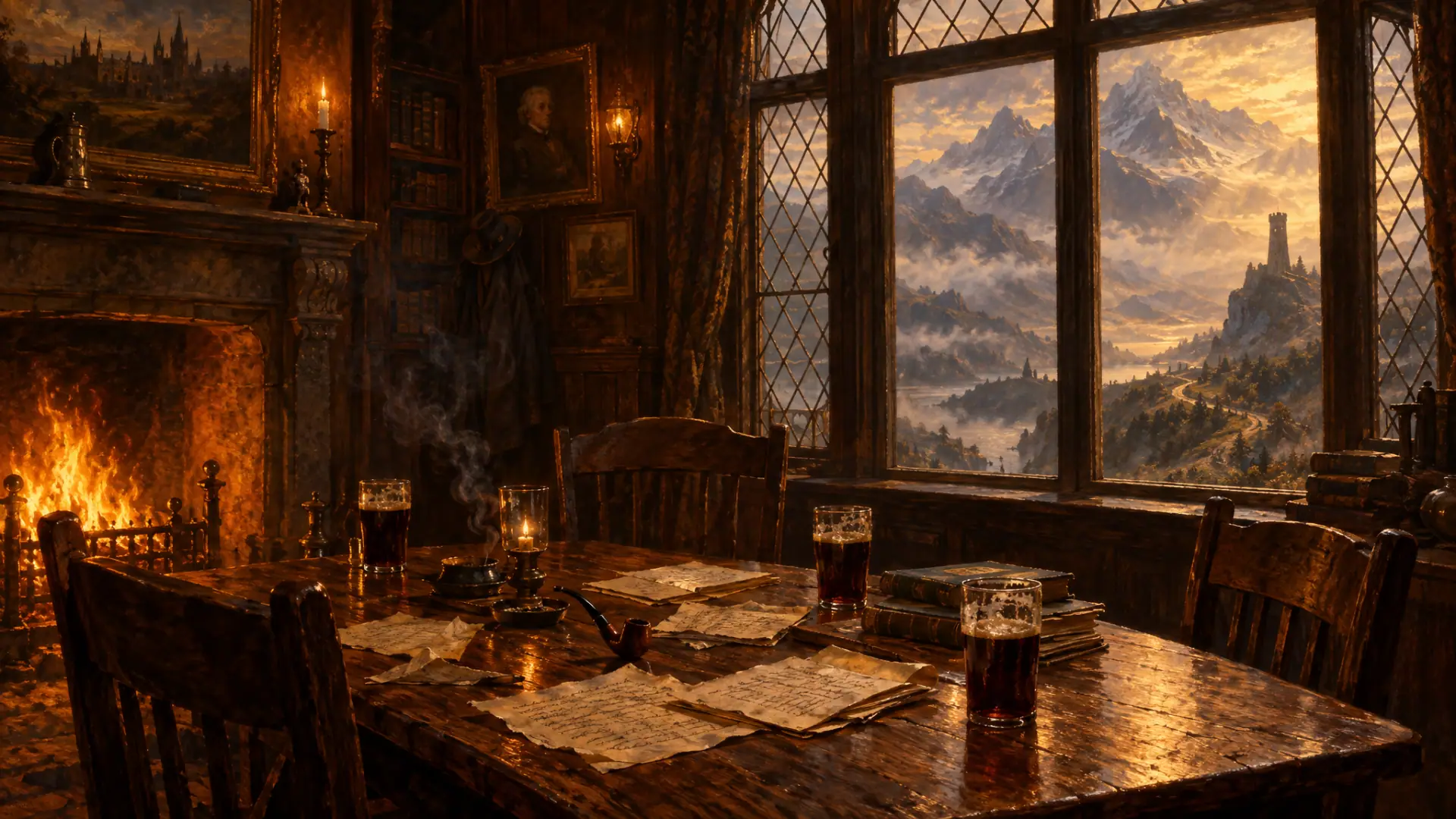
Peake's Gormenghast is the great alternative to Middle-earth: a secondary world with no magic, no quest and no Dark Lord, only a castle and its rituals. Its influence runs through dark fantasy, the New Weird and the atmospheric architecture of gothic games.
Life
Mervyn Laurence Peake was born on 9 July 1911 at Kuling (now Guling), a hill resort in central China, where his father, Ernest Cromwell Peake, was a doctor with the London Missionary Society. He spent his childhood in China, including at Tianjin, before the family returned to England in 1923, and the walled compounds, rituals and vast crowds he saw there are often cited as sources for his fiction. He studied at Eltham College, Croydon School of Art and the Royal Academy Schools, and in the 1930s joined a colony of artists on the Channel Island of Sark before teaching life drawing at the Westminster School of Art. There he met the painter Maeve Gilmore, whom he married in 1937; they had three children.
In the Second World War Peake served in the Royal Artillery and Royal Engineers and suffered a breakdown before being commissioned as a war artist. In 1945, weeks after its liberation, he visited the Belsen concentration camp as an artist for a magazine, and his drawings of the dying and his poems about what he saw marked him for life. After the war he returned to Sark for a time, then to London, painting, illustrating, teaching and writing. From the late 1950s his health declined; he suffered from what is now thought to have been dementia with Lewy bodies, lost the ability to draw and write, and spent his last years in care. He died on 17 November 1968 at Burcot, Oxfordshire.
Work
Peake began Titus Groan in the late 1930s and kept working on it through the war. Published in 1946, it opens with the birth of Titus, heir to the Earldom of Groan, in the colossal castle of Gormenghast — a stone world so vast that whole wings are forgotten, governed by an ancient, meaningless ritual kept in huge books by the Master of Ritual. Its inhabitants are among the most vivid grotesques in English fiction: the melancholy Earl Sepulchrave, who comes to believe he is an owl; the vast Countess Gertrude with her cats and birds; the twin sisters Cora and Clarice; the cook Swelter; the doctor Prunesquallor; and, above all, the kitchen boy Steerpike, climbing the castle's roofs and hierarchy through cunning and murder.
Gormenghast (1950) follows Titus's boyhood and the struggle to stop Steerpike, ending in a flood; Titus Alone (1959) sends Titus out of the castle into a strange, quasi-modern world. Peake planned further books but illness intervened; his widow's continuation, Titus Awakes, appeared in 2011. The three novels are collected in this museum as Gormenghast. Peake was equally celebrated as an illustrator: his drawings for Lewis Carroll's Alice books and The Hunting of the Snark, for Treasure Island and for The Rime of the Ancient Mariner are among the finest of the century. He also wrote nonsense verse, plays and a comic novel, Mr Pye (1953).
Legacy
Peake is often paired with Tolkien as one of the two great British fantasists of the 1950s, and as his opposite. Gormenghast has no magic, no elves, no quest and no The Dark Lord; its fantasy lies entirely in atmosphere, architecture and character. That made it a lodestar for writers who wanted fantasy without Tolkien's comforts. Michael Moorcock, who knew Peake and his family, championed him fiercely, and Peake's shadow lies over Dark Fantasy, the "New Weird" of China Miéville and others, and the whole idea of a fantasy world defined by a single labyrinthine building.
Peake is not on Gygax's Appendix N, and no D&D rule or monster traces to him. His influence on games is atmospheric rather than mechanical: the decaying noble house, the endless castle whose forgotten wings reward exploration, the scheming servant who climbs to power. Designers of gothic settings and labyrinthine castle-dungeons — the tradition that runs from Ravenloft to the interconnected keeps of Dark Souls — work in a mode Peake helped define, even when they do not name him. The BBC's 2000 serial Gormenghast, starring Jonathan Rhys Meyers as Steerpike, brought the castle to television.
Marginalia
- Peake was born in 1911 at Kuling in China, the son of a Congregationalist medical missionary.
- He was part of an artists' colony on the Channel Island of Sark in the 1930s.
- As a war artist he visited Belsen concentration camp in 1945, an experience that haunted his later work.
- His illustrations for the Alice books, The Hunting of the Snark and Treasure Island are considered classics.
- Titus Groan (1946), Gormenghast (1950) and Titus Alone (1959) were never planned as a trilogy; Peake intended more Titus books.
- The BBC adapted the first two novels as the television serial Gormenghast in 2000.
Quick answers
- Who was Mervyn Peake?
- A painter and illustrator born in China who built Gormenghast, a crumbling castle-world of ritual, shadow and grotesques, and proved that fantasy could be gothic, magicless and utterly unlike Tolkien.
- When was Mervyn Peake born?
- Mervyn Peake was born in 1911 in Kuling (Guling), Jiangxi, China and died in 1968.
- What is Mervyn Peake known for?
- Mervyn Peake is best known for Gormenghast.
- Why does Mervyn Peake matter to fantasy and games?
- Peake's Gormenghast is the great alternative to Middle-earth: a secondary world with no magic, no quest and no Dark Lord, only a castle and its rituals. Its influence runs through dark fantasy, the New Weird and the atmospheric architecture of gothic games.