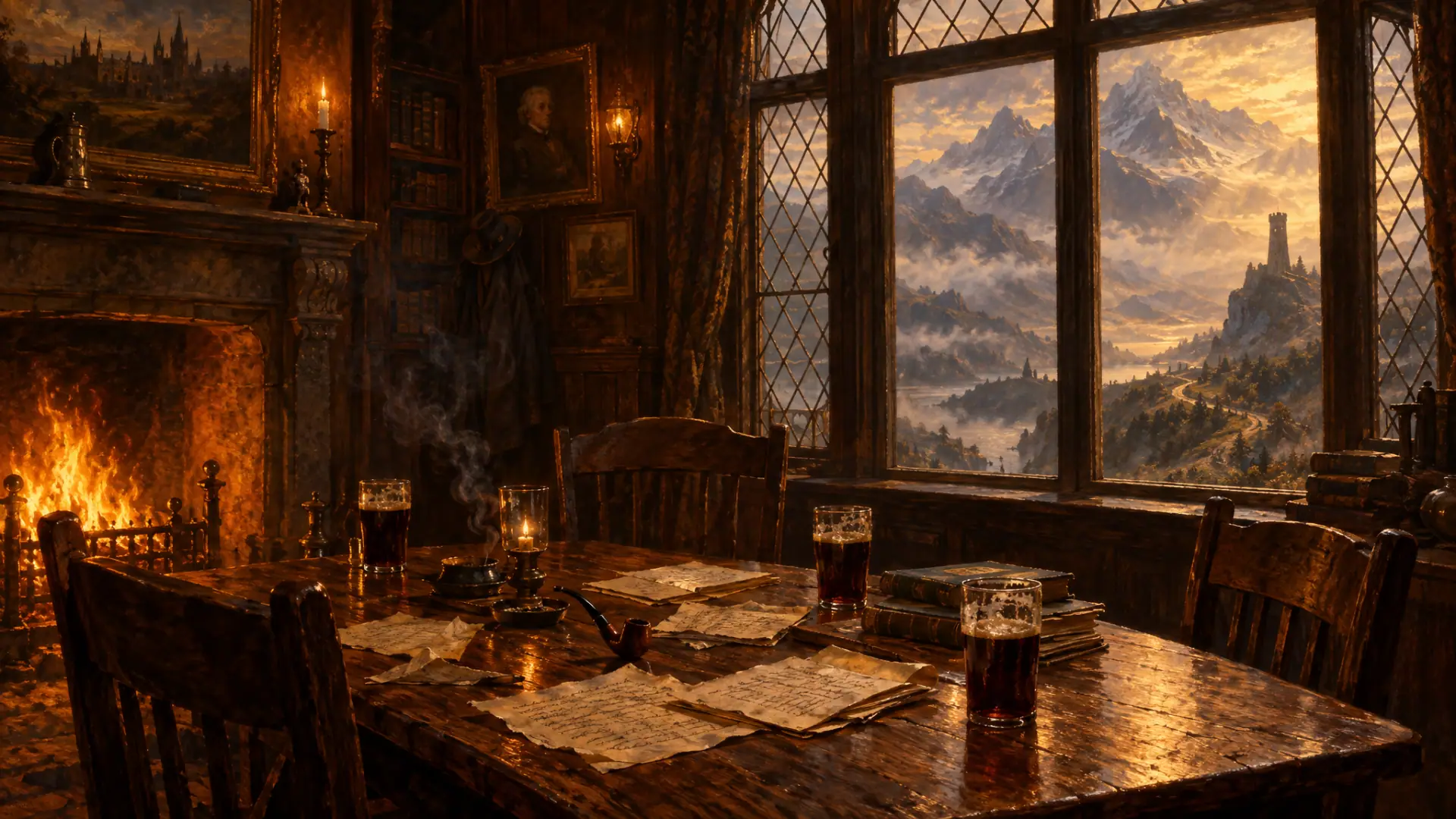
In Oxford college rooms and a pub called the Bird and Baby, Tolkien and Lewis read aloud the books that would define fantasy: The Hobbit, The Lord of the Rings and Narnia.
On a Thursday evening in the 1930s, in a set of rooms in the New Building of Magdalen College, Oxford, a handful of men settled into armchairs around a fire. The host, a broad, red-faced English tutor called Jack by his friends, poured tea or beer; pipes were lit; and someone took out a manuscript. The rule was simple: members read aloud what they were writing, and the others said, often loudly, what they thought of it. Over the next two decades the manuscripts read in those rooms would include a children's story about a creature called a hobbit, its vast and darkening sequel, a space trilogy, theological fantasies, and the first sketches of a land reached through a wardrobe. The group called itself the Inklings. Its two central figures, J. R. R. Tolkien and C. S. Lewis, were not trying to start a literary movement. They were trying to write the kind of stories they wanted to read. Between them they created the modern fantasy novel as the world now knows it.
A club of two, then many
The Inklings were never a formal society. Warren Lewis, C. S. Lewis's brother and one of the regulars, insisted that they were neither a club nor a literary society, though they partook of the nature of both. The core met from the early 1930s until late 1949, usually on Thursday evenings in Lewis's rooms at Magdalen (occasionally in Tolkien's at Merton), and more casually on Tuesday mornings at a pub on St Giles', the Eagle and Child, known to its regulars as the Bird and Baby. Its members were almost all Christian, almost all men of letters, and deeply unfashionable in an age of literary modernism: they cared about myth, romance, story and faith. Besides Tolkien and the Lewis brothers, they included the philosopher Owen Barfield, the lecturer Hugo Dyson, the doctor R. E. Havard, and, from 1939, when Oxford University Press moved its London staff out of the Blitz, the poet and novelist Charles Williams, author of theological thrillers such as War in Heaven (1930). E. R. Eddison, author of The Worm Ouroboros, came as a guest.
The friendship at the center was between J. R. R. Tolkien, the Rawlinson and Bosworth Professor of Anglo-Saxon, and C. S. Lewis, a fellow of Magdalen. They had met in 1926 at a faculty meeting and discovered a shared passion for Norse myth. In 1931 a long night's conversation on Addison's Walk, with Tolkien and Dyson arguing that the Christian story was a myth that had really happened, helped bring Lewis back to Christianity. Later in the decade, lamenting the state of contemporary fiction, the two men decided that if nobody else would write the stories they liked, they would have to write them themselves. They agreed that Lewis would try a story of space travel and Tolkien one of time travel. Lewis's became Out of the Silent Planet (1938). Tolkien's time-travel story stalled, but he had other things in the drawer.
Their meetings could be tough. Dyson, famously, grew so weary of the readings from Tolkien's great work in progress that he would lie on the couch and protest at the arrival of yet more elves. But the Inklings gave both writers what they most needed: an audience that took fantasy seriously.
There and back again
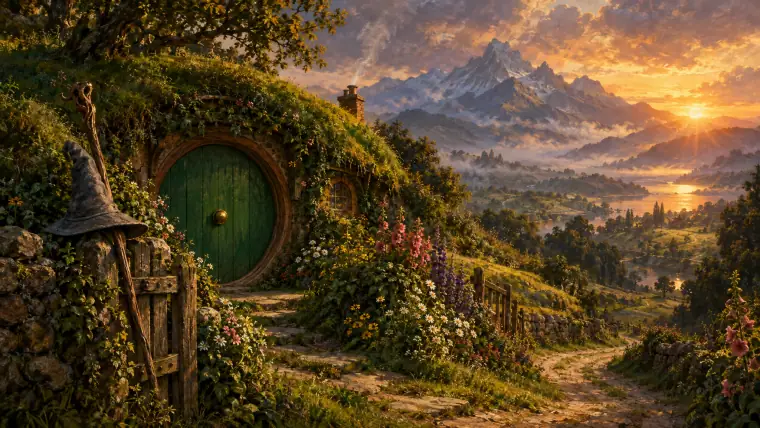
Tolkien had been building a mythology since the First World War (see The Invention of Modern Fantasy): a history of the Elder Days, with invented languages, the Elves, the fall of Gondolin, and the long war against the first The Dark Lord, Morgoth. It was not for publication; it was, as he later described his aim, something like a mythology for England. But sometime around 1930, marking exam papers, he famously wrote on a blank page, "In a hole in the ground there lived a hobbit," and then had to find out what a hobbit was.
The Hobbit began as a story for his children, told and written over several years and borrowing freely from the edges of his mythology. It follows Bilbo Baggins, a comfortable, middle-aged hobbit, hired as a burglar by thirteen dwarves (whose names Tolkien took from the Old Norse Dvergatal; see The Eddas) and the wizard Gandalf to recover their treasure from the Dragon Smaug. On the way there are trolls who turn to stone, goblins in the Misty Mountains, a riddle game in the dark with the creature Gollum and a magic ring, giant spiders, wood-elves and a Battle of Five Armies. By late 1932 the story was essentially finished and passing among friends, Lewis among them. In 1936 one of Tolkien's students, Elaine Griffiths, steered it toward Susan Dagnall, who worked for the London firm of George Allen & Unwin, and Dagnall showed it to the chairman, Stanley Unwin, who gave it to his ten-year-old son, Rayner, to read. Rayner's favorable report earned him a shilling. The Hobbit was published on September 21, 1937, illustrated by Tolkien himself, who also designed its dust jacket. The first printing of 1,500 copies sold out by December, thanks to enthusiastic reviews. Houghton Mifflin published it in the United States in 1938.
In the meantime Tolkien had given the most important lecture in the history of the genre, twice. In "Beowulf: The Monsters and the Critics" (British Academy, November 25, 1936) he argued that the monsters of Beowulf were not a childish distraction but the heart of the poem. In "On Fairy-Stories," delivered at the University of St Andrews on March 8, 1939, and published in 1947, he defended fantasy itself. The storyteller, he argued, is a "sub-creator" who makes a Secondary world which the reader's mind can enter and believe while inside it; the fairy story's highest gift is the Eucatastrophe, the sudden joyous turn at the moment of greatest danger; and the charge that fantasy is "escapism" confuses the escape of the prisoner with the flight of the deserter. Every later writer of Worldbuilding fantasy, and every game designer who ever built a world with its own history, has been working inside Tolkien's definitions.
The new Hobbit
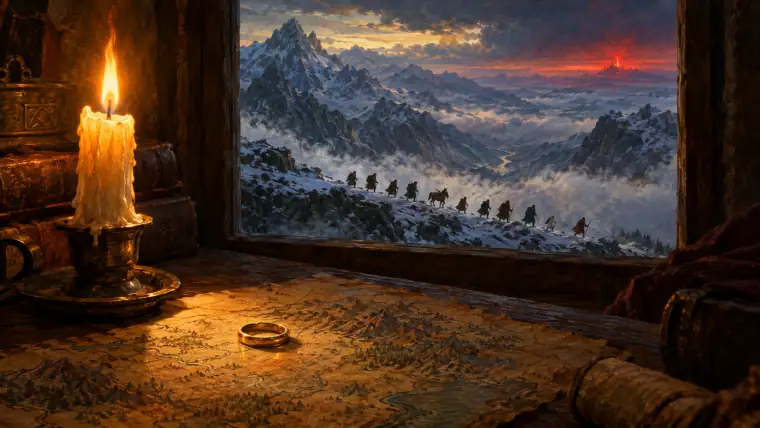
The public wanted more hobbits. In December 1937, at his publisher's urging, Tolkien began a sequel. It would take him until 1949 to finish writing it and five more years to see it in print. The "new Hobbit" rapidly turned into something else: Bilbo's ring was the One Ring of a Dark Lord, Sauron, servant of Morgoth, and the story became the tale of its destruction, an epic of the end of an age set against the vast backdrop of the older mythology. Tolkien wrote through the Second World War, sending chapters to his son Christopher Tolkien, then training with the RAF in South Africa, and reading them aloud to the Inklings. He abandoned the book for most of 1943 and returned to it in April 1944. Christopher would also draw the maps for the published book, the start of a lifetime as his father's editor.
The result was far too long and too strange for the postwar book trade. Tolkien wanted it published together with The Silmarillion, his unfinished mythology, and for a time he negotiated with another publisher. In the end Allen & Unwin took The Lord of the Rings alone, on unusual terms: no advance, and a profit-sharing agreement under which Tolkien would be paid only after the books had covered their costs. To reduce the risk of an expensive, typeset flop, the firm split it into three volumes: The Fellowship of the Ring (July 29, 1954), The Two Towers (November 11, 1954) and The Return of the King (October 20, 1955), the last delayed while Tolkien struggled to finish the appendices of chronologies, genealogies and languages. That the work is still widely called a "trilogy" is an accident of paper prices.
It was an extraordinary thing to put into the world in the age of the kitchen-sink novel. Here was a complete invented world with maps, calendars, scripts, several invented languages and thousands of years of history; a quest undertaken not to win a treasure but to destroy one; a hero who fails at the last moment and is saved by mercy; and a vision of evil as industrial, bureaucratic and addictive. It established the vocabulary of High / Epic Fantasy: the Fellowship of different peoples, the elves tall and fading, the dwarves delving too deep, the orcs as foot soldiers of the Dark Lord, the tree-herding Ents (see Treant), the Balrog / Balor in the mines of Moria, the ring-wraiths, the ruined kingdoms, the return of the king.
Critical opinion split at once. W. H. Auden, Tolkien's former student, called it a masterpiece; Lewis compared it to lightning from a clear sky. The American critic Edmund Wilson, in a 1956 review titled "Oo, Those Awful Orcs!", dismissed it as "juvenile trash." In 1957 it won the International Fantasy Award. But sales in the 1950s were steady rather than spectacular, and the book's great explosion was still a decade away.
Through the wardrobe
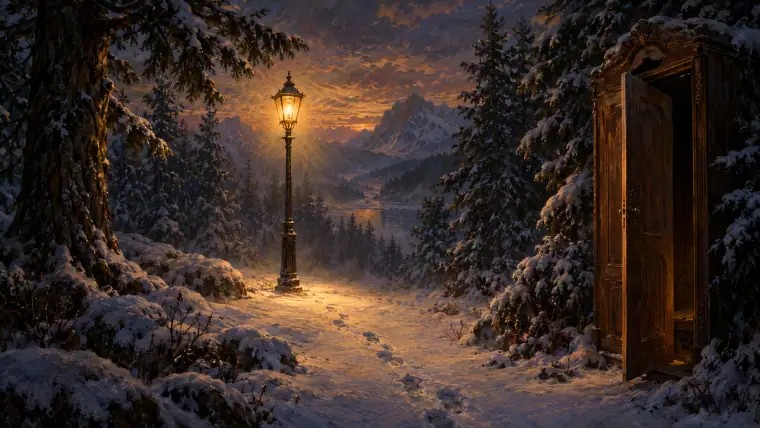
Lewis, meanwhile, had become a public figure. His wartime broadcasts on Christianity for the BBC and The Screwtape Letters (1942), the correspondence of a senior devil advising a junior tempter, made him one of the best-known Christian writers in the English-speaking world. His "space trilogy" (1938–45) had sent the philologist Elwin Ransom to Mars and Venus. And in the late 1940s he began writing a book for children that grew, he said, from a picture he had carried in his head since he was a teenager: a faun carrying an umbrella and parcels through a snowy wood.
The Lion, the Witch and the Wardrobe was published by Geoffrey Bles in 1950, illustrated by Pauline Baynes, and six more books followed, one a year, to make The Chronicles of Narnia (1950–56). Four English children step through a wardrobe into Narnia, a land of talking beasts, fauns, centaurs and giants under the endless winter of the White Witch, and help the lion Aslan, a Christ figure, to free it. Where Tolkien had built a secondary world closed off from ours, Lewis perfected the Portal Fantasy, with children from the real world crossing into and out of a magic kingdom. And where Tolkien was meticulous about keeping his mythology consistent, Lewis cheerfully mixed Father Christmas, Greek fauns, Norse giants and Christian allegory, a jumble Tolkien disliked. The final book, The Last Battle (1956), won the Carnegie Medal.
Narnia became the most widely read of all Children's & YA Fantasy, and one of the most argued-over. Philip Pullman would write His Dark Materials in the 1990s partly as a rebuttal of what he saw as its theology. Lewis himself did not live to see Narnia's full fame. He died at his home in Oxford on November 22, 1963, the same day as John F. Kennedy and Aldous Huxley.
Other castles
Oxford was not the only place where postwar fantasy was being built. In 1938 the Englishman T. H. White published The Sword in the Stone, a comic, tender, anachronistic account of the boyhood of King Arthur, in which the wizard Merlyn, who lives backwards through time, educates young Wart by turning him into a fish, a hawk, an ant and a goose. White continued the story through the war years and in 1958 gathered it, revised and darkened by the shadow of fascism and war, as The Once and Future King, a retelling of Malory's Le Morte d'Arthur. It became the Broadway musical Camelot (1960) and, from the first book, Disney's animated The Sword in the Stone (1963), and it remains the definitive modern Arthurian Fantasy.
In 1946 the painter and illustrator Mervyn Peake, who as a war artist visited Bergen-Belsen soon after its liberation in 1945, published Titus Groan, the first of the Gormenghast novels, followed by Gormenghast (1950) and Titus Alone (1959). Peake's world is a single, colossal, crumbling castle, ruled by meaningless ritual and inhabited by grotesques, through which the ambitious kitchen boy Steerpike climbs to power. There is no magic in it, no elves or dragons, and yet it is one of the great invented worlds of the century, a Gothic comedy that shows another road fantasy might have taken, one closer to Dickens and Kafka than to the Eddas.
Across the Atlantic, Poul Anderson published The Broken Sword in November 1954, the same year as The Fellowship of the Ring, a savage saga in which elves are cold and faithless, trolls are brutal, and the hero is doomed by a cursed sword; its bleakness anticipates the later reaction against Tolkien's moral clarity (see Grimdark). Anderson's own Three Hearts and Three Lions had appeared as a magazine serial the year before (see Pulps, Weird Tales & Sword-and-Sorcery). The pulp tradition of Sword & Sorcery and the Oxford tradition of High / Epic Fantasy were now running side by side, and within two decades a single game would combine them.
The shadow on the game table
It is hard to overstate how completely Tolkien's creatures colonized fantasy games. When Gary Gygax and Jeff Perren published Chainmail's Fantasy Supplement in 1971, it included hobbits, ents and balrogs by name. When Dave Arneson began Blackmoor the same year, The Lord of the Rings was one of its models. The original Dungeons & Dragons of 1974 let players be elves, dwarves and hobbits. Gygax, who preferred the pulps, was often at pains to minimize Tolkien's influence on his game, but the evidence of the rulebooks was plain, and in the mid-1970s lawyers made it plainer still. The holders of the film and merchandising rights sent TSR a cease-and-desist (accounts date it anywhere from 1975 to late 1977); in later printings hobbits became halflings, ents became treants, and balrogs were renamed. (See The Tolkien Rights Saga and From Kriegsspiel to Dungeons & Dragons.)
The names changed; the world did not. The standard fantasy party of the human warrior, the elf archer, the dwarf fighter and the halfling thief is Tolkien's Fellowship, redistributed. The dungeon beneath the mountain is Moria. The evil overlord in his dark tower is Sauron. Licensed games followed directly: Iron Crown's Middle-earth Role Playing (1984), Cubicle 7's and Free League's The One Ring Roleplaying Game, and the online world of The Lord of the Rings Online (2007). Through them and countless imitators, the Inklings' Thursday-night readings reached every corner of the gaming world.
What came next
By 1960 Tolkien was a respected professor with a devoted but small following, and Lewis was famous as a Christian apologist. Neither was yet a phenomenon. That changed in 1965, when an American paperback publisher, spotting what looked like a copyright loophole, printed The Lord of the Rings without permission, and a generation of students discovered Middle-earth at paperback prices. The resulting explosion, and the flood of fantasy it released, is the subject of The Paperback Boom & the Counterculture.