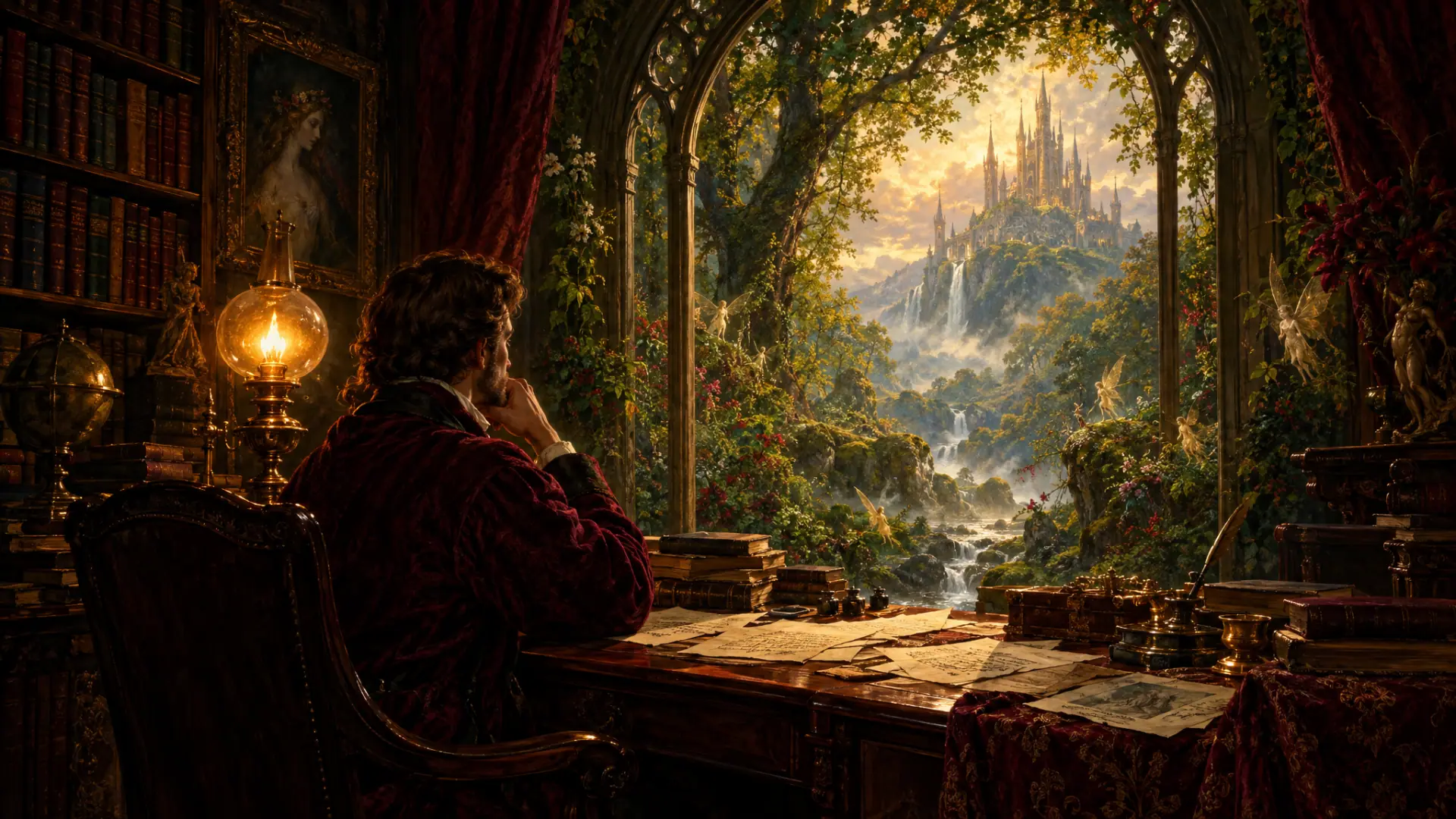
Eddison's Worm Ouroboros (1922) is the great bridge between William Morris and Tolkien: a full-scale heroic fantasy of invented kingdoms and pitched battles, written in a gorgeous archaic prose that later sword-and-sorcery writers revered.
Life
Eric Rücker Eddison was born on 24 November 1882 at Adel, near Leeds, into a prosperous Yorkshire family. As a boy he was taught at home by private tutors alongside Arthur Ransome, who later recalled Eddison's daring schemes for getting rid of unpopular teachers; he then went to Eton and to Trinity College, Oxford, where he studied classics. In 1906 he joined the Board of Trade, and for more than thirty years led a double life of the most English kind: by day a capable senior civil servant, rising to senior rank and collecting the CMG (1924) and CB (1929); by night the author of some of the most extravagant prose of the century.
He loved mountains, the classics, Elizabethan drama and above all the Icelandic sagas, which he read in the original. He retired in 1938 to devote himself to writing, and in the war years he visited Oxford and met C. S. Lewis and J. R. R. Tolkien, attending gatherings of The Inklings as an occasional guest. He died at Marlborough, Wiltshire, on 18 August 1945, leaving the last of his novels unfinished.
Work
The Worm Ouroboros (1922), illustrated by his friend Keith Henderson, opens with an Englishman named Lessingham carried in a dream to the planet Mercury — then quietly drops him. What follows is a titanic war between Demonland, whose lords Juss, Spitfire, Goldry Bluszco and Brandoch Daha are magnificent, reckless and proud, and Witchland, ruled by King Gorice XII, a sorcerer-king who summons dark powers from his iron tower at Carcë. There are sieges, duels, sea battles, mountain ascents in search of a captured brother, and a hippogriff's egg. The prose is a deliberate pastiche of sixteenth- and seventeenth-century English, studded with lines borrowed from Shakespeare, Webster and the sagas. And the ending is a famous shock: victorious and bored, the heroes pray for their enemies to be restored, and the war begins again — the serpent swallowing its own tail.
Eddison translated Egil's Saga (1930) and wrote a Viking novel, Styrbiorn the Strong (1926), before turning to the Zimiamvian trilogy: Mistress of Mistresses (1935), A Fish Dinner in Memison (1941) and The Mezentian Gate, published unfinished in 1958. These are subtler, more philosophical books, set in a paradise-world where the goddess Aphrodite appears in many forms and where Lessingham returns as a warrior-statesman.
Legacy
Eddison is the missing link between William Morris and Tolkien. Morris had invented the Secondary world; Eddison filled one with armies, politics and grand strategy, and so anticipated much of the scale of High / Epic Fantasy. Tolkien respected him — writing that he read Eddison "with great enjoyment for their sheer literary merit" — while objecting to his heroes' arrogance and his "evil and indeed silly philosophy," and deploring his invented names. Lewis admired him without such reservations.
Eddison is not on Gygax's Appendix N, and no game mechanic can be traced directly to him. His influence reached gaming by a more roundabout road: his glorying, ferocious heroes and haughty sorcerer-kings were revered by the writers who shaped Sword & Sorcery and the paperback fantasy of the 1960s and 1970s, and Ballantine's 1967 paperback of The Worm Ouroboros, issued in the wake of Tolkien's paperback success and later folded into the Ballantine Adult Fantasy Series line that Lin Carter edited, put him in the hands of a new mass readership. Ursula K. Le Guin singled out his archaic prose as exact, clear and powerful. Fritz Leiber and Poul Anderson were read beside him by the generation that invented roleplaying, and the pleasure of a war that restarts so the adventure can go on is a very gamer's ending — the campaign that no one wants to finish.
Marginalia
- Eddison shared a private tutor as a boy with Arthur Ransome, the future author of Swallows and Amazons.
- He rose to senior rank at the Board of Trade, receiving the CMG in 1924 and the CB in 1929, and retired in 1938.
- The Worm Ouroboros is nominally set on the planet Mercury, but the frame story is quietly abandoned after the opening chapters.
- He translated Egil's Saga from Old Norse (1930) and wrote a Viking novel, Styrbiorn the Strong (1926).
- Tolkien read Eddison 'with great enjoyment' for its literary merit but disliked what he called its 'evil and indeed silly philosophy'.
- Eddison is not on Gygax's Appendix N, though Ballantine's 1967 paperback of The Worm Ouroboros put him on the same racks as authors who are.
Quick answers
- Who was E. R. Eddison?
- A Board of Trade mandarin who wrote Jacobean-voiced epics of warring lords by night — The Worm Ouroboros most famously — and was an occasional guest of Tolkien and Lewis's Inklings.
- When was E. R. Eddison born?
- E. R. Eddison was born in 1882 in Adel, Leeds, Yorkshire, England and died in 1945.
- What is E. R. Eddison known for?
- E. R. Eddison is best known for The Worm Ouroboros.
- Why does E. R. Eddison matter to fantasy and games?
- Eddison's Worm Ouroboros (1922) is the great bridge between William Morris and Tolkien: a full-scale heroic fantasy of invented kingdoms and pitched battles, written in a gorgeous archaic prose that later sword-and-sorcery writers revered.