Eddings distilled post-Tolkien high fantasy into brisk, funny, dialogue-driven adventure, and The Belgariad became a template for the chosen-one quest that dominated 1980s fantasy shelves.
Life
David Carroll Eddings was born in Spokane, Washington, on July 7, 1931, and grew up in Snohomish, near Puget Sound. A gifted performer as a young man, he won a national oratory contest and took leading roles in school plays. He graduated from Reed College in 1954, submitting a novel as his senior thesis, served in the U.S. Army, and earned an MA from the University of Washington in 1961, again with a novel as his thesis. He then worked as a purchaser for Boeing, where he met Judith Leigh Schall; they married in 1962, and she took the name Leigh Eddings. For most of the 1960s he taught English at Black Hills State College in South Dakota.
In 1970 the couple lost custody of their two adopted children, and both pleaded guilty to eleven counts of physical child abuse. Each was sentenced to a year in jail. The case was reported in local newspapers at the time but was not widely known until after Eddings's death. He did not return to academia; after his release the couple settled in Spokane, where he worked in a grocery store and wrote in his spare time.
Leigh Eddings died in February 2007 after a series of strokes. David, who had been living with dementia, died on June 2, 2009. He bequeathed $18 million to Reed College for the study of languages and literature and $10 million to National Jewish Medical and Research Center in Denver for pediatric asthma research.
Work
Eddings's first published novel, the deer-hunting drama High Hunt, appeared from Putnam in 1972 and sold modestly. The turn to fantasy came later, and he told the story with self-deprecating relish: spotting The Lord of the Rings in a bookshop, he muttered, "Is this old turkey still floating around?" and learned it was in its 78th printing. (He had in fact taught Tolkien in his survey courses.) A map he had doodled grew into roughly 250 pages of kingdoms, peoples, theology and myth, the world of Aloria.
Assuming that fantasy came in threes, he planned a trilogy. Lester del Rey of Del Rey warned that booksellers would balk at 600-page volumes and offered advances for five books instead. The Belgariad followed: Pawn of Prophecy and Queen of Sorcery (1982), Magician's Gambit (1983), and Castle of Wizardry and Enchanters' End Game (1984), their titles marching across a chessboard. A farm boy named Garion discovers that his "Aunt Pol" and his wandering storyteller grandfather are the immortal sorcerers Polgara and Belgarath, and that he is the heir destined to face the maimed god Torak. What set the books apart was their voice: bantering companions, domestic comedy and a light touch with prophecy that often reads like an argument between two rival scripts.
The Eddingses returned to the same world in The Malloreon (1987–91) and the prequels Belgarath the Sorcerer (1995) and Polgara the Sorceress (1997), and built a second world for Sir Sparhawk in The Elenium (1989–91) and The Tamuli (1992–94). The Rivan Codex (1998) published the working notes behind Aloria, a rare look at an author's Worldbuilding scaffolding. Their last series, The Dreamers, appeared in four volumes from 2003 to 2006.
Legacy
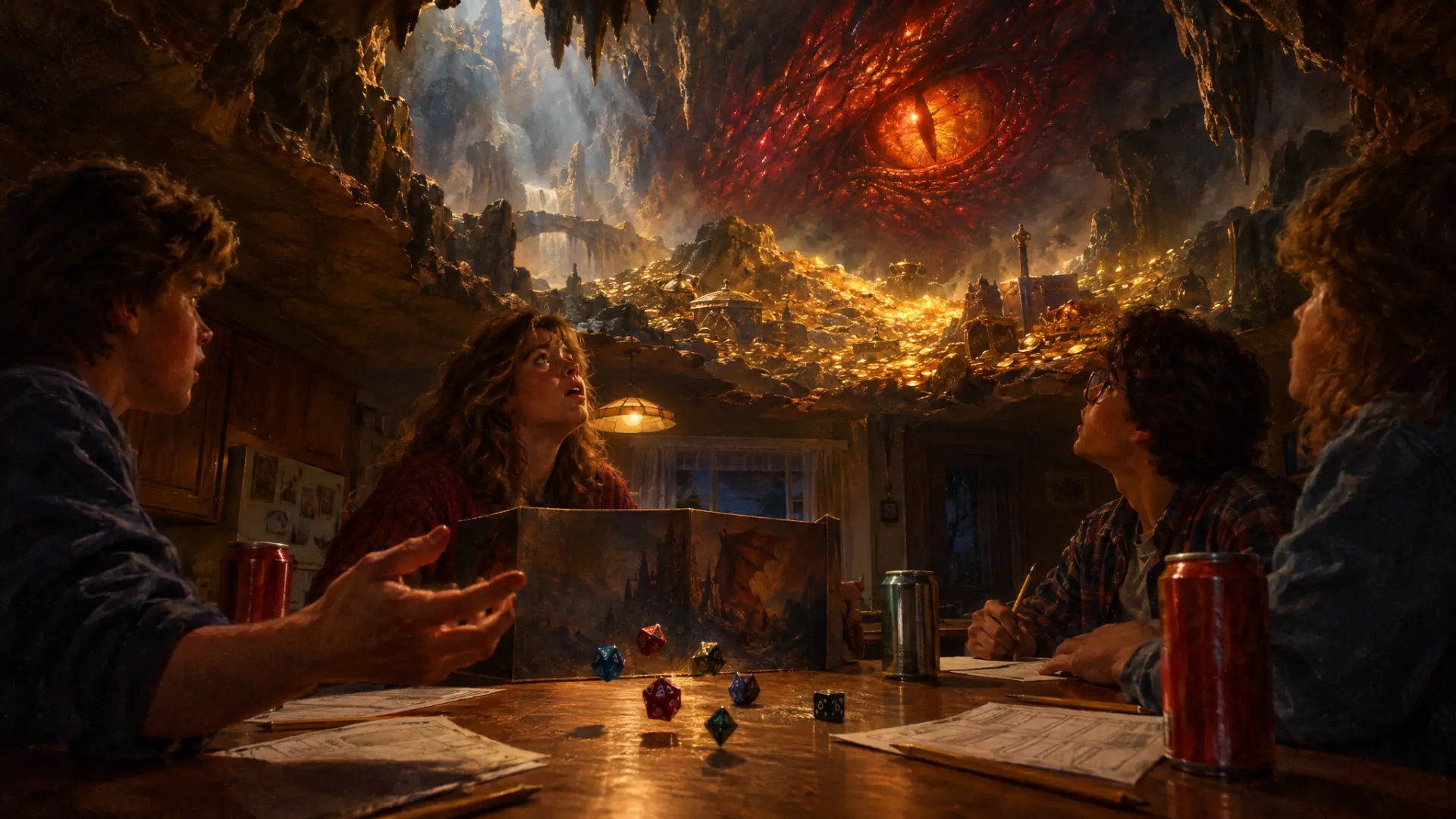
The Belgariad arrived at the height of the 1980s fantasy boom that Terry Brooks and Del Rey had opened, and it became for many readers the first epic fantasy after (or instead of) Tolkien. Its structure, an orphan with a hidden bloodline, a mentor wizard, a party of distinctive companions and a dark god waiting at the end, is so close to a textbook case of The Chosen One that it is often cited as a model of the form. For a generation that was simultaneously discovering Dungeons & Dragons and the fantasy The party, the Belgariad's squabbling fellowship read like a well-run game table.
The books have remained steady sellers for decades. The public discovery, after his death, of the couple's 1970 convictions has complicated how many readers remember them. His papers, including an unfinished manuscript his brother described as something that "plays with the genre," went to Reed College.
Marginalia
- He claimed the Belgariad began with a map doodled one morning before work, after he learned The Lord of the Rings was in its 78th printing.
- He planned a trilogy; editor Lester del Rey persuaded him to publish The Belgariad as five books, starting with Pawn of Prophecy in April 1982.
- The Belgariad's volume titles all borrow chess terms: Pawn, Queen, Gambit, Castle and End Game.
- From 1995 his books were co-credited to his wife, Leigh, who he said had been his collaborator "from the beginning."
- He and Leigh pleaded guilty in 1970 to physical abuse of their adopted children and each served a year in jail; the case became widely known only after his death.
- He left $18 million to his alma mater, Reed College, to support the study of languages and literature.
Quick answers
- Who was David Eddings?
- Author, with his uncredited and later credited wife Leigh, of The Belgariad: a five-book farm-boy-to-king quest that became one of the most widely read gateway epics of the 1980s.
- When was David Eddings born?
- David Eddings was born in 1931 in Spokane, Washington and died in 2009.
- What is David Eddings known for?
- David Eddings is best known for The Belgariad.
- Why does David Eddings matter to fantasy and games?
- Eddings distilled post-Tolkien high fantasy into brisk, funny, dialogue-driven adventure, and The Belgariad became a template for the chosen-one quest that dominated 1980s fantasy shelves.