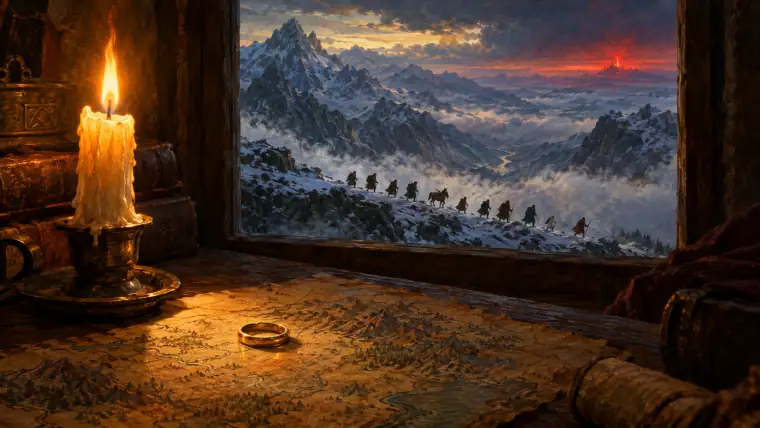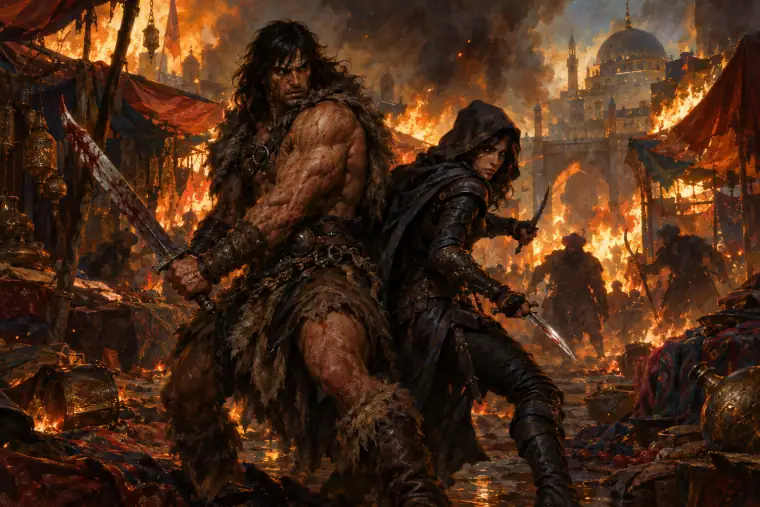
The Sword of Shannara showed publishers that readers hungry for more Middle-earth would buy a new secondary world by the hundred thousand. Its success launched Del Rey's fantasy list and the modern epic-fantasy series.
Overview
In 1977 a thick paperback with a painted cover of heroes, a druid and a sword arrived in American bookstores and did something no fantasy novel had done before: it climbed onto the New York Times trade paperback bestseller list. Terry Brooks's The Sword of Shannara was not the first Tolkien-inspired quest, but it was the first to prove that the audience The Lord of the Rings had created in the 1960s would buy a brand-new secondary world in industrial quantities. The book is where the modern epic-fantasy business begins, and for that reason it is also one of the most argued-over novels in the genre.
Origins
Brooks, a young man from Sterling, Illinois, worked on the book for about seven years, much of that time while studying law at Washington and Lee University. He drew openly on Tolkien and on the swashbuckling adventure fiction of Alexandre Dumas and Walter Scott.
The manuscript reached Lester del Rey at Ballantine Books, the house that had published the authorized American paperback of The Lord of the Rings after The Ace Paperback Affair. Lester and Judy-Lynn del Rey were building a new imprint, Del Rey Books, and they saw in Brooks exactly the book they needed: long, accessible, and aimed squarely at readers who had finished Tolkien and wanted more. Ballantine released it as a trade paperback, simultaneously with a Random House hardcover, with illustrations by The Brothers Hildebrandt, whose Lord of the Rings calendars had already defined how a generation pictured Middle-earth. That visual kinship was not an accident.
The story
The setting is the Four Lands, which careful readers eventually realize is our own world thousands of years after a nuclear catastrophe; the "Great Wars" left mutated races and buried ruins of a technological past. In Shady Vale, the half-elven Shea Ohmsford learns from the towering druid Allanon that he is the last heir of the elven king Jerle Shannara, and thus the only person who can wield the Sword of Shannara against the Warlock Lord, a sorcerer-The Dark Lord returned from death. With his foster brother Flick and a company of allies, Shea sets out on a long quest, while a second plot follows Prince Balinor's struggle to retake his throne in Callahorn.
The structure — a humble hero, a wise wizard, a fellowship that splinters into parallel storylines, and a single magical object that decides everything — maps closely onto Tolkien. The twist is the Sword itself: it defeats the Warlock Lord not by force but by compelling him to face the truth about himself.
Reception & impact
The book sold roughly 125,000 copies in its first year, an extraordinary figure for an original fantasy novel. Critics were less kind. Lin Carter, editor of the Ballantine Adult Fantasy Series line that had spent years reviving older fantasy, called it "the single most cold-blooded, complete rip-off of another book" he had read, and the charge of derivativeness has followed the novel ever since. Others praised exactly what Carter disliked: a fast, clear, commercial story that invited newcomers in.
Whatever its merits, the commercial lesson was unmistakable. The same year Del Rey published Stephen R. Donaldson's Covenant novels, and within a few years the house had built a stable of multi-volume epics that included David Eddings's The Belgariad. The long "fat fantasy" series — later embodied by The Wheel of Time — descends directly from this moment. It arrived, too, in the same season that Dungeons & Dragons was spreading through college dorms, and the two booms fed each other: quest novels gave players adventures to imitate, and the players became the next wave of readers.
Legacy
Brooks kept writing about the Four Lands for more than four decades. The Shannara universe grew to more than 30 novels across sequels, prequels and linking series, culminating in The Fall of Shannara tetralogy, whose final book, The Last Druid, appeared on October 20, 2020. Even that was not the end: The First Druids of Shannara began with Galaphile (2025), and its sequel Brona (August 2026), co-written with Delilah S. Dawson after Brooks announced a semi-retirement, is the first Shannara novel not written by Brooks alone.
The saga crossed into games early. Legend Entertainment, the Virginia studio founded by Bob Bates and Mike Verdu, released Shannara (1995), a graphic adventure game. On screen, MTV's The Shannara Chronicles, based on the second novel, The Elfstones of Shannara, premiered on January 5, 2016, moved to Spike for its second season in 2017, and was cancelled in January 2018.
Today The Sword of Shannara is read as much as a historical document as a novel: the book that turned High / Epic Fantasy from a single towering masterpiece into a genre with shelves of its own.
Marginalia
- It was the first fantasy novel to appear on the New York Times trade paperback bestseller list.
- Terry Brooks wrote it over roughly seven years, much of it while attending law school at Washington and Lee University.
- Ballantine's new Del Rey imprint issued it in trade paperback in 1977, simultaneously with a Random House hardcover; it sold about 125,000 copies in its first year.
- Lin Carter called it 'the single most cold-blooded, complete rip-off of another book' he had ever read.
- Legend Entertainment adapted the saga into a graphic adventure game, Shannara, in 1995.
- The last book of the main saga, The Last Druid, appeared on October 20, 2020; Brona (2026), co-written with Delilah S. Dawson, is the first Shannara novel not written by Brooks alone.
Quick answers
- When was The Sword of Shannara first published?
- The Sword of Shannara was first published in 1977.
- Who created The Sword of Shannara?
- The Sword of Shannara was made by Terry Brooks (author) and The Brothers Hildebrandt (illustrations).
- Who published or developed The Sword of Shannara?
- Del Rey Books and Ballantine Books.
- What kind of work is The Sword of Shannara?
- The Sword of Shannara is a novel in the High / Epic Fantasy tradition.
- Why is The Sword of Shannara important?
- The Sword of Shannara showed publishers that readers hungry for more Middle-earth would buy a new secondary world by the hundred thousand. Its success launched Del Rey's fantasy list and the modern epic-fantasy series.