Sword & Sorcery
Blood, steel and paperback covers
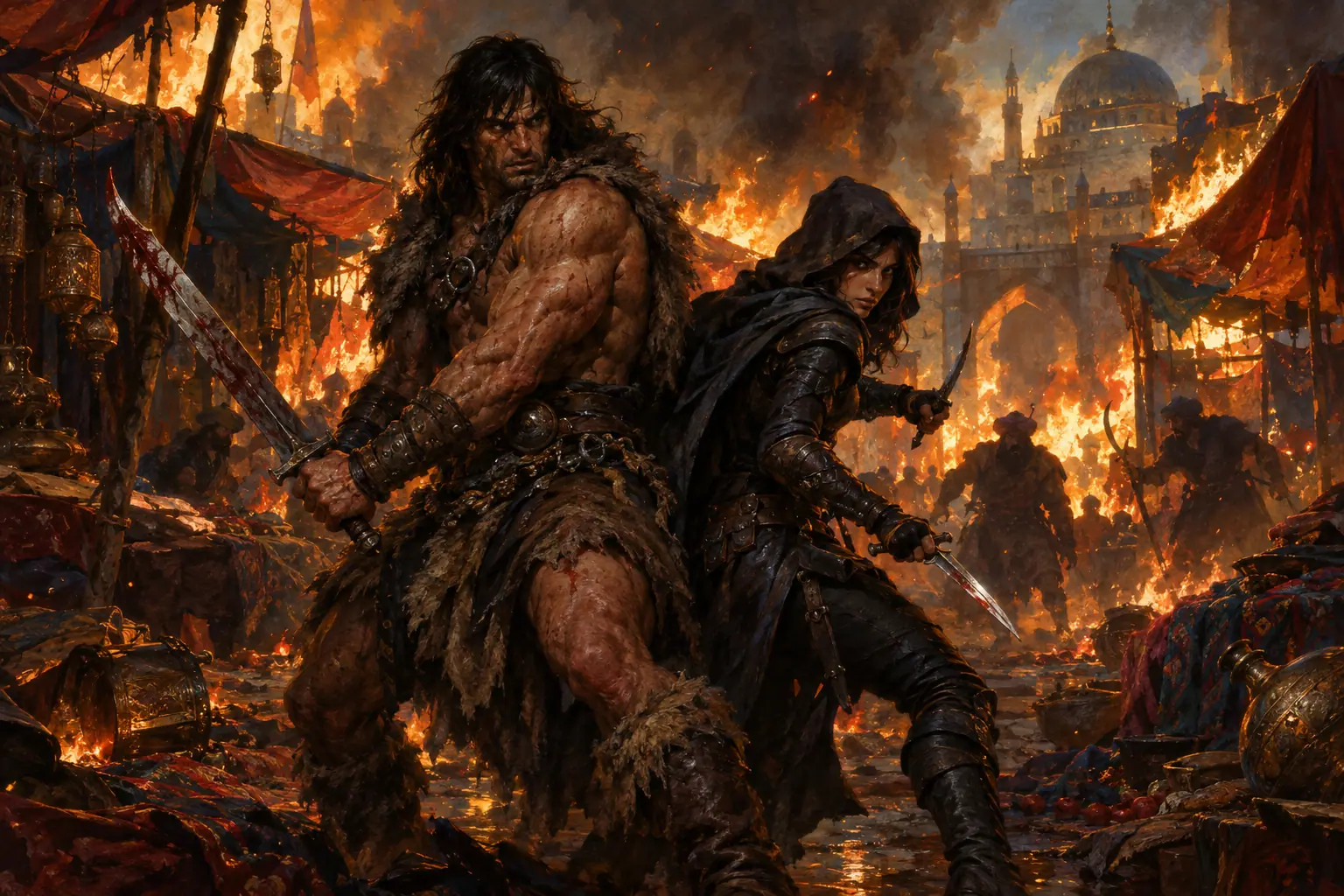
Before Tolkien's elves arrived in American paperbacks, fantasy in the United States belonged largely to the pulps. In cheap magazines such as Weird Tales, writers like Robert E. Howard, C. L. Moore, Clark Ashton Smith and Fritz Leiber told stories of barbarians, thieves and sorcerers with personal stakes and bloody consequences. Leiber eventually gave the form its name: Sword & Sorcery.
This tour follows that tradition. The first stops are the founders: Conan, Moore's Jirel of Joiry, Smith's decadent wizards and Leiber's Fafhrd and the Gray Mouser. Then comes the revival of the 1960s, when Michael Moorcock's Elric turned the barbarian hero inside out, and Frank Frazetta's Conan covers made the genre a visual phenomenon on paperback racks.
The genre's influence on games is easy to underestimate. Gary Gygax's Appendix N lists Howard, Leiber and Moorcock prominently, and D&D's thief, its fighter and its Alignment system of Law and Chaos all have roots here. The Thieves' World anthologies brought novelists and game publishers together. Conan the Barbarian took the barbarian to the cinema in 1982.
The final stops show the tradition's survival. Dungeon Crawl Classics Role Playing Game builds a whole RPG around Appendix N, and The First Law shows how much modern Grimdark owes to the pulps, even as it adds new cynicism of its own.
Notice, too, how often this lineage runs through cheap formats: pulp magazines, paperback reprints, fanzines and boxed game supplements. Sword and sorcery was rarely respectable, and that is part of why game designers felt free to borrow from it.
As you walk, compare these stories with the High / Epic Fantasy of the Tolkien tradition. Sword and sorcery rarely saves the world. Its heroes want gold, revenge or survival, and that is exactly what most D&D characters want too.
- 1Weird TalesPublication · 1923–1954
Start with a cheap Chicago pulp whose first issue appeared in 1923. Its pages carried Lovecraft, Clark Ashton Smith, Conan and Jirel of Joiry. Sword and sorcery grew up among its horror stories, and never entirely lost the smell of the crypt.
- 2Conan the CimmerianBook series · 1932–1936
Robert E. Howard's barbarian first appeared in December 1932: thief, pirate, mercenary and king in an invented prehistoric age. Notice the personal stakes and the distrust of sorcery and civilization, which define the genre.
- 3C. L. MooreAuthor · 1911–1987
In October 1934 C. L. Moore, writing under her initials, sent Jirel of Joiry into a hellish underworld to find a weapon for revenge. The genre's first great woman warrior was created only two years after Conan.
- 4Clark Ashton SmithPoet · 1893–1961
Howard's and Lovecraft's fellow contributor wrote jeweled, decadent tales of dying continents and doomed wizards. His Averoigne stories were credited as the inspiration for the 1981 D&D module Castle Amber.
- 5Fafhrd and the Gray MouserBook series · 1939–1988
Fritz Leiber's pair of rogues began in 1939, and Leiber later named the genre. Their city of Lankhmar is the model rotten city of fantasy, and the Mouser is one of the ancestors of the D&D thief.
- 6The Elric SagaBook series · 1961
Michael Moorcock's 1961 albino emperor inverted Conan: sickly, sorcerous, bound to a soul-drinking sword and caught in the war of Law and Chaos. That cosmic war became D&D's alignment system and Warhammer's Chaos.
- 7Frank FrazettaPainter · 1928–2010
From 1966, Frazetta's paintings for the Lancer Conan paperbacks showed what sword and sorcery looked like, and sold the books to a new generation. Look at any fantasy game box of the 1970s and 1980s for his influence.
- 8Appendix NMilestone · 1979
Gary Gygax's 1979 reading list in the Dungeon Masters Guide names Howard, Leiber, Moorcock, Smith and others. It is the clearest evidence of how much D&D owed to the pulps as well as to Tolkien.
- 9Thieves' WorldStory collection · 1979–1989
Robert Asprin's 1979 shared-world anthologies put many fantasy writers in one squalid city, Sanctuary. Chaosium's 1981 box gave it statistics for nine RPG systems, bringing fiction and gaming together.
- 10Conan the BarbarianFilm · 1982
John Milius's 1982 film, with Arnold Schwarzenegger and a look shaped by Frazetta's covers, carried the barbarian to the cinema and started a wave of sword-and-sorcery films.
- 11Dungeon Crawl Classics Role Playing GameTabletop RPG · 2012
Goodman Games' 2012 RPG deliberately rebuilds play around Appendix N: doomed peasants, dangerous magic and weird dungeons. It shows the pulp tradition returning to the game table on purpose.
- 12The First LawBook series · 2006–2008
End with a modern heir. Joe Abercrombie's 2006–08 trilogy of barbarians, torturers and compromised heroes is usually filed as grimdark, but its violence, cynicism and personal stakes owe much to the sword-and-sorcery tradition.