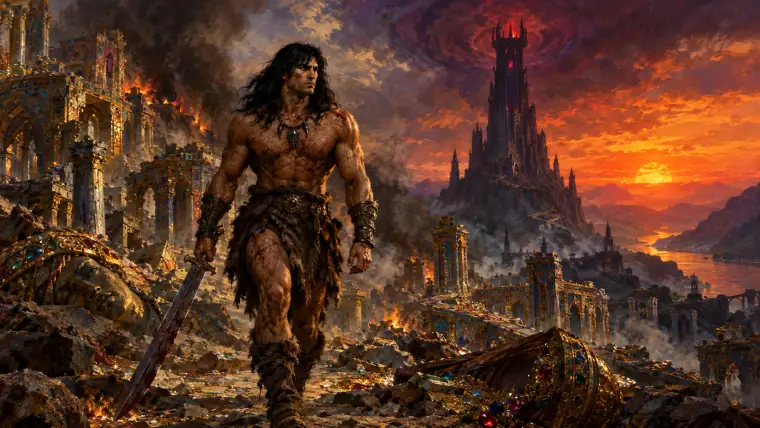
The film that carried Robert E. Howard's pulp barbarian from paperback covers to multiplexes, made Arnold Schwarzenegger a star, and set off the early-1980s wave of sword-and-sorcery cinema.
Overview
Conan the Barbarian is the moment Sword & Sorcery conquered the cinema. Directed by John Milius and released in the United States on May 14, 1982, it turned Robert E. Howard's Cimmerian, created for Weird Tales in 1932, into a sweeping, grimly serious revenge epic starring a former Mr. Universe, Arnold Schwarzenegger, in the role that made him a film star. There is little dialogue; the film is carried instead by images of steel, fire and snakes, by Ron Cobb's Dark Age sets, and by Basil Poledouris's choral score, which has long outlived the film's critical reputation.
It opened to what was reported as a record weekend for an R-rated film, earned $39.6 million in the United States, and proved that muscular, pulp-derived fantasy could fill theaters. The wave of imitators it inspired defined the look of early-1980s fantasy film.
Origins
Howard's stories, first published in the 1930s, were revived in the late 1960s by the Lancer paperback editions, edited and supplemented by L. Sprague de Camp and Lin Carter. Their Frank Frazetta covers, full of straining muscle and fur, sold the character to a new generation, and Marvel's comic book followed in 1970. In 1975 the writer Edward Summer suggested a film to the producer Edward R. Pressman, who then spent two years untangling the rights among competing claimants.
The first screenplay, by Oliver Stone, set Conan in a post-apocalyptic future in which he leads an army against thousands of mutants. When John Milius took over, he discarded most of it, keeping the revenge spine and reworking material from Howard's own stories, including "A Witch Shall Be Born" and "The Tower of the Elephant," along with cues from Kurosawa's Seven Samurai. Dino De Laurentiis came in as executive producer, with Buzz Feitshans and Raffaella De Laurentiis producing.
Shooting took place in Spain, around Madrid and in the province of Almería, beginning in January 1981, on a budget of $20 million. Ron Cobb's production design deliberately avoided the Greco-Roman look of older sword-and-sandal films, drawing instead on Dark Age cultures, while Frazetta's paintings shaped the overall visual mood. Schwarzenegger was reportedly paid $250,000. Poledouris, in his first large-scale orchestral score, recorded with a 90-piece orchestra and a 24-voice choir in Rome.
The story
The film opens with an epigraph attributed to Nietzsche, "That which does not kill us makes us stronger," and an aged narrator's invocation of an age "undreamed of." As a boy in Cimmeria, Conan watches the warlord and snake-cult leader Thulsa Doom (James Earl Jones) massacre his village and kill his parents. Enslaved, he grows to manhood chained to the Wheel of Pain, becomes a champion pit fighter, and is eventually freed. Fleeing through the wilderness, he finds an ancient Atlantean sword in a tomb.
With the Hyrkanian archer Subotai (Gerry Lopez) and the thief Valeria (Sandahl Bergman), Conan robs a Tower of Set and is recruited by the aging King Osric (Max von Sydow) to rescue his daughter from Doom's cult. Captured, he is crucified on the Tree of Woe; his companions cut him down and a wizard (Mako) revives him. In the battle that follows, Valeria is killed. Conan finally confronts Thulsa Doom at his temple, beheads him before his followers, and sets the temple ablaze.
Reception & impact
Critics were divided: many praised the action, direction and design, while others objected to the violence and to the sparse, stilted dialogue. Audiences responded more simply. The film opened with $9.6 million, reportedly breaking the R-rated record set by Halloween II, and grossed $39.6 million in the United States; worldwide totals are reported between $68.9 and $79.1 million. Later home-video sales pushed its lifetime earnings far higher.
The commercial success unleashed a flood of barbarian films, from The Beastmaster and The Sword and the Sorcerer in 1982 onward, and it established Schwarzenegger as an international star two years before The Terminator. The sequel, Conan the Destroyer, followed in 1984.
Legacy
The film sits at the junction of pulp, paint and play. It arrived as roleplaying games were exploding, and TSR soon licensed Conan himself, publishing the Conan Role-Playing Game, designed by Zeb Cook, in 1985. Howard's Hyborian tales were already on the reading lists of the hobby's founders, among them Gary Gygax's Appendix N, and the film put a moving image of that world before the same audience that was buying dice and modules.
Poledouris's score, from the pounding "Anvil of Crom" opening onward, has had a long independent life on record and in concert, and the film itself has become a cult classic. It remains the best-known screen Conan; a 2011 remake with Jason Momoa failed to displace it.
Marginalia
- Oliver Stone's first-draft script set the story in a post-apocalyptic future; Milius rewrote it, drawing on Howard's original tales.
- Its $9.6 million opening weekend was reported as a record for an R-rated debut, topping Halloween II's $7.4 million.
- Schwarzenegger was reportedly paid $250,000 for the title role.
- Basil Poledouris recorded the score in Rome with a 90-piece orchestra and a 24-member choir, and the soundtrack was mixed in mono.
- Scenes adapt Howard's stories "A Witch Shall Be Born" and "The Tower of the Elephant."
- Its look was shaped heavily by Frank Frazetta's Conan paperback covers, though Frazetta did not work on the film.
Quick answers
- When was Conan the Barbarian first released?
- Conan the Barbarian was first released in 1982 (U.S., May 14).
- Who created Conan the Barbarian?
- Conan the Barbarian was made by Robert E. Howard (creator of Conan (source stories)).
- What kind of work is Conan the Barbarian?
- Conan the Barbarian is a film in the Sword & Sorcery and Fantasy Film tradition.
- Why is Conan the Barbarian important?
- The film that carried Robert E. Howard's pulp barbarian from paperback covers to multiplexes, made Arnold Schwarzenegger a star, and set off the early-1980s wave of sword-and-sorcery cinema.