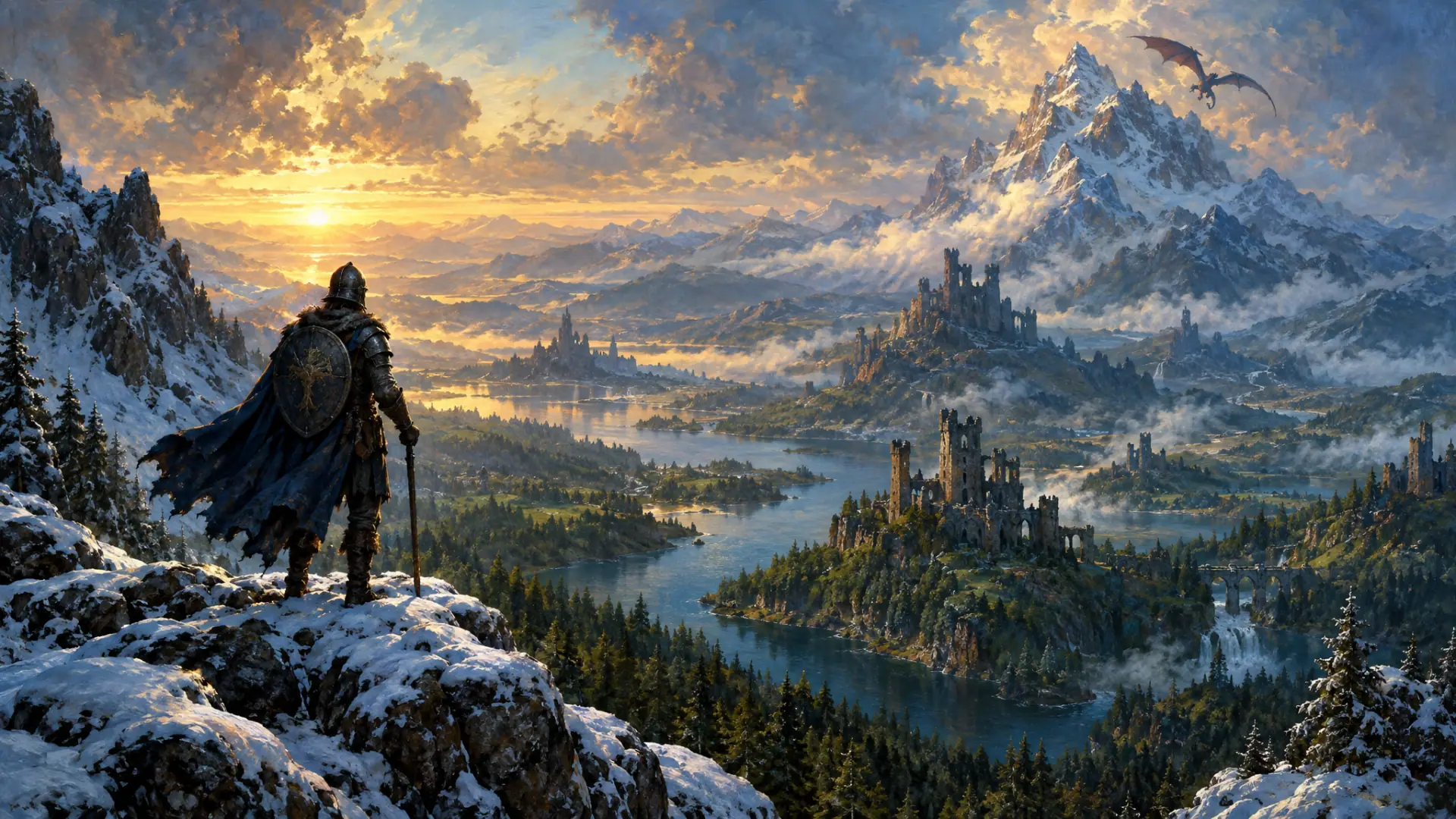
Fantasy cinema carried Tolkien, Howard, Henson and Dungeons & Dragons to audiences far beyond readers and gamers. The Lord of the Rings trilogy's Best Picture win in 2004 ended the genre's long exile as a B-movie form.
Hallmarks
- Magic, myth and the impossible made visible, which ties the genre's fortunes to special-effects technology
- Secondary worlds or enchanted corners of our own, rather than technological futures
- Quests, dark lords, chosen heroes and fellowships borrowed from myth and fantasy literature
- Creatures as stars: stop-motion skeletons, animatronic goblins, digital dragons
- Heavy reliance on adaptation, from fairy tales to Tolkien, Rowling and Dungeons & Dragons
- A long reputation as a B-genre, overturned by the blockbusters of the 2000s
What it is
Fantasy film is cinema of the impossible made literal: wizards, dragons, talking beasts, cursed swords and whole invented worlds put in front of a camera. Its stories come from myth, fairy tale and, increasingly, from fantasy novels and games. What binds it together is less a plot than a promise: that the screen will show you something that cannot exist and make you believe it for two hours.
That promise has always depended on technology. Written fantasy needs only words; filmed fantasy needs a way to put a Dragon on screen that does not look like a puppet. The genre's history is therefore a history of effects breakthroughs, stage tricks, stop-motion, animatronics, rotoscoping and computer graphics, each of which briefly made new kinds of fantasy possible.
Origins
Fantasy is almost as old as film. In the late 1890s the French stage magician Georges Méliès began filming fairy tales such as Cendrillon (1899), using stop-trick cuts and double exposures to make people vanish and transform. The silent era produced grand spectacles: Fritz Lang's two-part Die Nibelungen (1924), drawn from the Nibelung legend that also runs through the Eddas, and Douglas Fairbanks's The Thief of Bagdad (1924), out of the Arabian Nights.
Sound and color brought Disney's Snow White and the Seven Dwarfs (1937) and MGM's The Wizard of Oz (1939), fairy-tale fantasy aimed at families. After the war, effects artist Ray Harryhausen turned mythic adventure into a stop-motion showcase, from The 7th Voyage of Sinbad (1958) to Jason and the Argonauts (1963), whose sword-fighting skeletons inspired a generation of effects artists and filmmakers.
Evolution
For decades, fantasy was a minor genre. The 1970s offered the Arthurian satire Monty Python and the Holy Grail (1975) and, on television, Rankin/Bass's animated The Hobbit (1977). The following year Ralph Bakshi's The Lord of the Rings used rotoscoping to put half of Tolkien's epic into theaters.
Then, in the early 1980s, as Dungeons & Dragons became a craze, came a boom. John Boorman's Excalibur (1981) brought Malory to the screen with operatic intensity; John Milius's Conan the Barbarian (1982) turned Robert E. Howard's pulp hero and Frank Frazetta's paperback covers into a hit, and a wave of cheaper Sword & Sorcery imitators followed. Fairy-tale fantasy flourished beside it: The Dark Crystal (1982), The Last Unicorn (1982), The NeverEnding Story (1984), Jim Henson's Labyrinth (1986), The Princess Bride (1987) and George Lucas and Ron Howard's Willow (1988). Several underperformed at the box office and found devoted audiences on home video.
Computer graphics finally closed the gap between page and screen. Peter Jackson's The Lord of the Rings (2001–03), designed by Tolkien illustrators Alan Lee and John Howe, combined New Zealand landscapes, miniatures and digital armies. The Return of the King won all 11 Oscars it was nominated for, including Best Picture, and became only the second film, after Titanic, to gross more than $1 billion worldwide. The Harry Potter films (2001–11), adapting J. K. Rowling's novels, ran alongside it, and studios rushed to adapt Narnia, His Dark Materials and more. Jackson returned to Middle-earth with a three-film Hobbit (2012–14). After a notorious flop in 2000, the game that had fed on fantasy film finally got a well-received movie of its own in Dungeons & Dragons: Honor Among Thieves (2023).
How to tell it apart
Fantasy vs science-fiction film. Both show the impossible, but science fiction explains it with technology and extrapolation, while fantasy accepts magic on its own terms. The boundary blurs in science fantasy: Star Wars has spaceships, but also knights, a mystical Force and a farm-boy hero straight out of fairy tale.
Fantasy vs sword-and-sandal. The Italian peplum boom that followed Hercules (1958) filled the screen with musclemen, gods and monsters, but set them in a version of the ancient Mediterranean. Critics sometimes lump 1980s barbarian films into "sword and sandal," often as an insult; the useful distinction is that sword-and-sandal is mythologized history, while Sword & Sorcery and high fantasy build invented worlds.
Fantasy vs horror. Both deal in the supernatural. Horror uses it to frighten, and the monster is the point; fantasy uses it to create wonder, and the monster is an obstacle on a quest. Labyrinth's goblins are mischievous; a vampire film's vampire is the threat.
Fantasy film vs fantasy television. A film has two or three hours, so adaptations compress; The Lord of the Rings cut Tom Bombadil. Television's long serial form let Game of Thrones keep sprawling casts and slow-burning politics that cinema could not.
Where to start
- The Thief of Bagdad (1924): silent-era spectacle and the ancestor of the swashbuckling fantasy adventure.
- Jason and the Argonauts (1963): Harryhausen's stop-motion masterpiece.
- Excalibur (1981) and Conan the Barbarian (1982): the two poles of the 1980s boom, myth and muscle.
- Labyrinth (1986) and The Princess Bride (1987): fairy-tale fantasy at its most beloved.
- The Lord of the Rings (2001–03): the genre's summit, and the reason studios take it seriously.
- Honor Among Thieves (2023): a tabletop game's worldview, from owlbears to failed plans, translated to film.
Marginalia
- The Return of the King won all 11 Academy Awards it was nominated for, and was the first fantasy film to win Best Picture.
- Peter Jackson first read Tolkien after seeing Ralph Bakshi's rotoscoped 1978 Lord of the Rings.
- Ray Harryhausen's stop-motion skeletons in Jason and the Argonauts (1963) remain a touchstone of screen creature effects.
- Conan the Barbarian (1982) opened at number one at the US box office and set off a wave of low-budget sword-and-sorcery films.
- In Willow (1988), Industrial Light & Magic pioneered the digital morphing later used in Terminator 2.
- The villain's two-headed dragon in Willow is called an Eborsisk, a jab at critics Roger Ebert and Gene Siskel.
Quick answers
- What is Fantasy Film?
- From Méliès's stage-trick fairy tales to Peter Jackson's Middle-earth, fantasy film has always been a race between imagination and effects technology, and for most of a century the effects lost.
- What are the hallmarks of Fantasy Film?
- Magic, myth and the impossible made visible, which ties the genre's fortunes to special-effects technology; Secondary worlds or enchanted corners of our own, rather than technological futures; Quests, dark lords, chosen heroes and fellowships borrowed from myth and fantasy literature; Creatures as stars: stop-motion skeletons, animatronic goblins, digital dragons; Heavy reliance on adaptation, from fairy tales to Tolkien, Rowling and Dungeons & Dragons; A long reputation as a B-genre, overturned by the blockbusters of the 2000s.
- When did Fantasy Film emerge?
- Late 1890s, the trick films of Georges Méliès.
- What are the key works of Fantasy Film?
- The Lord of the Rings, Excalibur, Conan the Barbarian, Labyrinth, Willow, The Lord of the Rings film trilogy and Dungeons & Dragons: Honor Among Thieves.