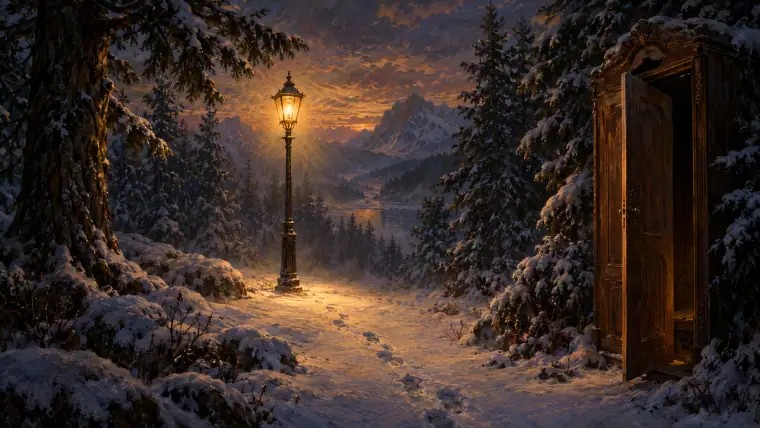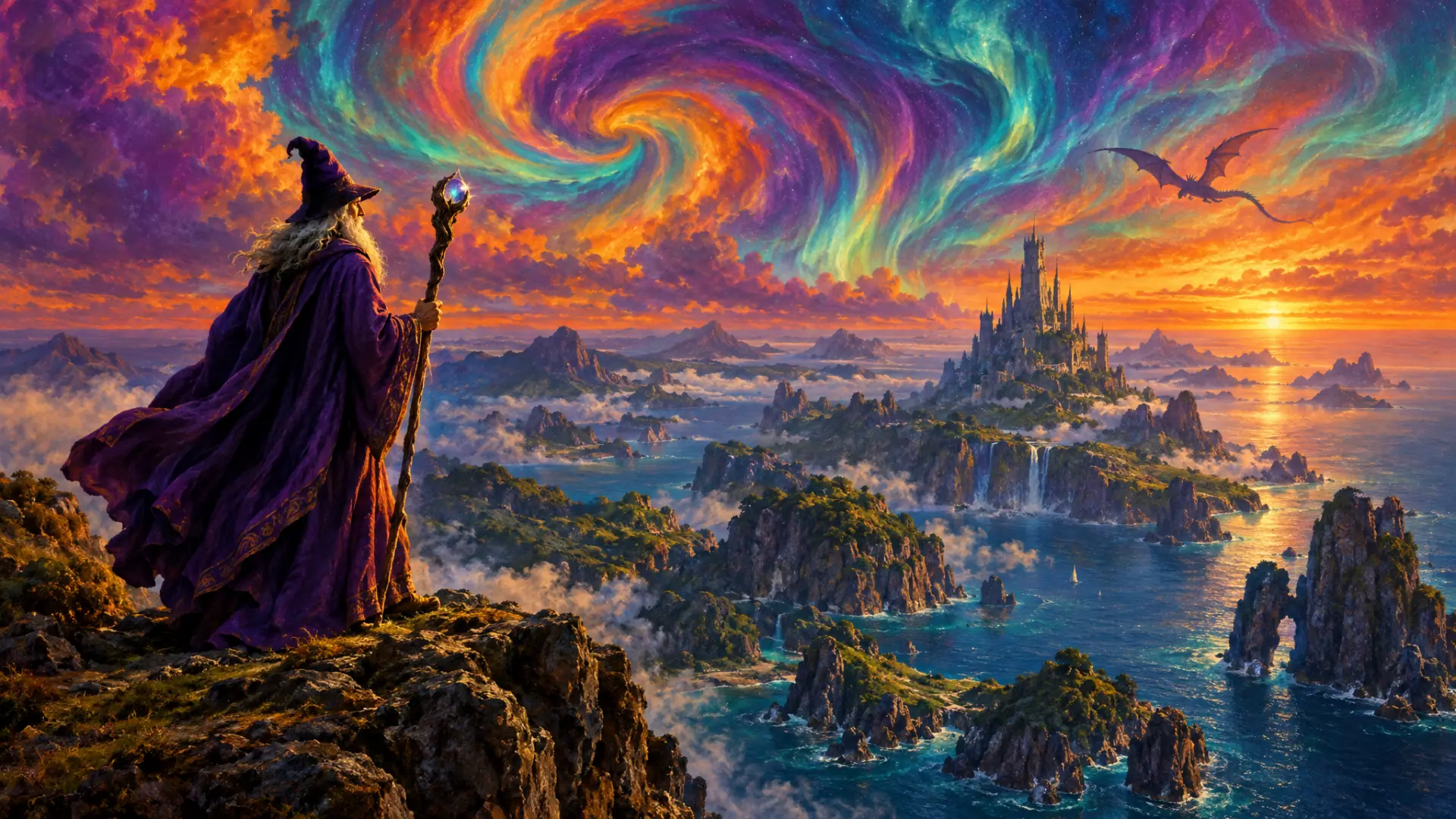
The great German contribution to postwar fantasy, The Neverending Story made the act of reading its subject, and its 1984 film put the Nothing, Falkor and Atreyu in front of a generation that would grow up to play fantasy games.
Overview
Few novels are as physically aware of themselves as Die unendliche Geschichte. Its first edition, published by Thienemann Verlag in Stuttgart in 1979, was a copper-colored hardback printed in two inks: red for the chapters set in the ordinary world, green for those set in Fantastica. Inside the story, a boy named Bastian Balthazar Bux holds a copper-colored book bearing the same emblem of two snakes biting each other's tails. Michael Ende had written a fantasy about the reader's relationship with fantasy — and it became one of the best-selling books in German publishing history.
Origins
Ende, the son of the surrealist painter Edgar Ende, had already won acclaim for the children's novels Jim Button and Momo. He conceived the book as a meditation on imagination, escapism and responsibility, and insisted that it first appear in hardcover so that the object in the reader's hands would match the one in Bastian's. The novel's 26 chapters each open with a successive letter of the alphabet, in illuminated initials by Roswitha Quadflieg.
The story
Bastian, an overweight, bullied, motherless boy, hides in a bookshop, steals a strange book called The Neverending Story and takes it to his school's attic. He reads of Fantastica, a land being devoured by the Nothing, and of its Childlike Empress, who is dying. The young warrior Atreyu, accompanied by the luckdragon Falkor, is sent on a Great Quest to find a cure, and gradually Bastian realizes that the characters can hear him — that the cure is a human child who will give the Empress a new name.
This is only the first half, and the half most people remember. In the second, Bastian enters Fantastica and, wielding the amulet AURYN with its inscription "Do What You Wish," reshapes the world with his wishes. Each wish costs him a memory of his real life. The boy who wanted to escape becomes a tyrant who cannot find his way home, and the book becomes a warning about the very thing it celebrates: a Portal Fantasy that questions why we walk through the door. Ende repeatedly breaks off subplots with the refrain "But that is another story and shall be told another time."
Reception & impact
The novel sat at the top of Der Spiegel's bestseller list for 113 weeks. Ralph Manheim's English translation followed in 1983, and by 2010 the book had been translated into 36 languages and sold more than eight million copies.
Its fame multiplied with Wolfgang Petersen's 1984 film, an English-language West German production with a pop theme song and a puppet luckdragon that became a touchstone of 1980s childhood alongside Labyrinth. The film adapted only the first half of the book, and Ende detested it; he asked for production to be halted or the title changed, sued the producers and lost, and later called it and its 1990 sequel a "gigantic melodrama made of kitsch and commerce, plush and plastic."
Games followed the film. Ocean Software's 1985 The Neverending Story was a text adventure for home computers such as the ZX Spectrum and Commodore 64, one of a string of licensed adventures that brought 1980s fantasy films into the bedroom-computer boom.
Legacy
The Neverending Story sits in the lineage of Alice's Adventures in Wonderland and The Chronicles of Narnia — Children's & YA Fantasy as a way of thinking about the mind — but it is uniquely self-referential. The idea that a story needs its reader, and that a reader can be changed or consumed by a story, would echo through later fiction and games about immersion, from interactive fiction to the virtual worlds of Sword Art Online, where characters literally cannot leave the fantasy.
Ende died in 1995, but his book has never gone out of print, and a new film series from See-Saw Films and Michael Ende Productions has been announced. Bastian's lesson, earned the hard way, is that it is good to visit Fantastica — and essential to come back.
Marginalia
- The German first edition was printed in two colors: red for the human world, green for Fantastica.
- It held the top of Der Spiegel's bestseller list for 113 weeks.
- Ralph Manheim's English translation appeared in 1983.
- Ende called Wolfgang Petersen's 1984 film and its 1990 sequel a 'gigantic melodrama made of kitsch and commerce, plush and plastic.'
- Ocean Software released a Neverending Story text adventure in 1985.
- Its 26 chapters each begin with a successive letter of the alphabet.
Quick answers
- When was The Neverending Story first published?
- The Neverending Story was first published in 1979 (German); 1983 (English).
- Who created The Neverending Story?
- The Neverending Story was made by Michael Ende (author).
- What kind of work is The Neverending Story?
- The Neverending Story is a novel in the Portal Fantasy, Children's & YA Fantasy and Fairy-Tale Fantasy tradition.
- Why is The Neverending Story important?
- The great German contribution to postwar fantasy, The Neverending Story made the act of reading its subject, and its 1984 film put the Nothing, Falkor and Atreyu in front of a generation that would grow up to play fantasy games.