The defining portal fantasy: seven short books that made another world reachable from an ordinary English house, and that remain among the best-selling fantasy ever published.
Overview
The Chronicles of Narnia are seven short novels by C. S. Lewis, published between 1950 and 1956, about English children who pass from the ordinary world into Narnia — a country of talking animals, fauns, giants and dryads created and ruled by Aslan, a great lion. They are the purest example of portal fantasy: the magic lies not in the world alone but in the door, and in what the children bring back when they return. With an estimated 120 million copies sold in 47 languages, they are among the most widely read fantasy books ever written.
Origins
Lewis, an Oxford don and one of the most famous Christian apologists of his day, said the series began with a single image that had been in his head since he was about sixteen: a faun carrying an umbrella and parcels through a snowy wood. In 1939 he began a story about four children sent away from London because of the air raids — echoing the evacuee children who actually stayed at his home, the Kilns — and he returned to it a decade later. The Lion, the Witch and the Wardrobe was published by Geoffrey Bles in October 1950.
The rest came quickly: Prince Caspian (1951), The Voyage of the Dawn Treader (1952), The Silver Chair (1953) and The Horse and His Boy (1954) from Bles, then The Magician's Nephew (1955) and The Last Battle (1956) from The Bodley Head. Lewis drew freely on classical myth, medieval romance, Norse legend and Christian theology, and on the Victorian fantasist George MacDonald, whose Phantastes he credited with "baptizing" his imagination. His friend J. R. R. Tolkien, who heard early chapters among the Inklings, thought the mixture — Father Christmas beside fauns and a Christian lion — careless, and never warmed to the books.
The story
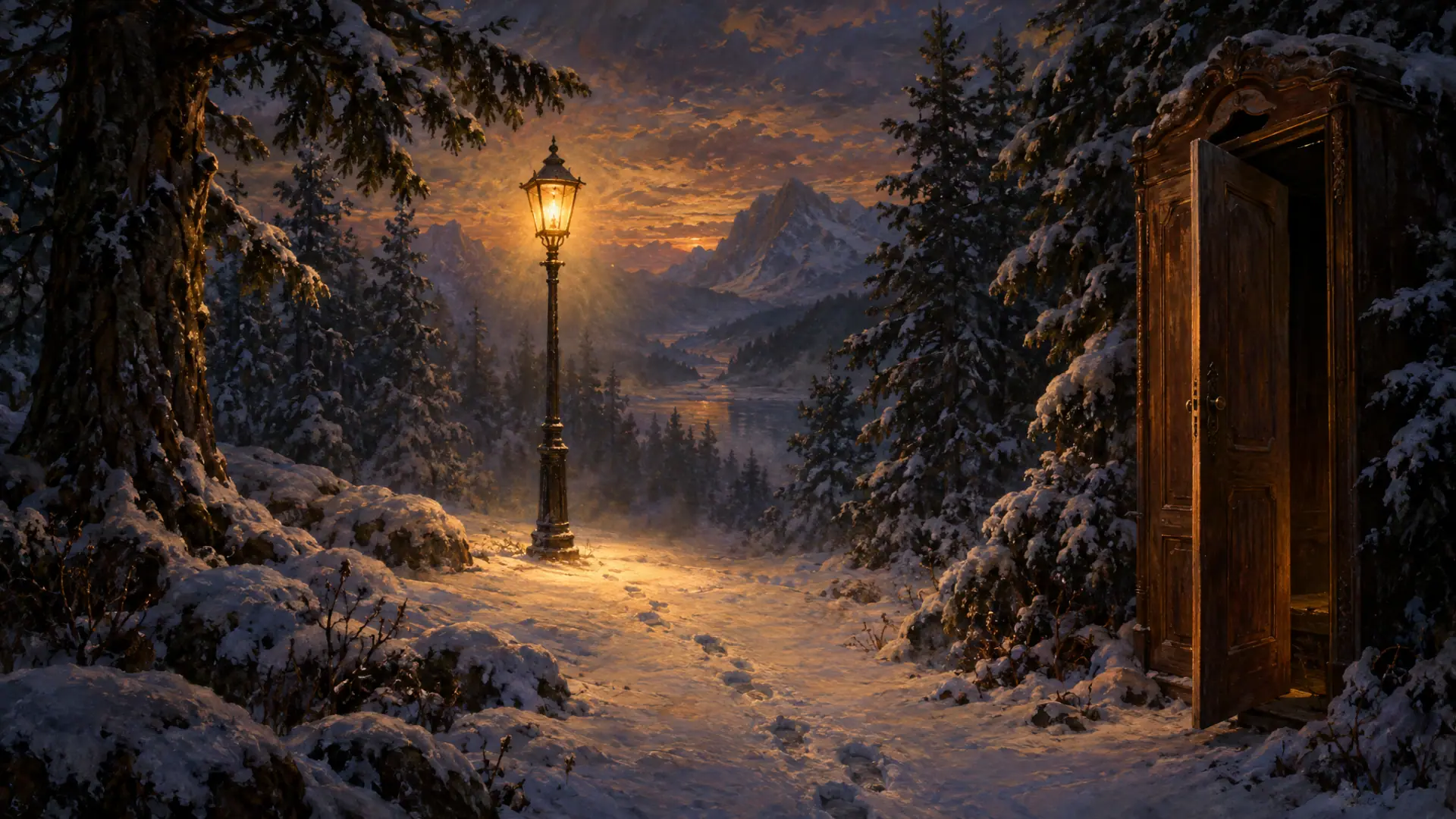
In The Lion, the Witch and the Wardrobe, Lucy, Edmund, Susan and Peter Pevensie find Narnia locked in a hundred-year winter by the White Witch. Edmund betrays his siblings for enchanted Turkish Delight; Aslan gives his life on the Stone Table to redeem him and rises again, and the children are crowned kings and queens. Later books return the Pevensies to a Narnia centuries older (Prince Caspian), sail to the edge of the world (The Voyage of the Dawn Treader), rescue a bewitched prince from an underground realm (The Silver Chair), and follow a runaway boy and a talking horse across the southern desert of Calormen (The Horse and His Boy). The Magician's Nephew tells of Narnia's creation, sung into being by Aslan, and explains the lamp-post and the wardrobe. The Last Battle ends Narnia itself, in an apocalypse and a passage into a truer country beyond.
Reception & impact
The books were popular from the start, and The Last Battle won the Carnegie Medal in 1956. Pauline Baynes's delicate line drawings became inseparable from the text. The reading order has been argued over ever since HarperCollins renumbered the series in 1994 to follow Narnian chronology rather than publication; many readers and scholars still argue that the wardrobe should come first.
Criticism has been persistent too. Philip Pullman condemned the books' theology and their treatment of Susan, who is excluded from the final paradise, apparently for growing interested in "nylons and lipstick and invitations." Pullman's His Dark Materials was written in part as an answer to Lewis. Others have objected to the depiction of the Calormenes. The books survive the arguments because the storytelling — brisk, funny, sensuous, direct — is so strong.
Legacy
Narnia fixed the portal story's grammar for generations of writers: an ordinary threshold, children who become royalty, time that runs differently on the other side, and the bittersweet return. Its fingerprints are visible in Harry Potter's platform nine and three-quarters, in Pullman's windows between worlds, and in the countless doors, wardrobes and mirrors of later children's fantasy. Unlike Tolkien's work, it left little direct mark on roleplaying games; its influence runs instead through children's literature and the screen.
Adaptations have been numerous: a 1979 animated television film of the first book; the BBC's live-action serials (1988–90); and three Hollywood features — The Lion, the Witch and the Wardrobe (2005), Prince Caspian (2008) and The Voyage of the Dawn Treader (2010). In 2018 the Lewis estate licensed the series to Netflix, and a film of The Magician's Nephew written and directed by Greta Gerwig was scheduled for release in 2027.
Marginalia
- The first image came to Lewis at about sixteen: a faun carrying an umbrella and parcels through a snowy wood.
- Children evacuated from London stayed at Lewis's Oxford home, the Kilns, during the Second World War; the first book begins with four such evacuees.
- Tolkien, Lewis's closest friend in The Inklings, disliked the books' jumble of mythologies.
- The Last Battle won the Carnegie Medal in 1956, the only Narnia book to do so.
- In 1994 HarperCollins renumbered the books in internal chronological order, putting The Magician's Nephew first — a choice still debated.
- Pauline Baynes, who illustrated all seven books, had earlier illustrated Tolkien's Farmer Giles of Ham.
Quick answers
- When was The Chronicles of Narnia first published?
- The Chronicles of Narnia was first published in 1950–56.
- Who created The Chronicles of Narnia?
- The Chronicles of Narnia was made by C. S. Lewis (author).
- What kind of work is The Chronicles of Narnia?
- The Chronicles of Narnia is a book series in the Portal Fantasy and Children's & YA Fantasy tradition.
- Why is The Chronicles of Narnia important?
- The defining portal fantasy: seven short books that made another world reachable from an ordinary English house, and that remain among the best-selling fantasy ever published.