The first great adult fantasy novel of the Victorian age, Phantastes 'baptised' the imagination of C. S. Lewis and helped set the template for the portal into another world that runs from Narnia to the fantasy video game.
Overview
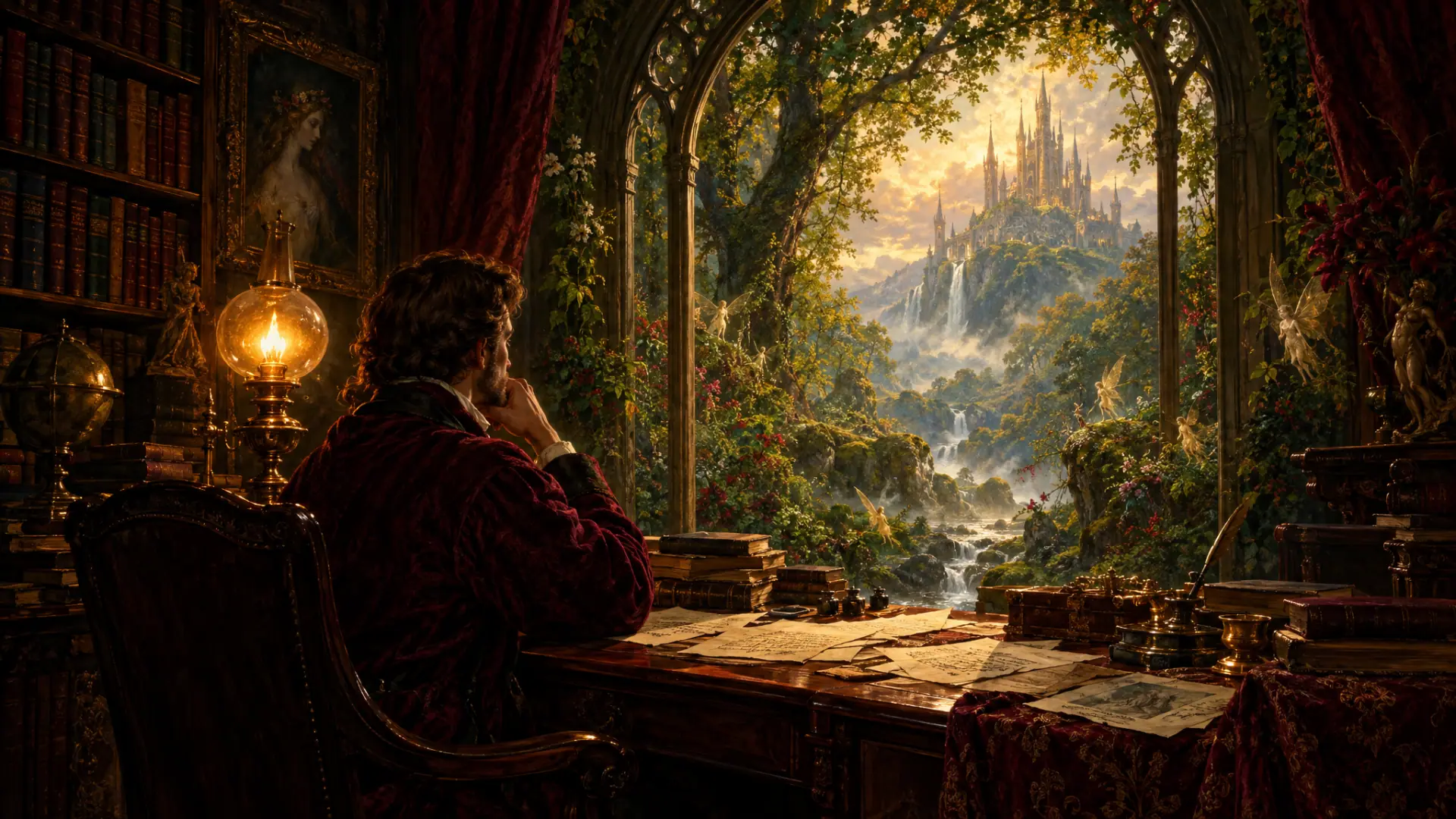
On the morning after his twenty-first birthday, a young man named Anodos wakes to find the basin in his bedroom overflowing into a stream, the green carpet sprouting grass and daisies, and his furniture turning into trees. He has entered Fairy Land. Phantastes, published in 1858 by the Scottish minister and writer George MacDonald, follows him through a loosely linked sequence of enchantments before returning him, changed, to the ordinary world.
It is a strange, digressive, luminous book, and one of the first full-length fantasies written for adults rather than children. Its reputation rests less on sales than on the writers it transformed — above all C. S. Lewis, who said it had baptized his imagination.
Origins
MacDonald, born in Aberdeenshire in 1824, trained for the Congregationalist ministry but was forced out of his pulpit over his unorthodox theology, and turned to writing to support a large family. Phantastes was his first prose fantasy. It draws on German Romanticism — Novalis, whose words supply the epigraph for the book, and E. T. A. Hoffmann — and on the English and Scottish fairy traditions, and it is threaded with poems and songs. Its subtitle, "A Faerie Romance for Men and Women", announced that fairy stories could be serious adult literature.
MacDonald went on to write the children's classics At the Back of the North Wind (1871), The Princess and the Goblin (1872) and The Princess and Curdie (1883), fairy tales such as "The Golden Key", and a second adult fantasy, Lilith (1895). He was also a friend and mentor to Lewis Carroll: the enthusiasm of MacDonald's children for a draft of Alice's Adventures in Wonderland helped persuade Carroll to publish it.
The story
Anodos is warned early to beware the Ash and the Alder. He is stalked by the Ash, a malevolent tree-spirit, and later seduced by the Alder-maiden, who hands him over to the Ash. He meets the knight Sir Percivale, whose armor is rusted from his own encounter with her. In the cottage of an ogress he opens a forbidden door and acquires a Shadow, which follows him thereafter, withering whatever it falls on and making him doubt all beauty.
He reaches a fairy palace full of marble statues, where he reads a story within the story — the tale of Cosmo, a student of Prague who loves a woman trapped in an enchanted mirror — and sings a marble lady to life, only to lose her. Later he joins two princely brothers to fight three giants in a tower; the brothers die. At last, serving as squire to the knight he once scorned, Anodos exposes a sinister ceremony in a forest temple, dies in the struggle, and wakes back in his own world, having been gone twenty-one days. His final conviction is that "a great good is coming".
Reception & impact
Phantastes was not a popular success, but it found devoted readers. G. K. Chesterton credited MacDonald's The Princess and the Goblin with changing his whole existence. W. H. Auden admired him. Lewis bought a copy of Phantastes at the bookstall of Leatherhead railway station in 1916, and wrote in Surprised by Joy that "that night my imagination was, in a certain sense, baptized; the rest of me, not unnaturally, took longer." He later called MacDonald his master, compiled an anthology of his writings, and cast him as his guide to heaven in The Great Divorce (1945).
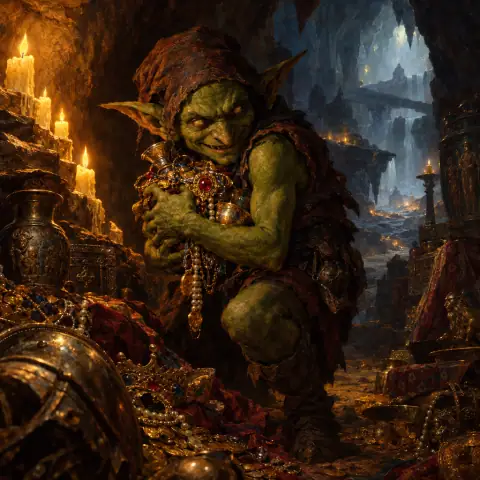
J. R. R. Tolkien was more ambivalent about MacDonald's moralizing, but acknowledged a debt: the goblins of The Hobbit, he wrote, owed a good deal to the goblin tradition as it appears in MacDonald. His late story Smith of Wootton Major (1967) began as an intended preface to MacDonald's "The Golden Key".
Legacy
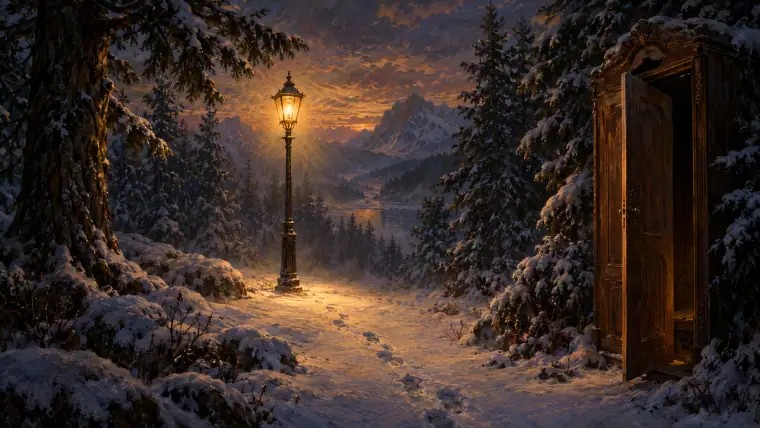
The book's most visible legacy is the doorway. Anodos passes into Fairy Land not through a magic ritual but through his own bedroom — the ordinary room that opens onto another world — and he meets there a knight of the Round Table, trees that hate, and a mirror that holds a trapped soul. That device, the everyday threshold to an enchanted realm, reaches its most famous form in Lewis's wardrobe in The Chronicles of Narnia, and it defines Portal Fantasy as a genre. The malevolent tree-spirits of Fairy Land also anticipate the hostile forests of later fantasy, Tolkien's Old Forest included.
When the Ballantine Adult Fantasy series reissued Lilith in 1969 and Phantastes in April 1970, Lin Carter was presenting MacDonald to the paperback generation as one of the founders of the genre, on the same racks as Dunsany, Morris and Eddison. Every fantasy game that opens with a player waking in their own room and stepping out into a world of wonder is walking, knowingly or not, the path Anodos found in 1858.
Marginalia
- The hero's name, Anodos, comes from the Greek for 'pathless'.
- Anodos enters Fairy Land when the basin in his room overflows into a stream and the carpet's pattern turns to grass and flowers.
- C. S. Lewis bought a copy at Leatherhead railway station in 1916 and later wrote that that night his imagination was 'baptized'.
- Lewis called MacDonald his master and made him his guide through the afterlife in The Great Divorce (1945).
- Tolkien wrote that his goblins owed 'a good deal' to the goblin tradition as it appears in George MacDonald.
- Ballantine's Adult Fantasy line reprinted MacDonald's Lilith in 1969 and Phantastes in 1970.
Quick answers
- When was Phantastes first published?
- Phantastes was first published in 1858.
- Who created Phantastes?
- Phantastes was made by George MacDonald (author).
- What kind of work is Phantastes?
- Phantastes is a novel in the Fairy-Tale Fantasy and Portal Fantasy tradition.
- Why is Phantastes important?
- The first great adult fantasy novel of the Victorian age, Phantastes 'baptised' the imagination of C. S. Lewis and helped set the template for the portal into another world that runs from Narnia to the fantasy video game.