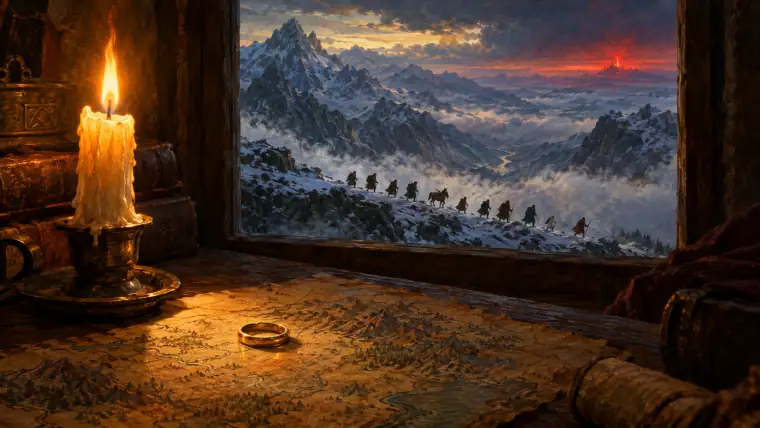
A pirated Tolkien paperback, a campus craze and a shelf of unicorn-stamped reprints turned fantasy into a mass-market genre, and gave a generation of gamers its reading list.
In the autumn of 1965 an American college student browsing a campus bookstore could find two different paperback editions of The Lord of the Rings on the same rack. One, from Ace Books, had been published earlier that year without the author's permission. The other, from Ballantine Books, carried on its back cover a message from the author himself, asking readers who respected courtesy to living authors to buy only the authorized edition. The student who picked up either one was joining the first great fantasy craze of the modern age. Within a few years "Frodo Lives!" would be a slogan of the counterculture, Middle-earth maps would hang in dormitories, and publishers who had believed there was no market for adult fantasy would be racing to find the next Tolkien. This chapter is the story of how fantasy became a genre, with its own imprints, artists, conventions, awards and bestsellers, and of the paperback shelf from which a generation of wargamers took the monsters, heroes and spells of their new game.
The pirate and the professor
Before the 1960s, no major American paperback house would touch long epic fantasy; the conventional wisdom was that nobody would buy it. The Lord of the Rings had sold respectably in hardcover through Houghton Mifflin, but it was expensive and obscure. Donald A. Wollheim, the veteran fan-editor running Ace Books, believed that Tolkien's American copyright had lapsed on a technicality, and in 1965 Ace published its own three-volume paperback without paying the author. It was the first mass-market paperback edition of the book.
Tolkien, who had resisted a paperback, now had every reason to want one. He hurried through a revision of the text so that an authorized edition would contain something new, and Ballantine Books printed it in October 1965. Its back cover carried Tolkien's appeal to readers, and Tolkien himself told his many American correspondents what Ace had done. Fans, science-fiction writers and booksellers took his side, and the pressure worked: Ace agreed to pay Tolkien royalties and to let its edition go out of print. (See The Ace Paperback Affair.) The quarrel was the best publicity the book ever had. Ballantine's edition sold a quarter of a million copies within ten months, alongside the paperback The Hobbit Ballantine had issued that August. A professor's philological romance, a decade old, became the most talked-about book on American campuses.
Frodo lives
Why then? Part of the answer was simply price: paperbacks put the book in the hands of students. But The Lord of the Rings also spoke to the moment. A story in which small, peaceable people resist a militarized industrial power, in which the wizard and the elves are ecologists before the word was fashionable, and in which the quest is to destroy the ultimate weapon, was read by the Vietnam-era counterculture as its own. "Frodo Lives!" appeared on badges and walls, a playful answer to the evangelical "Jesus Lives." "Gandalf for President" was another. Tolkien, a conservative Catholic in his seventies, was bemused; his fan mail and visitors became so overwhelming that he removed his number from the telephone directory, and he and his wife Edith eventually moved to the seaside at Bournemouth.
Fans organized. The Tolkien Society of America formed in the mid-1960s; in 1967 Glen GoodKnight founded the Mythopoeic Society in Southern California to study Tolkien, Lewis and Charles Williams together, and in 1972 it absorbed the American Tolkien society. In Britain, Vera Chapman announced the "hopeful conception" of The Tolkien Society in November 1969; it held its first meeting the following year. Rock musicians put Middle-earth into their lyrics: Led Zeppelin's "Ramble On," recorded in 1969, mentions Mordor and Gollum. That same year Tolkien sold the film, stage and merchandising rights to his two great books to United Artists, the beginning of a long legal history (see The Tolkien Rights Saga).
Tolkien died on September 2, 1973. By then his work had changed the book trade for good.
Barbarians on the spinner rack
Tolkien's success sent publishers hunting through the back catalog for anything that looked like fantasy, and the first place they found it was the pulps. In 1966 the small paperback house Lancer Books began what became a twelve-volume paperback series (completed by Ace after Lancer folded) of Robert E. Howard's Conan stories, edited by L. Sprague de Camp and padded out with pastiches by de Camp and Lin Carter. Frank Frazetta, who won the Hugo Award for best professional artist in 1966, painted eight of the twelve covers. His Conan, all muscle and menace, standing on a hill of corpses or wading through a swamp with a woman at his feet, redefined how sword-and-sorcery looked and set the visual template for a generation of fantasy paperbacks, heavy-metal album covers and early roleplaying-game art.
The genre also got a new name and a new anti-hero. In the fanzine Amra, a young British writer, Michael Moorcock, asked what to call Howard's kind of fiction; in April 1961 Fritz Leiber proposed "sword-and-sorcery" (see Pulps, Weird Tales & Sword-and-Sorcery). That June, Moorcock's own Elric appeared in the British magazine Science Fantasy: a sickly, albino, drug-dependent emperor of a decadent inhuman race, bound to a soul-drinking black sword, Stormbringer, and caught in a cosmic war between Law and Chaos. Elric was everything Conan was not: tormented, intellectual, doomed. As editor of New Worlds from 1964, Moorcock championed the experimental "New Wave" in science fiction, and in his 1978 essay "Epic Pooh" he attacked Tolkien and Lewis as purveyors of comforting nursery conservatism. The argument between the cozy and the dark, the Shire and Melniboné, would run through fantasy to Grimdark.
Wollheim, meanwhile, left Ace in 1971 and with his wife Elsie founded DAW Books, the first publisher devoted exclusively to science fiction and fantasy; its first book, in 1972, was Andre Norton's Spell of the Witch World.
The unicorn's head
The most ambitious response to the Tolkien boom came from the publishers who had benefited most. Ian and Betty Ballantine, having made a fortune on Middle-earth, hired the writer and enthusiast Lin Carter to build a library of the genre's classics. The Ballantine Adult Fantasy Series series ran from May 1969 to April 1974, sixty-five titles under a distinctive unicorn's-head colophon, each introduced by Carter. It brought back into print books that had been out of reach for decades: William Morris's The Well at the World's End and The Wood Beyond the World, Eddison, Dunsany's The King of Elfland's Daughter, James Branch Cabell, Hope Mirrlees's Lud-in-the-Mist, George MacDonald's Phantastes, and collections of Clark Ashton Smith. It also published original work, including Katherine Kurtz's Deryni Rising (1970) and Evangeline Walton's retellings of The Mabinogion, and a revised edition of Poul Anderson's The Broken Sword (1971). Carter's Imaginary Worlds (1973), a history of the genre, gave readers a map of their own tradition.
Carter was a natural choice. A Florida-born pulp devotee and prolific author of Conan pastiches and sword-and-planet adventures, he had already written Tolkien: A Look Behind "The Lord of the Rings" (1969), one of the first popular guides to Middle-earth's sources, which led readers from Tolkien back to the Eddas, Morris and Dunsany, exactly the path the Ballantine series then let them walk.
The series ended when Ballantine was sold to Random House and its founders' patronage ended, but it had done its work. For the first time there was a canon of fantasy, a sense that Morris, Dunsany, Eddison, Tolkien and the pulp writers belonged to one tradition. When Gary Gygax compiled his list of inspirational reading for the Dungeon Masters Guide in 1979 (Appendix N), he was describing the shelf the Ballantine series, Lancer and Ace had built.
A new generation of wizards
The boom was not all reprints. The late 1960s and 1970s produced a remarkable run of original fantasy, much of it by writers who had absorbed Tolkien but wanted to do something different.
Children's fantasy flowered first. Lloyd Alexander's five-book The Chronicles of Prydain (1964–68), set in a Wales-like land drawn from The Mabinogion, followed the assistant pig-keeper Taran to adulthood; its last volume, The High King, won the 1969 Newbery Medal. Susan Cooper began The Dark Is Rising with Over Sea, Under Stone (1965) and completed it between 1973 and 1977; its fourth book, The Grey King, won the Newbery Medal. In 1968 the small press Parnassus published Ursula K. Le Guin's A Wizard of Earthsea, the first of the Earthsea books, a coming-of-age story set in an archipelago where magic depends on knowing things' true names and its brown-skinned hero must confront a shadow he himself has released. The Farthest Shore won the 1973 National Book Award for children's books. In a 1972 talk later published as "From Elfland to Poughkeepsie," Le Guin argued that fantasy demanded a truly distinct style and not a bargain-basement imitation of Tolkien.
For adults, Peter S. Beagle's The Last Unicorn (1968) was a melancholy, funny fable of the last Unicorn searching for her vanished kind. Anne McCaffrey's Dragonriders of Pern blurred fantasy and science fiction with telepathic dragons bonded to their riders; "Weyr Search" (1967) made her the first woman to win a Hugo Award for fiction, and "Dragonrider" the first woman to win a Nebula. Roger Zelazny's Nine Princes in Amber (1970) opened The Chronicles of Amber, a hard-boiled family feud among the princes of the one true world, of which all others, including ours, are shadows. William Goldman's The Princess Bride (1973) wrapped a fairy tale in a mock scholarly frame and laughed affectionately at the whole tradition.
Living the dream
Fantasy also escaped the page. In 1963 a Los Angeles teacher, Phyllis Patterson, staged a small Renaissance fair in her backyard as a class activity, the seed of the Renaissance Faires movement. On May Day 1966, at a backyard "Grand Tournament" thrown by the Berkeley medievalist and writer Diana Paxson, guests in helmets and fencing masks fought with plywood swords and padded maces; the science-fiction writer Marion Zimmer Bradley coined the name the Society for Creative Anachronism so the group could book a park. The SCA would grow into an international society, and among its members in the 1970s was the young game designer Steve Jackson, who joined partly to understand the hand-to-hand combat he was modeling in games such as Melee. In 1977 Bryan Wiese, advertising on the Washington, D.C., radio station WGTB for recruits to battle with padded weapons, founded Dagorhir, the pioneer of boffer Live-Action Roleplay (LARP).
The genre acquired institutions. The first World Fantasy Convention & Award was held in Providence, Rhode Island, from October 31 to November 2, 1975, with the theme "The Lovecraft Circle," and its first award for best novel went to Patricia McKillip's The Forgotten Beasts of Eld. Fantasy art became a collectible in its own right. Greg and Tim Hildebrandt's Tolkien calendars of the mid-1970s hung in thousands of bedrooms, and in 1977 the twins painted the British poster for Star Wars, a space movie that was also, unmistakably, a fantasy of a farm boy, a wizard and a princess.
And early in 1974, in Lake Geneva, Wisconsin, a small company called TSR published a game in which players could become the heroes of the books they loved (see From Kriegsspiel to Dungeons & Dragons and Dungeons & Dragons). The roleplaying hobby was built by people who had read Tolkien in the Ballantine edition, Conan in Lancer's with the Frazetta covers, and Moorcock, Leiber and Vance in whatever Ace or DAW had on the rack.
The blockbuster arrives
In 1977 fantasy became big business. That year Judy-Lynn del Rey and her husband, the author and editor Lester del Rey, launched Del Rey Books, a new imprint within Ballantine. Its first new novel was Terry Brooks's The Sword of Shannara, a long quest fantasy that critics noted resembled The Lord of the Rings closely; it became the first fantasy novel to appear on The New York Times trade paperback bestseller list, and the Hildebrandts painted its art. The same year brought Stephen R. Donaldson's Lord Foul's Bane, the first of The Chronicles of Thomas Covenant, whose hero is a bitter leper from our world who refuses to believe in the magical Land he finds himself in. The modern commercial epic, the multi-volume series with a map at the front, was born.
On September 15, 1977, Allen & Unwin published The Silmarillion, the mythology Tolkien had worked on for sixty years, edited and completed by his son Christopher Tolkien with the help of a young Canadian, Guy Gavriel Kay, who would become a fantasy novelist himself. Dense and austere, it has nonetheless sold more than a million copies.
The screen followed. United Artists had sold the film rights to Saul Zaentz's company in 1976. On Sunday, November 27, 1977, NBC broadcast Rankin/Bass's animated The Hobbit, whose teleplay won a Peabody Award. On November 15, 1978, Ralph Bakshi's The Lord of the Rings opened in American cinemas, a partly rotoscoped animated epic that covered only the first half of the story and never got its sequel. Bakshi, known until then for adult-oriented animation such as Fritz the Cat, had spent years lobbying United Artists for the project before Zaentz and the studio funded it. His technique of shooting scenes in live action and tracing them onto animation cels gave the Black Riders and orcs an uncanny, half-real movement that divided critics but haunted a generation of young viewers. Fans and toys and records followed. So did a cease-and-desist letter to TSR, which renamed its hobbits "halflings" (see The Tolkien Rights Saga).
At the era's edge, in 1979, Robert Asprin's Thieves' World invited a roster of writers to share one sword-and-sorcery city, the literary twin of a D&D campaign, and in West Germany Michael Ende's The Neverending Story began a run of 113 weeks at the top of the Der Spiegel bestseller list. Fantasy was now everywhere.
What came next
This chapter has followed the books. But the most consequential thing to happen to fantasy in these years did not start in a publisher's office. It started on a sand table in Prussia in 1812 and wound its way through toy soldiers, cardboard hex maps and Midwestern basements until, in 1974, it met the paperback shelf and became Dungeons & Dragons. That parallel story, running from Kriegsspiel to the white box, is told in From Kriegsspiel to Dungeons & Dragons.