A Prussian officer's sand table, a novelist's toy cannon and a Minnesota basement dungeon: the 165-year road by which the wargame became the roleplaying game.
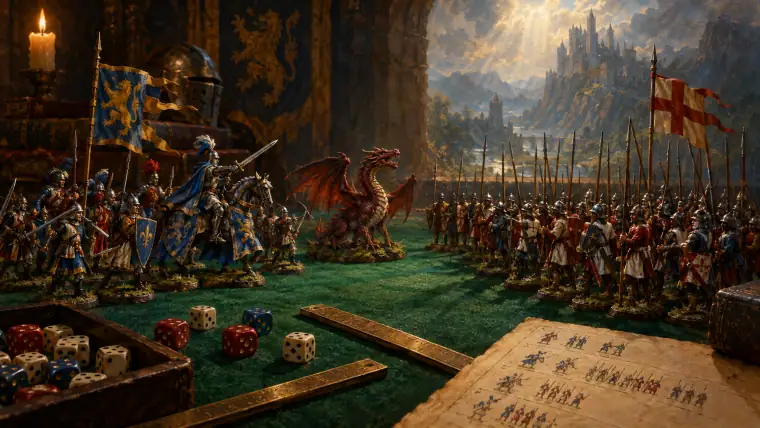
In 1812, while Napoleon's Grande Armée was marching toward Moscow, a Prussian civil servant named Georg Leopold von Reisswitz delivered an extraordinary piece of furniture to King Frederick William III: a wooden cabinet whose drawers held porcelain terrain tiles and little blocks representing troops, a whole landscape in miniature that could be assembled on a tabletop. It was a war machine made of toys. It had no complete rules, it was never mass-produced, and its maker could not have imagined that the line of descent he was starting would, a century and a half later, end in a basement in Lake Geneva, Wisconsin, with teenagers fighting a dragon on graph paper. The fantasy tradition told in the other chapters of this chronicle gave roleplaying games their dreams. This chapter follows the other inheritance, the machinery, which came not from poets but from general staffs, toy-soldier collectors and hobbyists with slide rules.
The general staff at play
War games were older than Reisswitz. In 1780 Johann Christian Ludwig Hellwig had turned chess into a game of war, coloring the squares of an enlarged board to stand for mountains, marsh and water; in 1797 Georg Venturini pushed the idea further on a larger grid. But grids are abstractions, and the father's sand-table and porcelain-tile experiments were attempts to escape them. It was his son, the artillery lieutenant Georg Heinrich Rudolf von Reisswitz, who turned the idea into a system. His Kriegsspiel rules, published in 1824, were played on large-scale topographical maps (1:8,000) with metal blocks for units, and they contained three ideas that every roleplayer will recognize.
The first was the umpire, a neutral officer who knew the positions of both sides, adjudicated what each commander could see, and applied the rules. The second was the die: combat results were not fixed but drawn from tables keyed to dice, so that the same attack might succeed brilliantly or stall. The third was attrition: a unit did not simply vanish when struck but lost strength step by step, a bookkeeping of damage that is the direct ancestor of Hit points. When the younger Reisswitz demonstrated the game to the chief of the general staff, General Karl von Müffling, the old soldier is reported to have declared that this was no mere game but schooling for war. The king ordered sets for the army. (See Georg von Reisswitz for the father and son.)
The inventor's own story ended badly; transferred to a provincial garrison, the younger Reisswitz took his own life in 1827. His game languished, and was revived in the 1860s as Prussia's wars came thick and fast. After the Prussian victory over France in 1870–71, general staffs everywhere wanted to know what the Prussians knew, and Kriegsspiel spread to Britain, France, the Netherlands and the United States. Its rules also split in a way that would matter enormously. In 1876 Julius von Verdy du Vernois proposed "free Kriegsspiel," in which an experienced umpire dispensed with most of the tables and simply judged outcomes from his own knowledge. The tension between rigid rules and a referee's free judgment, which D&D players would later argue about as rules lawyers and improvising referees, was already a century old when the first dungeon was drawn. In 1880 an American artillery officer, Charles A. L. Totten, published Strategos: A Series of American Games of War, which offered both approaches. Its idea of a referee would reach Minnesota, by a very indirect route, ninety years later.
Toy soldiers on the nursery floor
The military game crossed into the civilian world through the toy box. By the 1890s the London firm of W. Britain was selling hollow-cast lead soldiers cheaply enough for middle-class nurseries, and in 1911 H. G. Wells — the author of The Time Machine and The War of the Worlds — published Floor Games, a little book about building cities and islands on the carpet with his sons. Two years later came Little Wars (1913), its title page promising a game "for boys from twelve years of age to one hundred and fifty and for that more intelligent sort of girl who likes boys' games and books." The game had begun, according to Wells, after dinner, when his friend Jerome K. Jerome started firing a spring-loaded toy cannon at a row of soldiers. Wells formalized the fun into rules for movement, capture and bombardment with wooden projectiles.
Little Wars was a hobbyist's book with a pacifist's sting: Wells closed it by contrasting his bloodless floor battles with the real thing, and in 1914 the real thing arrived. But the book established that war games could be played for pleasure, and it gave the English-speaking world a founding text. Gary Gygax would one day write a foreword to a reissue of it.
The hobby grew slowly through the interwar years and exploded after the Second World War. In 1957 the California figure-maker Jack Scruby launched the War Game Digest, the first periodical devoted to miniatures gaming, with a subscription list of about fifty. In 1962 the English physiotherapist Donald Featherstone published War Games, the book that turned a scattering of enthusiasts into a transatlantic community of clubs, newsletters and home-cast armies. These were the ancestors of the grognards: meticulous, argumentative, historical to a fault, and utterly uninterested, for the moment, in elves.
Hexes, counters and the mail-order army
A parallel revolution happened in cardboard. In 1952 a Maryland businessman named Charles S. Roberts designed Tactics, a war game with a printed map, cardboard counters and rules in a box, and from 1954 he sold it by mail from his home. The operation became Avalon Hill, and its Gettysburg (1958) was the first board wargame to simulate a real historical battle. Avalon Hill's hex grids, zones of control and combat-results tables made the wargame a consumer product, and its General magazine (from 1964) gave players a place to argue. In 1969 James F. Dunnigan took over the struggling magazine Strategy & Tactics and built Simulations Publications, Inc. (SPI) around it, publishing a new game in nearly every issue. Allan Calhamer's Diplomacy (1959), which rewarded negotiation and betrayal as much as generalship, was being played by postal correspondence, and the fanzines that grew around it pioneered the long-distance, story-rich Play-by-Mail Games game.
One quieter Avalon Hill product would prove unexpectedly important. Outdoor Survival (1972) was a hex-map game about staying alive in the wilderness. Two years later, the first edition of Dungeons & Dragons would tell its buyers to use that board for overland adventures.
By the late 1960s, then, America had a wargaming subculture with its own publishers, magazines and clubs, and at its heart were a handful of Midwestern enthusiasts. One of them, a Lake Geneva, Wisconsin, insurance underwriter named Gary Gygax, co-founded the International Federation of Wargaming and, in 1968, persuaded it to hold a convention in his town. On August 24, 1968, about 96 people gathered in the vine-covered Horticultural Hall, which Gygax had rented for fifty dollars. That was Gen Con I, the seed of Gen Con. At Gen Con II the next summer Gygax met a young gamer from St. Paul, Minnesota, named Dave Arneson.
Braunstein, knights and the fantasy supplement
The twin cities of Minneapolis and St. Paul had their own miniatures scene, the Twin Cities Military Miniatures Group, and one of its members, David Wesely, had read Totten's Strategos. Around 1969 (the dating is usually given as 1969, though accounts vary slightly) Wesely ran a Napoleonic game unlike any before it. Braunstein was set in a fictional German town of that name, and instead of commanding armies, nearly twenty players each received a single role: the mayor, a banker, the university chancellor, student revolutionaries, the rival generals. Wesely intended a war game with a political prelude. What happened instead was that the players ignored the battle and started scheming, bargaining and talking in character, turning to the referee to find out what their one person could do. The game "failed" and was a revelation. Wesely ran more Braunsteins, and when he left for military service in 1970, Arneson took over as referee, while another member, Duane Jenkins, ran Wild West variants with recurring characters.
Meanwhile, in Lake Geneva, medieval wargaming was having its moment. Gygax and friends formed the Castle & Crusade Society within the International Federation of Wargaming, with a newsletter called the Domesday Book that began in 1970. A local hobby-shop owner, Jeff Perren, wrote four pages of medieval miniatures rules; Gygax expanded them, and after appearing in fanzines they were published in March 1971 by Guidon Games as Chainmail. It sold, by the standards of the hobby, very well, around a hundred copies a month.
What made Chainmail historic was an appendix: a fourteen-page Fantasy Supplement. Here, alongside the knights and pikemen, were heroes and superheroes, wizards who could hurl a fireball or a lightning bolt, and a menagerie drawn straight from the fantasy shelf: elves, dwarves, orcs, goblins, trolls, dragons, and Tolkien's hobbits, ents and balrogs. The supplement cited Tolkien, Robert E. Howard, Poul Anderson and Michael Moorcock, and it sorted its creatures into Law and Chaos, the cosmic sides of Anderson's Three Hearts and Three Lions and Moorcock's Elric stories, which would become D&D's Alignment. It was here that the two strands of this chronicle, the wargame table and the paperback rack (see The Paperback Boom & the Counterculture and Pulps, Weird Tales & Sword-and-Sorcery), first physically touched. In 1972 Gygax and Arneson collaborated on a set of Age of Sail naval rules, Don't Give Up the Ship!, written with Mike Carr, who also edited it: their first joint credit.
Under Castle Blackmoor
In April 1971 Arneson invited his Braunstein players to a "medieval Braunstein" promising mythical creatures and, famously, a poker game under the troll's bridge. The setting was Blackmoor, a barony he placed in the cold northern reaches of the Castle & Crusade Society's shared fantasy map, the Great Kingdom. Its tone came from The Lord of the Rings and, by Arneson's own account, from the gothic soap opera Dark Shadows; its first rules came from Chainmail's Fantasy Supplement. Something new grew out of the Braunstein principle of one player, one person. Arneson's players kept their characters from session to session, and those characters improved with experience. And more and more, the action moved underground, into the dungeons beneath Castle Blackmoor, where a referee could control exactly what the players saw, room by room, a perfect engine for the hidden information that Kriegsspiel umpires had managed with separate maps. By 1972 the Dungeon crawl was the heart of the game.
Arneson's system was a patchwork, and historians still argue over exactly which of its pieces came from where. Arneson later said that the idea of a character absorbing a number of hits, and of armor classes, came out of his naval and ironclad wargames; the one-on-one combat was a descendant of Chainmail. What is not disputed is that in the fall of 1972 he and a Blackmoor player drove to Lake Geneva and ran the game for Gygax and his circle. Gygax began his own campaign almost immediately, with a castle called Greyhawk and his young children among the first adventurers, and the two men began corresponding about a set of rules. Arneson supplied notes; Gygax wrote, expanded and systematized, drawing on everything he read, including Jack Vance's The Dying Earth, whose wizards memorize spells and forget them in the casting (the root of Vancian magic). The draft circulated among playtesters under the working title The Fantasy Game. The authorship of this process would later be fought over in court; see The Gygax–Arneson Disputes.
The white box
No established publisher wanted a game with no board, no fixed ending and no winner. So in October 1973 Gygax and his childhood friend Don Kaye founded Tactical Studies Rules, TSR, Inc., with $1,000 apiece, Kaye borrowing his share against his life-insurance policy. A newer member of the local club, Brian Blume, put up $2,000 for printing. Early in 1974 (January is the traditional date, though advertising appeared that spring) TSR released Dungeons & Dragons: a woodgrain box holding three digest-sized booklets, Men & Magic, Monsters & Treasure and The Underworld & Wilderness Adventures. It cost $10. The first printing was 1,000 copies, assembled by hand, and it sold out within the year.
The game assumed a great deal. Its buyers were expected to own Chainmail and Avalon Hill's Outdoor Survival, and to know what a referee was. There were three classes (fighting-man, magic-user, cleric), Polyhedral dice that most gamers had never seen, and a referee, the Game Master, who invented the world. It spoke to wargamers but spread among students, science-fiction fans and university clubs, often by photocopy and word of mouth. Its central insight was the Braunstein insight, now fused to fantasy: each player is one character, a single life in a world run by an impartial judge, moving through a story no one has written in advance. The party of adventurers, cooperating rather than competing, was new in the history of games.
Tragedy struck early. Don Kaye died of a heart attack on January 31, 1975, aged 36; the Blume family bought his stake, and in July 1975 the partnership was reorganized as TSR Hobbies. TSR began publishing the magazine that became The Strategic Review in 1975, succeeded by The Dragon in 1976. Supplements followed quickly: Greyhawk and Blackmoor in 1975, the second including Arneson's "Temple of the Frog," one of the first published adventures; Eldritch Wizardry and Gods, Demi-Gods & Heroes in 1976. Gygax tested players with tournament dungeons such as Tomb of Horrors, run at the first Origins Game Fair in Baltimore in 1975, a gauntlet of traps built to humble the proudest players. TSR also released Dungeon! (1975), David Megarry's attempt, born in the Blackmoor group, to capture a dungeon expedition without needing a referee.
A hobby is born
By 1975 D&D was no longer a single game but the founder of a form. In Arizona, Ken St. Andre read the rules, found them confusing, and wrote his own; Tunnels & Trolls was self-published in 1975 and picked up by Flying Buffalo later that year (accounts of the exact months differ), the second roleplaying game in print, simpler and jokier and friendly to solitaire play. The University of Minnesota linguist M. A. R. Barker had been building an invented world called Tékumel since boyhood; TSR published it in 1975 as Empire of the Petal Throne, the first fully realized Campaign setting sold as a game, with a culture drawn from Mesoamerica, India and the Middle East rather than medieval Europe. In California, Greg Stafford founded Chaosium in 1975 to publish his board game of the world of Glorantha. In London that same year, Ian Livingstone, Steve Jackson (the British one) and John Peake founded Games Workshop; their newsletter Owl and Weasel became White Dwarf in June 1977, and the company began importing D&D to Britain.
Variety came fast. Bob Bledsaw and Bill Owen founded Judges Guild on July 4, 1976, and at Gen Con IX that August released City State of the Invincible Overlord, the first published fantasy city setting for D&D. James M. Ward's Metamorphosis Alpha (1976) took roleplaying to a derelict generation starship; 1977 brought Marc Miller's Traveller from Game Designers' Workshop, Edward Simbalist and Wilf Backhaus's dense, feudal Chivalry & Sorcery, and Metagaming's pocket-sized Melee, the first piece of Steve Jackson's The Fantasy Trip, designed by the American Steve Jackson partly from what he had learned as a member of the Society for Creative Anachronism. That Berkeley medieval-reenactment society, founded in 1966, was a cousin of the hobby, and in 1977 a Washington-area teenager named Bryan Weise went further still, advertising for recruits to fight "Hobbit Wars" with padded weapons. The group became Dagorhir, and the live-action roleplaying tradition had begun.
The digital world was listening too. On the University of Illinois's PLATO, students wrote dungeon games within months of D&D's arrival: Rusty Rutherford's pedit5 and Gary Whisenhunt and Ray Wood's dnd, both of 1975, were among the first computer role-playing games. In 1976 Will Crowther, a programmer, caver and D&D player, wrote Colossal Cave Adventure; Don Woods expanded it in 1977, adding a stronger fantasy flavor. The machine, it turned out, could be an umpire too.
The rules become a library
By 1977 TSR's original booklets were showing their age. They were cryptic, contradictory and written for wargamers, and D&D was now being bought by people who had never seen Chainmail. TSR answered in two directions at once. In July 1977 came the Basic Set, edited from the original rules by the California neurologist J. Eric Holmes, with a blue rulebook, dice and a clear explanation of how to play; it went on sale at Origins that month. And in December 1977 came the Monster Manual, the first hardcover of Advanced Dungeons & Dragons, the systematized, authoritative edition Gygax would complete with the Players Handbook (1978) and Dungeon Masters Guide (1979). (See Dungeons & Dragons Basic Set for the whole Basic lineage.)
Even here the fantasy shelf was pressing on the rules. TSR received a cease-and-desist over Tolkien's creatures from the holders of the non-literary rights; accounts date it anywhere from 1975 to late 1977 (see The Tolkien Rights Saga). In subsequent printings hobbits became halflings, ents became treants, and the balrog was quietly replaced (see Balrog / Balor). Tolkien's names left the rulebooks. His influence did not.
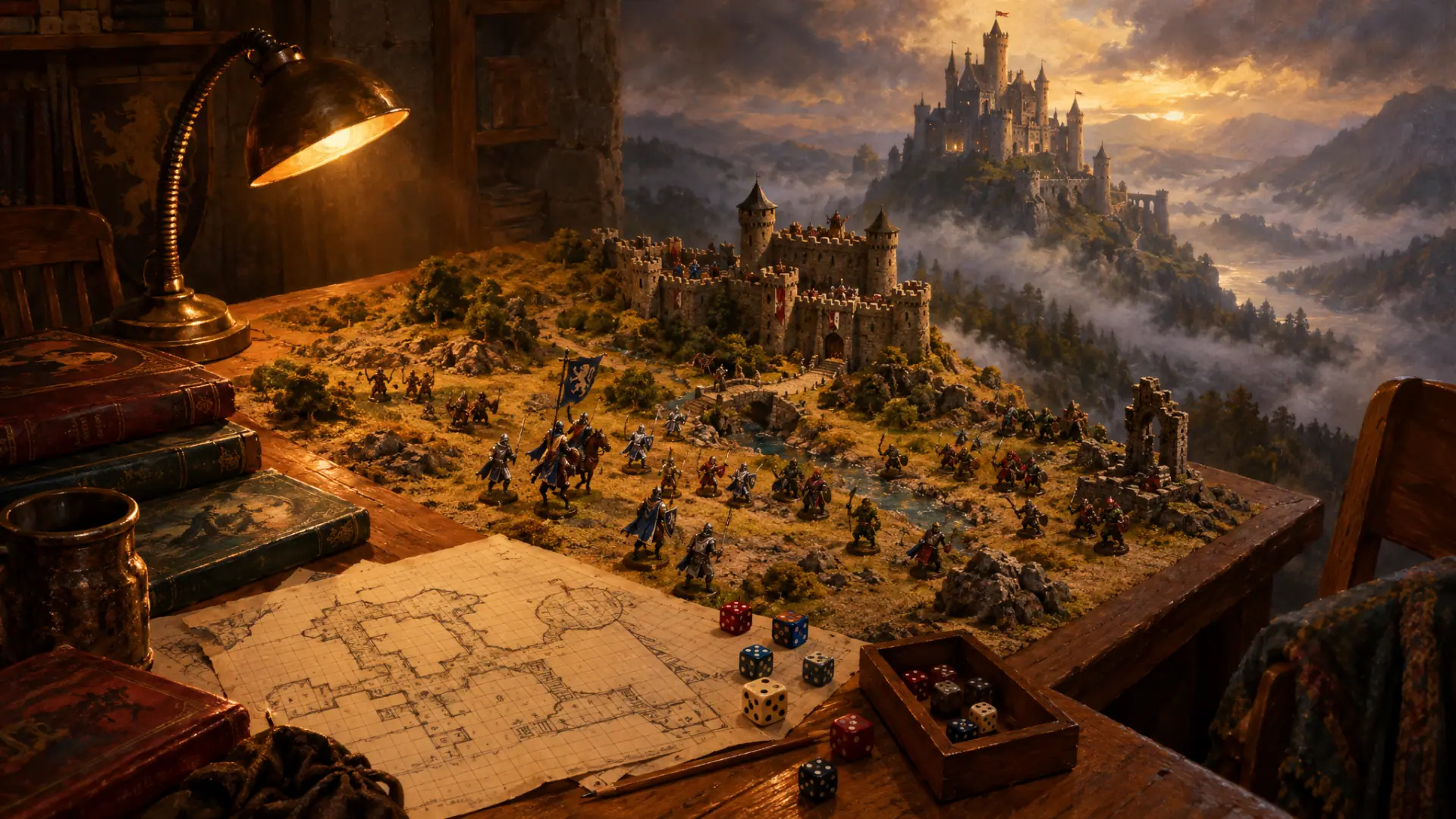
The machinery that Reisswitz had built for Prussian officers was now complete in its new form. There was an umpire, now a storyteller. Dice gave uncertainty. Hit points gave durability. Each player now commanded not an army but one hero. It had taken 165 years, a novelist's cannon, a failed Napoleonic scenario and a castle in the imaginary north to get there.
What came next
In 1977 roleplaying games were a hobby of a few tens of thousands of wargamers, students and science-fiction fans. Within five years D&D would be a household name, a boxed set in department stores, a Saturday-morning cartoon and, to some frightened parents, a moral menace. Its designers would quarrel, its publisher would boom and nearly collapse, and its rivals would multiply into a whole industry. That story — the Basic Sets and the modules, RuneQuest and Call of Cthulhu, White Dwarf and Fighting Fantasy, and the long shadow of the Satanic Panic & D&D — is told in The Tabletop Golden Age & the Satanic Panic. The machines were waking up at the same time, and their parallel story runs through Mainframes to Microcomputers: the First Computer RPGs.