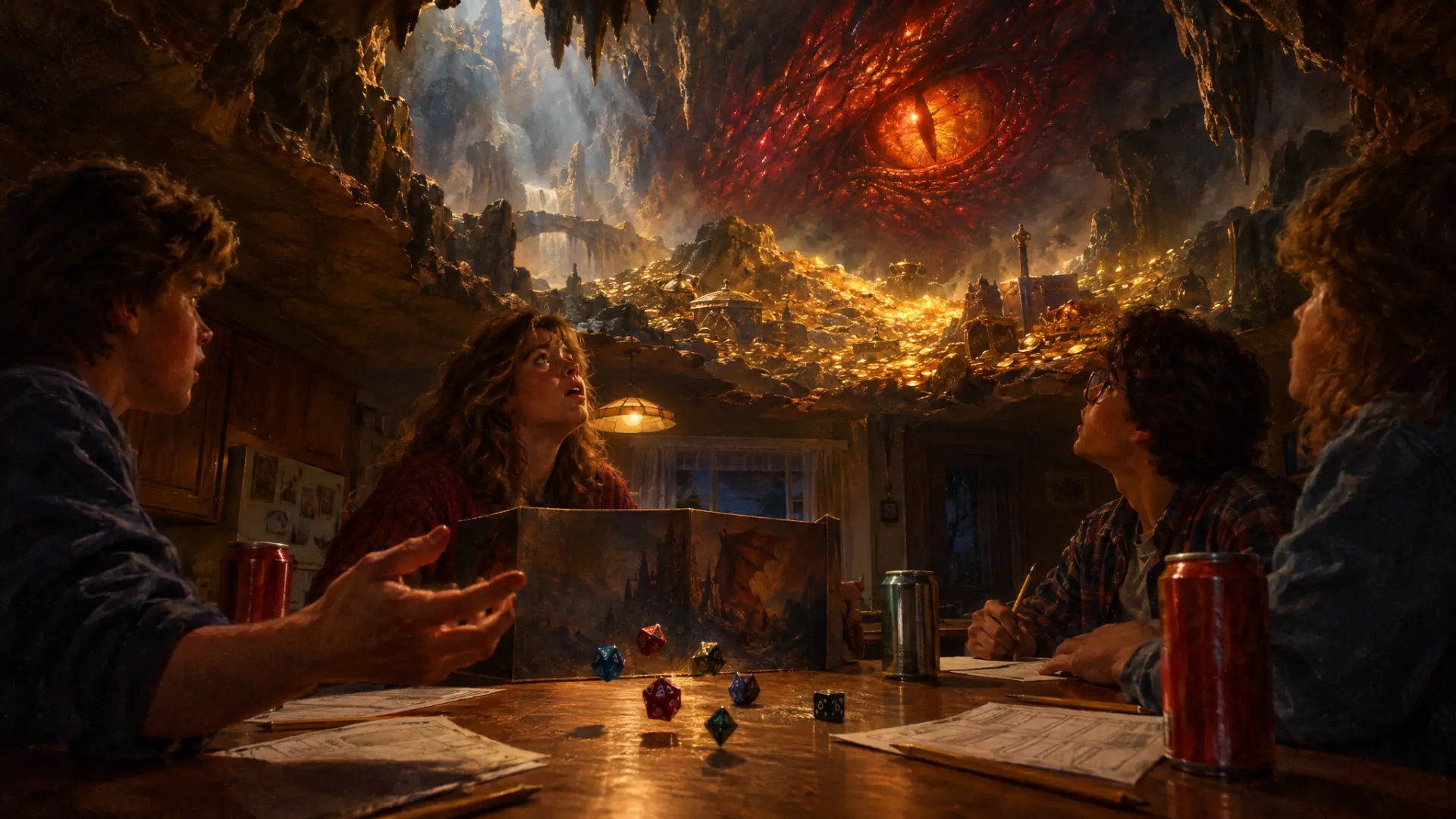
Jackson pioneered compact, tactical fantasy combat with Melee (1977), point-buy character creation in The Fantasy Trip, and the universal RPG with GURPS (1986). His company's 1990 raid and lawsuit became a founding case of digital civil liberties.
Life
Steve Jackson was born in 1953 and studied at Rice University in Houston, graduating in 1974, before briefly attending the University of Texas School of Law. Games won out over law. He has lived and worked in Austin, Texas, for most of his career, and is well known in the hobby for his enthusiasm for LEGO, especially its pirate sets.
A word on names: there are two celebrated game designers called Steve Jackson, born two years apart on opposite sides of the Atlantic. This one is the American founder of Steve Jackson Games. The other, the British Steve Jackson, co-founded Games Workshop and co-created Fighting Fantasy. The confusion was compounded when the American wrote three Fighting Fantasy books in the mid-1980s (Scorpion Swamp, Demons of the Deep and Robot Commando) with no note on the covers that they were by a different author.
Work
Jackson began his career at Metagaming Concepts, a small Texas publisher run by Howard Thompson that specialized in inexpensive, pocket-sized "MicroGames." His Ogre (1977), a science-fiction game of a giant cybernetic tank against a conventional army, was a hit, followed by G.E.V. (1978). The same year as Ogre he published Melee (1977), a fast, tactical game of man-to-man fantasy combat on a hex map, inspired by D&D but designed to make fights more interesting. Wizard (1978) added magic.
Those two games grew into a full roleplaying game, The Fantasy Trip, with In the Labyrinth (1980) as the core rulebook. It was an early example of point-based character creation, in which players distribute a fixed pool of points among attributes rather than rolling them. But Jackson and Thompson disagreed about the direction of the line, and the expanded books were published without Jackson seeing final proofs. He left in 1980 to found his own company, Steve Jackson Games. When Metagaming folded in 1983, Thompson turned down Jackson's offer of $250,000 for the rights, and The Fantasy Trip went out of print for decades.
Steve Jackson Games flourished anyway. Its early hits included Car Wars, a game of armed automobiles on the highways of a violent future, and Illuminati, a card game of rival secret societies. Jackson's most ambitious design was GURPS, the Generic Universal RolePlaying System, announced in 1983 and released as the Basic Set in 1986. Built on point-based character design, it aimed to handle any genre with one set of rules and a vast line of worldbooks, and it became the defining universal RPG. In 2001 he designed Munchkin, a comic card game that parodies dungeon-crawling and the players who min-max it, which became a long-running hit with dozens of expansions.
On March 1, 1990, the U.S. Secret Service raided Steve Jackson Games as part of a hacking investigation, seizing computers, a bulletin board system and the manuscript of GURPS Cyberpunk, which an agent reportedly called a "handbook for computer crime." The company nearly went under. Its lawsuit, supported by the newly formed Electronic Frontier Foundation, succeeded in 1993 in Steve Jackson Games, Inc. v. United States Secret Service: Judge Sam Sparks found for the company on two of three counts, under the Privacy Protection Act and the Stored Communications Act, and awarded $50,000 in statutory damages plus $250,000 in attorney's fees. The case became an early landmark for civil liberties online.
Legacy
Jackson's career has shaped both how games are designed and how they are sold. The pocket-sized MicroGames showed there was a market for cheap, clever games; GURPS popularized the idea of one system for every setting, with sourcebooks widely admired for their research; and Munchkin brought gamer in-jokes to a mass market. In 1982 he was inducted into the Charles Roberts Awards Hall of Fame, the youngest designer so honored at the time, and both GURPS and Munchkin have entered the Origins Hall of Fame.
He also became an early master of crowdfunding. His 2012 Kickstarter for a deluxe Ogre raised $923,680, and after reclaiming The Fantasy Trip in 2017 through a provision of U.S. copyright law that lets creators terminate old grants of rights, he relaunched it in 2019 as the Legacy Edition following a 2018 campaign that raised more than $450,000.
Marginalia
- This Steve Jackson, born in 1953 and a 1974 graduate of Rice University, is a different person from the British Steve Jackson, co-founder of Games Workshop.
- He wrote three Fighting Fantasy gamebooks, Scorpion Swamp, Demons of the Deep and Robot Commando, which added to the confusion between the two.
- Melee (1977) and Wizard (1978) were cheap pocket "MicroGames" for Metagaming that grew into The Fantasy Trip.
- Federal agents raided Steve Jackson Games on March 1, 1990, seizing the manuscript of GURPS Cyberpunk; the company won its suit in 1993.
- In December 2017 he used U.S. copyright termination law to reclaim The Fantasy Trip from its long-defunct first publisher.
- His 2012 Kickstarter for the Ogre Designer's Edition drew 5,512 backers pledging $923,680, then a record for a board game on the platform.
Quick answers
- Who is Steve Jackson?
- The Texas designer of Ogre, Melee and The Fantasy Trip who founded Steve Jackson Games, created GURPS and Munchkin, and won a landmark free-speech case against the U.S. Secret Service.
- When was Steve Jackson born?
- Steve Jackson was born in 1953.
- What is Steve Jackson known for?
- Steve Jackson is best known for The Fantasy Trip and GURPS.
- Why does Steve Jackson matter to fantasy and games?
- Jackson pioneered compact, tactical fantasy combat with Melee (1977), point-buy character creation in The Fantasy Trip, and the universal RPG with GURPS (1986). His company's 1990 raid and lawsuit became a founding case of digital civil liberties.