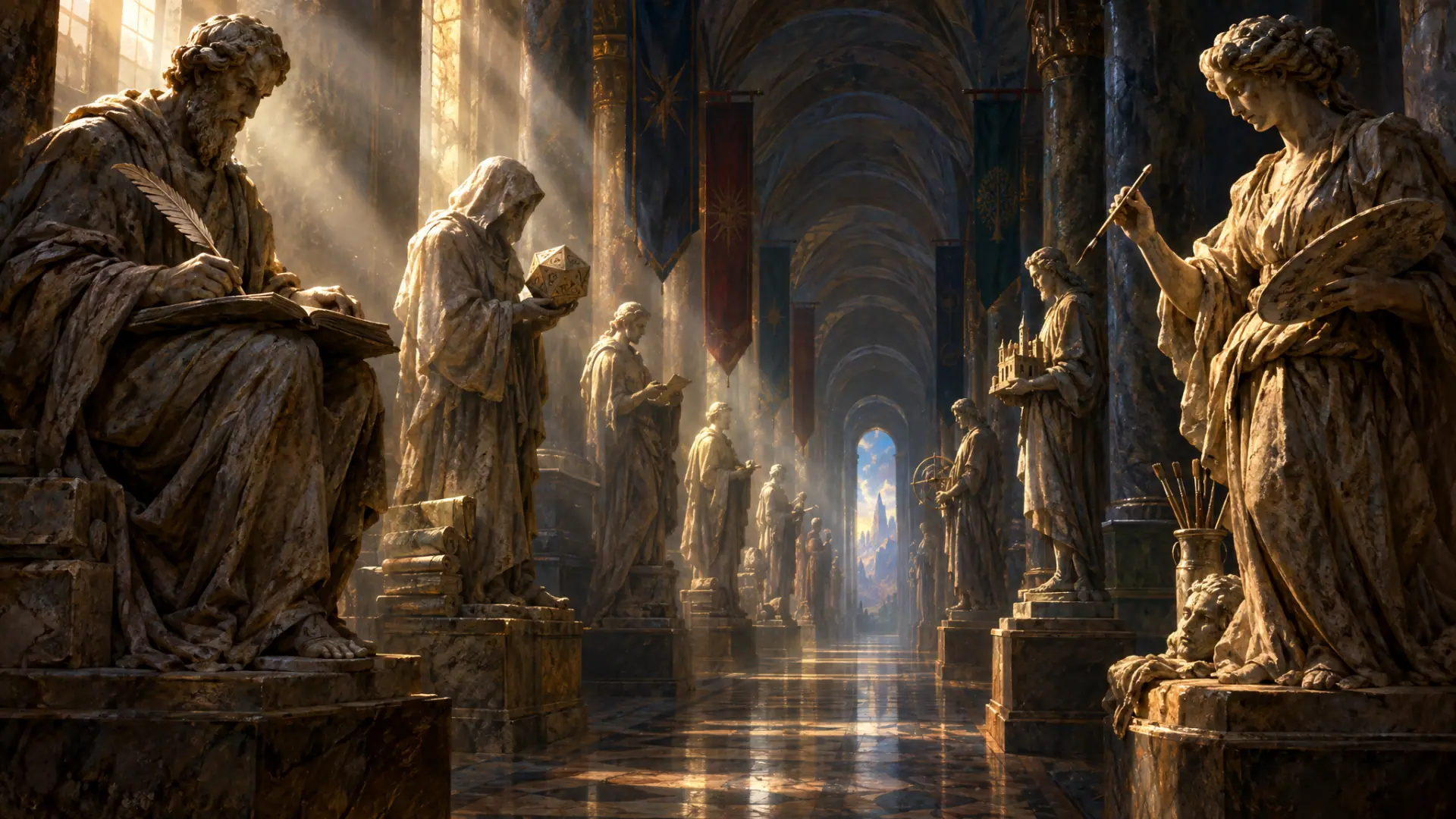
Hall of Makers
144 people who built the genre: the storytellers, the wargamers who invented roleplaying, the programmers who put it on screens, and the artists who showed us what it looks like.
Snorri Sturluson
Poet, Historian, Mythographer. The Icelandic chieftain, poet and lawspeaker whose Prose Edda preserved the Norse gods, dwarves and Ragnarök for Tolkien, D&D and every game that ever sent a hero to Valhalla.
George MacDonald
Novelist, Poet, Minister. The Scottish minister-turned-fantasist whose Phantastes and goblin-haunted mountains taught C. S. Lewis, Tolkien and Lewis Carroll what a fairy tale for grown-ups could be.
Lewis Carroll
Author, Mathematician, Logician. An Oxford mathematician who told a story on a river trip and invented Wonderland, the looking-glass world and the vorpal blade that still decapitates monsters in Dungeons & Dragons.
William Morris
Author, Poet, Designer. Wallpaper designer, saga translator, socialist and printer who, in his last years, wrote the first fantasy novels set in wholly invented worlds — and handed the idea to Tolkien and Lewis.
H. G. Wells
Novelist, Journalist, Social thinker. The author of The Time Machine and The War of the Worlds, who also wrote Little Wars (1913), the first published rules for hobby wargaming with toy soldiers.
Lord Dunsany
Author, Playwright, Poet. An Anglo-Irish peer who wrote with a quill in a castle, invented his own gods in 1905 and taught Lovecraft, Tolkien and Le Guin that fantasy could sound like scripture.
E. R. Eddison
Novelist, Civil servant, Saga translator. A Board of Trade mandarin who wrote Jacobean-voiced epics of warring lords by night — The Worm Ouroboros most famously — and was an occasional guest of Tolkien and Lewis's Inklings.
H. P. Lovecraft
Author, Poet, Letter writer. A reclusive Providence gentleman who died nearly unknown, then became the patron saint of cosmic horror — and, through Call of Cthulhu, the reason tabletop characters go insane.
J. R. R. Tolkien
Author, Philologist, Professor of Anglo-Saxon. An Oxford philologist who invented languages, then a world for them to be spoken in — and, with The Hobbit and The Lord of the Rings, supplied the elves, dwarves, orcs and halflings of every roleplaying game since.
Clark Ashton Smith
Poet, Short-story writer, Sculptor. The self-taught poet of Auburn, California, whose jeweled tales of Zothique, Hyperborea and Averoigne gave the pulps their most decadent sorcerers — and gave D&D the setting of Castle Amber.
C. S. Lewis
Author, Literary scholar, Christian apologist. Oxford don, Christian apologist and Tolkien's closest literary ally, who sent four children through a wardrobe into Narnia and made the portal fantasy a staple of childhood.
Robert E. Howard
Pulp writer, Poet. A young Texan who typed furiously for the pulps from a small oil town and created Conan the Cimmerian — the barbarian from whom sword and sorcery, the fighter class and a thousand games descend.
T. H. White
Novelist, Schoolmaster, Naturalist. A lonely, brilliant schoolmaster and falconer who retold Malory as The Once and Future King — giving the world Wart, a befuddled Merlyn who lives backward in time, and the musical Camelot.
Fritz Leiber
Author, Actor, Game designer. The actor's son who invented Fafhrd and the Gray Mouser, coined the phrase 'sword and sorcery', and designed a Lankhmar wargame in 1937 that TSR published four decades later.
C. L. Moore
Author, Screenwriter. A bank secretary in Indianapolis who hid behind her initials and wrote Jirel of Joiry — the first great woman warrior of sword and sorcery — into the pages of Weird Tales in 1934.
Mervyn Peake
Novelist, Illustrator, Painter. A painter and illustrator born in China who built Gormenghast, a crumbling castle-world of ritual, shadow and grotesques, and proved that fantasy could be gothic, magicless and utterly unlike Tolkien.
Donald A. Wollheim
Editor, Publisher, Author. The Ace Books editor whose unauthorized 1965 paperback of The Lord of the Rings detonated the Tolkien boom, and who went on to found DAW Books, arguably the first mass-market house devoted to SF and fantasy.
Jack Vance
Author, Science fiction writer, Fantasy writer. A sardonic Californian stylist whose Dying Earth, written aboard a wartime merchant ship, gave Dungeons & Dragons its spell-memorizing wizards — and whose name, scrambled, became the lich-god Vecna.
Christopher Tolkien
Editor, Scholar, Cartographer. J. R. R. Tolkien's youngest son, first reader and mapmaker, who spent nearly half a century turning his father's boxes of drafts into The Silmarillion and the twelve-volume History of Middle-earth.
Lloyd Alexander
Author, Translator. A Philadelphia writer who fell in love with Wales as a wartime soldier and turned the Mabinogion into Prydain — Taran the Assistant Pig-Keeper, the Horned King and the Black Cauldron — winning the Newbery Medal and a Disney film.
Anne McCaffrey
Author, Science fiction writer. The creator of Pern, whose telepathic, fire-breathing dragons and their bonded riders made her the first woman to win a Hugo for fiction — and filled bookshelves, computer screens and online MUSHes for decades.
Poul Anderson
Author, Science fiction writer, Fantasy writer. A physics graduate of Danish descent who wrote hard science fiction and saga-dark fantasy with equal skill — and whose Three Hearts and Three Lions handed D&D its paladin, its regenerating troll and its war of Law and Chaos.
Frank Frazetta
Painter, Illustrator, Comics artist. The Brooklyn painter whose muscular, storm-lit Conan covers of the 1960s taught the world what sword and sorcery should look like, and whose shadow falls across every barbarian since.
M. A. R. Barker
Linguist, Professor of South Asian studies, Game designer. The University of Minnesota linguist who spent decades building the alien, non-European world of Tékumel, and in 1975 published it through TSR as Empire of the Petal Throne.
Michael Ende
Novelist, Children's author, Playwright. German author of The Neverending Story, a novel about a boy who reads himself into the dying land of Fantastica, and of Momo; he famously disowned the 1984 film that made his story a global childhood memory.
Ursula K. Le Guin
Novelist, Poet, Essayist. An anthropologist's daughter who sent a boy named Ged to a school for wizards in 1968 and made true names, balance and the shadow within into the deepest magic in fantasy.
J. Eric Holmes
Neurologist, Professor of neurology, Editor. The Los Angeles neurology professor who turned D&D's scattered original booklets into the 1977 Basic Set, the first edition written to teach newcomers how to play.
Lin Carter
Novelist, Editor, Anthologist. The fan-turned-editor who, as curator of the Ballantine Adult Fantasy line, rescued Dunsany, Morris and Clark Ashton Smith from obscurity and built the first paperback canon of fantasy.
David Eddings
Novelist, Professor. Author, with his uncredited and later credited wife Leigh, of The Belgariad: a five-book farm-boy-to-king quest that became one of the most widely read gateway epics of the 1980s.
Edward Packard
Author, Lawyer. A lawyer whose bedtime stories for his children became the second-person branching book, first as Sugarcane Island and then as Bantam's Choose Your Own Adventure, which sold more than 250 million copies.
Koichi Sugiyama
Composer, Conductor, Orchestrator. The classically trained television composer who wrote Enix a fan letter about a shogi game, then scored Dragon Quest and for thirty-five years gave the series its fanfares, overtures and symphonic concerts.
William Goldman
Novelist, Screenwriter, Playwright. Two-time Oscar-winning screenwriter who hid a fairy tale inside a fake abridgment and gave the world The Princess Bride, first as a 1973 novel and then as Rob Reiner's 1987 cult film.
Susan Cooper
Author, Journalist, Screenwriter. A former Sunday Times reporter who heard Tolkien lecture at Oxford and went on to write The Dark Is Rising, five books in which the Old Ones, Arthurian legend and Welsh myth wake in modern Britain.
Will Crowther
Programmer, ARPANET engineer, Caver. The BBN network engineer and Kentucky caver who turned his survey maps of Mammoth Cave into Colossal Cave Adventure, the text game that invented the adventure genre and seeded the computer RPG.
Roger Zelazny
Author, Poet. A poet-turned-novelist who worked for Social Security by day, won Hugos by night, and wrote The Chronicles of Amber — a multiverse of Shadow worlds that inspired Gygax's Appendix N and a diceless roleplaying game.
Gary Gygax
Game designer, Publisher, Co-creator of Dungeons & Dragons. The Lake Geneva insurance underwriter and wargamer who co-created Dungeons & Dragons, co-founded TSR, and wrote the rulebooks that taught a generation how to be a Dungeon Master.
Ralph Bakshi
Animator, Film director, Painter. The Brooklyn-raised maverick of adult animation who rotoscoped Tolkien onto the big screen in 1978, made fantasy films with Frank Frazetta, and inspired a teenage Peter Jackson to read The Lord of the Rings.
Michael Moorcock
Author, Editor, Musician. The prodigious London editor, musician and anti-Tolkien firebrand who created Elric of Melniboné and the cosmic war of Law and Chaos that D&D wrote into its alignment system.
Peter S. Beagle
Novelist, Screenwriter, Songwriter. A Bronx-born prodigy who wrote his first novel at nineteen, wrote The Last Unicorn, and co-wrote the screenplay for Ralph Bakshi's 1978 animated Lord of the Rings.
The Brothers Hildebrandt
Painters, Illustrators. Twin painters from Detroit whose glowing, storybook Tolkien calendars of the 1970s showed a generation what Middle-earth looked like, and who painted Star Wars in thirty-six hours.
Terry Brooks
Novelist, Lawyer. The Illinois lawyer whose Tolkien-shaped debut, The Sword of Shannara, launched Del Rey Books in 1977 and proved that epic fantasy could be a mass-market genre rather than a one-book phenomenon.
David Wesely
Wargame designer, Referee, Game designer. The Minnesota physics student and miniatures referee whose Braunstein games of 1969 handed players individual roles instead of armies, and accidentally invented the roleplaying session.
Philip Pullman
Novelist, Teacher. The Oxford schoolteacher who rewrote Paradise Lost for young readers as His Dark Materials, giving every human a daemon and fantasy one of its fiercest arguments with Narnia.
Robert Asprin
Novelist, Anthology editor, Fan organizer. The prankish fan and comic novelist who dreamed up Thieves' World, the anthology city of Sanctuary where a dozen authors shared one sword-and-sorcery setting, and invented the modern shared world.
Steve Perrin
Game designer, Writer, Video game designer. The Bay Area medievalist and lead designer of RuneQuest (1978), whose skill-based percentile system became the engine of Chaosium's games from Call of Cthulhu to Stormbringer.
Alan Lee
Illustrator, Film concept designer. The quiet English watercolorist whose misty, melancholy Middle-earth became the definitive illustrated Tolkien, and then, through Peter Jackson's films, the Middle-earth most of the world now sees.
Dave Arneson
Game designer, Co-creator of Dungeons & Dragons, Teacher. The Minnesota wargamer whose Blackmoor campaign of 1971 put single heroes, dungeons and hit points on the table, and who co-created Dungeons & Dragons with Gary Gygax.
Jeff Perren
Wargame designer, Hobby shop owner. The Lake Geneva wargamer whose four pages of medieval miniatures rules became Chainmail, the 1971 game whose fantasy supplement was the launching pad for Dungeons & Dragons.
Ken St. Andre
Game designer, Librarian, Author. The Phoenix librarian who read the D&D rules in 1975, decided they made no sense, and wrote Tunnels & Trolls, the second roleplaying game ever published and the first built for solo play.
Stephen R. Donaldson
Novelist. Creator of Thomas Covenant, a bitter, leprous unbeliever transported to a fantasy Land he refuses to accept, whose ten-novel chronicle made 1970s epic fantasy darker, stranger and morally harder.
Andrzej Sapkowski
Novelist, Short-story writer, Translator. The Łódź sales rep who entered a magazine contest in 1986 with a story about a mutant monster hunter, Geralt of Rivia, and ended up with one of the most successful fantasy franchises in games and television.
George R. R. Martin
Novelist, Screenwriter, Television producer. The Bayonne dockworker's son, chess tournament director and TV writer whose A Song of Ice and Fire became Game of Thrones, and who wrote the ancient mythology behind FromSoftware's Elden Ring.
Greg Stafford
Game designer, Publisher, Founder of Chaosium. The founder of Chaosium and creator of Glorantha, a mythic world he began imagining as a college freshman in 1966, who later considered his Arthurian RPG King Arthur Pendragon his masterpiece.
Larry Elmore
Fantasy artist, Illustrator, Cartoonist. The Kentucky painter who joined TSR in 1981 and gave 1980s Dungeons & Dragons its heroic face: the Red Box dragon, the Dragonlance companions, and a thousand distinct wyrms.
Margaret Weis
Novelist, Editor, Game publisher. A TSR book editor who, with Tracy Hickman, rescued a stalled tie-in novel and turned Dragonlance into the fantasy bestseller that made game fiction a genre of its own.
Robert Jordan
Novelist, Nuclear engineer, Vietnam War veteran. The Vietnam helicopter gunner turned nuclear engineer who wrote Conan pastiches for Tor, then spent the rest of his life on The Wheel of Time, a fourteen-volume epic finished after his death by Brandon Sanderson.
Terry Pratchett
Novelist, Satirist, Journalist. The satirist who put a flat world on four elephants and a turtle, then used it for 41 Discworld novels that skewered sword and sorcery, then everything else, selling more than 100 million books.
Tom Moldvay
Game designer, Writer, Editor. The TSR designer who rewrote the D&D Basic Set in 1981 and co-wrote The Isle of Dread and Castle Amber, some of the most widely played adventures of the D&D boom.
Ian Livingstone
Game designer, Author, Entrepreneur. The co-founder of Games Workshop and first editor of White Dwarf who co-created Fighting Fantasy, wrote Deathtrap Dungeon, and later chaired Eidos during the Tomb Raider years.
Steve Jackson
Game designer, Author, Games journalist. The British co-founder of Games Workshop who, with Ian Livingstone, created Fighting Fantasy and wrote The Citadel of Chaos, Creature of Havoc and the four-part Sorcery! epic.
Robin Hobb
Novelist, Short-story writer. The Alaska-raised writer who, after a critically admired but modest career as Megan Lindholm, became Robin Hobb in 1995 and wrote the Farseer books, epic fantasy told from inside one wounded assassin's head.
Shigeru Miyamoto
Game designer, Producer, Director. Nintendo's master designer, who turned boyhood explorations of the Kyoto countryside into The Legend of Zelda and shaped the action RPG while professing a dislike of stats-driven RPGs.
Yoshitaka Amano
Illustrator, Character designer, Painter. The Japanese painter whose ethereal, Art Nouveau-tinged watercolors gave Final Fantasy its dreamlike identity, and whose calligraphic logos still crown every numbered entry.
Henk Rogers
Game designer, Publisher, Entrepreneur. The Dutch-born New Yorker who followed love to Japan, introduced Japanese players to the dungeon RPG with The Black Onyx in 1984, and then crossed the Iron Curtain to win Tetris for Nintendo's Game Boy.
Roberta Williams
Game designer, Writer, Co-founder of Sierra On-Line. The Colossal Cave fan who drew Mystery House's pictures by hand, co-founded Sierra On-Line, turned fairy tales into King's Quest, and four decades later came back to remake the cave that started it all.
Steve Jackson
Game designer, Publisher, Founder of Steve Jackson Games. The Texas designer of Ogre, Melee and The Fantasy Trip who founded Steve Jackson Games, created GURPS and Munchkin, and won a landmark free-speech case against the U.S. Secret Service.
Don Woods
Programmer, Hacker, Co-author of Colossal Cave Adventure. The Stanford hacker who found Will Crowther's cave game on the ARPANET in 1977 and, with a dragon, a pirate and a 350-point score, turned it into the Adventure that conquered every computer room.
Yuji Horii
Game designer, Writer, Director. The Shōnen Jump writer who won an Enix programming contest, saw Wizardry at a Macworld show, and distilled the Western computer RPG into Dragon Quest, the game that taught Japan to play role-playing games.
Akira Toriyama
Manga artist, Character designer. The creator of Dragon Ball whose rounded, joyful designs gave Dragon Quest its heroes and its grinning Slime, turning Japan's first great console RPG into a national phenomenon.
Jean Wells
Game designer, Editor, Columnist. TSR's first woman designer, who launched Dragon's long-running "Sage Advice" column and wrote Palace of the Silver Princess, the module TSR famously destroyed on the day of its release.
Sandy Petersen
Game designer, Video game level designer, Publisher. The zoology student turned designer who brought H. P. Lovecraft's mythos to roleplaying with Call of Cthulhu (1981), then built many of Doom's levels and co-designed Age of Empires expansions.
Tracy Hickman
Game designer, Novelist. The Utah designer who co-wrote the gothic D&D module Ravenloft with his wife Laura and, with Margaret Weis, turned Dragonlance into a bestselling saga of novels and adventures.
Jennell Jaquays
Game designer, Artist, Level designer. The designer and artist whose looping, many-pathed dungeons, from Caverns of Thracia to Quake III Arena's arenas, taught two industries how to build spaces worth exploring.
Joe Dever
Author, Game designer, Musician. A session bassist and Public Image Ltd road manager who won America's AD&D championship, then turned his home campaign world of Magnamund into Lone Wolf, one of the best-selling gamebook series ever.
Andrew C. Greenberg
Game designer, Programmer, Co-creator of Wizardry. The Cornell student who began a dungeon game in 1978, co-created Wizardry with Robert Woodhead, lent his reversed first name to its villain Werdna, and later became a patent attorney.
John Howe
Illustrator, Concept designer, Author. The Canadian illustrator and armor enthusiast whose dragons, wizards and grim fortresses helped design Peter Jackson's Middle-earth, and later Amazon's Second Age.
Tad Williams
Novelist, Comics writer. Author of Memory, Sorrow, and Thorn, the doorstop trilogy that showed George R. R. Martin what epic fantasy could still do, and of Otherland, a four-volume saga set inside virtual worlds that looked a lot like MMORPGs.
Ed Greenwood
Game designer, Novelist, Librarian. A Toronto library clerk whose boyhood story-world grew, through years of Dragon magazine articles and a famously detailed home campaign, into the Forgotten Realms, D&D's most enduring setting.
Nobuo Uematsu
Composer, Keyboardist, Founder of Dog Ear Records. The self-taught pianist from Kōchi who took a side job writing tunes for Square in 1986 and became the voice of Final Fantasy, from the NES prelude to One-Winged Angel and the concert halls of the world.
R. A. Salvatore
Novelist, Game writer, Creative director. The former bouncer who auditioned for TSR's second Forgotten Realms novel, invented a scimitar-wielding dark elf named Drizzt on a whim, and turned him into the most famous character in Dungeons & Dragons fiction.
Steven Erikson
Novelist, Archaeologist, Anthropologist. Canadian archaeologist whose ten-volume Malazan Book of the Fallen grew out of an AD&D and GURPS campaign run with his friend Ian Cameron Esslemont, and became epic fantasy's most demanding cult classic.
Susanna Clarke
Novelist, Short-story writer, Editor. The cookbook editor who spent ten years of early mornings writing Jonathan Strange & Mr Norrell, a footnoted Regency epic of English magic that won the Hugo, and later Piranesi, a haunting novel of an infinite house.
Richard Bartle
Game designer, Co-creator of MUD1, Game researcher. The Essex student who co-wrote MUD1, gave it points, puzzles and the long climb to Wizard, and then spent four decades explaining why people play online worlds, from the Bartle taxonomy to Designing Virtual Worlds.
Peter Jackson
Film director, Screenwriter, Producer. The self-taught New Zealand director who went from backyard splatter comedies to filming all of The Lord of the Rings at once, winning Best Picture and making high fantasy a blockbuster screen genre.
Richard Garriott
Game designer, Programmer, Entrepreneur. The astronaut's son who sold his first RPG in Ziploc bags, ruled Britannia as Lord British through the Ultima series, built a castle with secret passages outside Austin, and in 2008 paid his own way to the space station.
Hironobu Sakaguchi
Game designer, Director, Producer. The would-be rock musician who skipped classes to play Wizardry, bet his career on an RPG he called Final Fantasy, and led Square's series from 1987 to the heights of Final Fantasy VII before founding Mistwalker.
Rebecca Heineman
Programmer, Game designer, Co-founder of Interplay. The self-taught hacker who won America's first national video game championship, co-founded Interplay, designed The Bard's Tale III and Dragon Wars, and spent four decades as a master programmer.
Richard Garfield
Game designer, Mathematician. A combinatorics PhD student who crossed a fantasy card duel with baseball-card collecting and created Magic: The Gathering, the first collectible card game.
Rieko Kodama
Artist, Director, Producer. Sega's "First Lady of RPGs," who drew Phantasy Star's heroine Alis in 1987, directed Phantasy Star IV, produced Skies of Arcadia, and spent 38 years at Sega shaping its role-playing games.
Mark Rein·Hagen
Game designer, Publisher. The co-creator of Ars Magica who, on a road trip to Gen Con in 1990, came up with Vampire: The Masquerade and launched the gothic-punk World of Darkness that took roleplaying beyond the dungeon.
J. K. Rowling
Novelist, Screenwriter, Producer. The single mother who drafted a boy wizard's first adventure in Edinburgh cafés and saw Harry Potter become the best-selling book series in history, then a film, game and theme-park empire.
Jonathan Tweet
Game designer, Author. The co-creator of Ars Magica and the surreal Over the Edge who led the design of Dungeons & Dragons 3rd Edition, rebuilding the game around a single d20 roll and opening its rules to the world.
Julian LeFay
Programmer, Game designer, Musician. The Danish musician-turned-programmer called the "Father of The Elder Scrolls," who engineered Arena and led Daggerfall, the vast procedurally built worlds from which Morrowind and Skyrim descend.
Satoshi Tajiri
Game designer, Director, Studio founder. The boy the neighborhood called "Dr. Bug," who turned insect collecting and the Game Boy link cable into Pokémon, the monster-catching RPG behind one of the world's most lucrative media franchises.
Jake Song
Game designer, Programmer, Studio founder. The KAIST-trained programmer who co-founded Nexon, built Kingdom of the Winds, then designed Lineage, the online world that made South Korea the capital of the MMORPG.
David Brevik
Game designer, Programmer, Producer. The roguelike fan who dreamed up Diablo, named it after a California mountain, and, at Blizzard's urging, turned a turn-based dungeon crawl into the real-time click-and-loot game that defined the action RPG.
Monte Cook
Game designer, Writer, Publisher. A Planescape stalwart who wrote the 3rd Edition Dungeon Master's Guide, helped prove that game books could sell as PDFs, and later crowdfunded the far-future science fantasy Numenera.
Brad McQuaid
Game designer, Producer, Programmer. The shareware programmer who became EverQuest's producer and co-designer, walked Norrath as the avatar Aradune, and spent his later career chasing the hardcore, group-driven MMO he believed in.
Rob Pardo
Game designer, Executive, Studio founder. The Dungeon Master and EverQuest raider who became Blizzard's design chief, steering Warcraft III and World of Warcraft into the mainstream before leaving to found Bonfire Studios.
Starr Long
Game director, Producer, Executive producer. The theater-trained game tester who rose at Origin Systems to direct Ultima Online, took the in-game name Lord Blackthorn, and spent decades as Richard Garriott's producing partner.
Raph Koster
Game designer, Author, Entrepreneur. The poet-turned-MUD-wizard who led the design of Ultima Online, directed Star Wars Galaxies, and wrote A Theory of Fun, the book that taught a generation of designers why play matters.
Swen Vincke
Game director, Game designer, Programmer. The Ghent computer-science graduate who founded Larian Studios in 1996, spent two decades on the Divinity games, and then led Baldur's Gate 3 to a clean sweep of the year's biggest awards.
Patrick Rothfuss
Novelist, Game collaborator, Charity founder. Wisconsin author of The Name of the Wind, the lyrical first-person legend of the musician-arcanist Kvothe, whose long-awaited conclusion, The Doors of Stone, remains unpublished.
Hidetaka Miyazaki
Game director, Game designer, Writer. The Oracle account manager who changed careers at 29 after playing Ico, rescued a failing project called Demon's Souls, and built the Souls games and Elden Ring into a genre of their own.
Joe Abercrombie
Novelist, Film editor, Screenwriter. The freelance film editor and lifelong gamer whose First Law trilogy, with its torturer, berserker and preening swordsman, made him the self-styled "Lord Grimdark" of 21st-century fantasy.
Marcin Iwiński
Entrepreneur, Studio co-founder, Publisher. The Warsaw teenager who sold copied Western games at a market stall, co-founded CD Projekt with $2,000, and gambled the company on a video game of Andrzej Sapkowski's Witcher saga.
Reki Kawahara
Light novelist, Screenwriter. The Japanese light novelist who, rather than cut a manuscript down to a contest's page limit, posted Sword Art Online on his own website, and ended up defining the trapped-in-a-game story for a generation.
Brandon Sanderson
Novelist, Teacher, Podcaster. The prolific architect of the Cosmere, author of Mistborn and The Stormlight Archive, finisher of The Wheel of Time, and the writer whose 2022 Kickstarter raised $41.7 million for four secret novels.
Josh Sawyer
Game designer, Game director, Narrative designer. The history major who went from Black Isle web designer to Icewind Dale II lead, directed Fallout: New Vegas, and talked Obsidian into the Kickstarter that became Pillars of Eternity.
Matt Dinniman
Novelist, Pet portrait artist. The pet-show portrait artist who started posting a story about a man, his ex-girlfriend's cat and an alien game-show dungeon on Royal Road, and made Dungeon Crawler Carl LitRPG's first true mass-market blockbuster.
Tarn Adams
Game programmer, Game designer, Mathematician. The Stanford-trained mathematician who quit academia to spend his life, with his brother Zach, on Dwarf Fortress, a procedurally generated fantasy that simulates everything from world history to a dwarf's grudges.
Rebecca Yarros
Novelist. The romance novelist who pitched five ideas for a new romantic-fantasy line and got to write the third, Fourth Wing, a dragon-rider war-college saga that became the publishing phenomenon of 2023.
Sarah J. Maas
Novelist. The New Yorker who began posting an assassin-Cinderella story online at sixteen and grew into the best-selling queen of romantasy with Throne of Glass, A Court of Thorns and Roses and Crescent City.
Andrew Gower
Game designer, Programmer, Studio founder. The Cambridge programmer who wrote RuneScape in Java from his family's home in Nottingham, turning a free browser game into one of the most-played MMORPGs ever made.
Brian Fargo
Game designer, Producer, Executive. The Interplay founder who produced The Bard's Tale and Wasteland, backed Blizzard, Black Isle and Baldur's Gate, and later led the Kickstarter revival of the old-school computer RPG through inXile.
Chris Avellone
Game designer, Writer, Comic book writer. The Dungeon Master turned Black Isle designer who wrote Planescape: Torment, an RPG that begins where most games end, and became the most sought-after writer in the CRPG revival.
Feargus Urquhart
Game designer, Producer, Studio head. The Interplay tester who built Black Isle Studios, shepherded Fallout, Baldur's Gate and Planescape: Torment to market, then founded Obsidian Entertainment and kept the classic CRPG alive for three decades.
Frank Mentzer
Game designer, Editor, Founder of the RPGA. The TSR designer behind the 1983 "Red Box" and its four sequels, the BECMI sets that took D&D characters from first level to immortality, and founder of the RPGA.
Georg von Reisswitz
Wargame inventor, Prussian official (father), Artillery officer (son). A Prussian father and son whose sand table, porcelain-tile cabinet and 1824 rulebook created Kriegsspiel, the first wargame used to train real officers and the distant ancestor of the Dungeon Master.
Glenn Wichman
Game designer, Software developer, Co-creator of Rogue. The Santa Cruz student who dreamed of designing board games, co-designed Rogue with Michael Toy, gave it its name, and later drew the Macintosh version's graphics in exchange for a used Mac.
Greg Zeschuk
Physician, Studio co-founder, Executive. The D&D-loving medical graduate who co-founded BioWare in his Edmonton basement, co-ran it for seventeen years, then traded role-playing games for wild-fermented beer.
Isaac Childres
Board game designer, Publisher. A physics PhD who gave up the lab to self-publish board games, then crowdfunded Gloomhaven, a massive campaign dungeon crawl that spent more than five years as BoardGameGeek's top-ranked game.
James Ohlen
Game designer, Creative director, Studio head. The comic-shop Dungeon Master whose waiting-listed D&D campaigns got him hired at BioWare, where he led the design of Baldur's Gate and a string of the studio's most beloved RPGs.
Jason Bulmahn
Game designer, Editor. A Milwaukee architecture graduate turned Dragon magazine editor who, when D&D moved to 4th Edition, led Paizo's reworking of the 3.5 rules into Pathfinder, for years D&D's closest rival.
Jeremy Crawford
Game designer, Rules designer, Game director. D&D's longtime chief rules designer: co-lead of 5th Edition, author of Sage Advice, lead designer of the 2024 Player's Handbook, and later Game Director of Critical Role's Darrington Press.
John Harper
Game designer, Graphic artist. A Seattle designer and graphic artist whose free one-shot Lady Blackbird charmed the indie scene and whose Blades in the Dark, a game of scoundrels in a haunted industrial city, founded the Forged in the Dark family.
Jon Van Caneghem
Game designer, Programmer, Producer. The UCLA-trained programmer who spent three years writing Might and Magic almost alone, shipped it from his apartment, and built New World Computing into the home of Might and Magic and Heroes of Might and Magic.
Lorraine Williams
Business executive, Publisher. The Buck Rogers heiress and hospital administrator who took control of TSR from Gary Gygax in 1985, presided over AD&D's second edition and its setting boom, and sold the failing company to Wizards of the Coast in 1997.
Matthew Mercer
Voice actor, Game master, Game designer. The voice actor behind Critical Role's Dungeon Master screen, whose decade of livestreamed campaigns turned watching D&D into mass entertainment and made him the most recognizable game master in the world.
Michael Cranford
Game designer, Programmer, Ethicist. The Southern California programmer who designed and coded The Bard's Tale, the best-selling computer RPG of the 1980s, then walked away from games to become a professor of ethics.
Michael Toy
Programmer, Co-creator of Rogue, Software engineer. The Santa Cruz student programmer who coded Rogue's randomly built Dungeons of Doom, carried it to Berkeley and into BSD Unix, co-founded A.I. Design to sell it, and later helped ship Netscape's browser.
Mike Mearls
Game designer, Creative director. A d20 freelancer who rose through Wizards of the Coast to lead D&D's design, helped build 4th Edition, and co-led the fifth edition that brought Dungeons & Dragons its largest audience.
Peter Adkison
Entrepreneur, Game designer, Convention owner. A Boeing systems analyst who started Wizards of the Coast in his basement, asked Richard Garfield for a cheap convention game, got Magic: The Gathering, and used the proceeds to buy TSR and Dungeons & Dragons.
Ray Muzyka
Physician, Studio co-founder, Executive. The Edmonton family doctor who co-founded BioWare, ran it as CEO through Baldur's Gate, Knights of the Old Republic and Mass Effect, then left games for a 'third career' in impact investing.
Robert J. Harris
Board game designer, Novelist. A St Andrews Latin scholar who, after his first weekend of D&D, turned a schoolboy game about becoming headmaster into Talisman, Games Workshop's 1983 magical quest game, and later became a children's novelist.
Robert Woodhead
Programmer, Co-creator of Wizardry, Entrepreneur. The Sir-Tech co-founder who co-created Wizardry with Andrew Greenberg, lent his reversed name to the Mad Overlord Trebor, then wrote early Mac antivirus software and co-founded the anime label AnimEigo.
Roy Trubshaw
Programmer, Co-creator of MUD1. The University of Essex student who, in the autumn of 1978, wrote the first multi-user dungeon on a DEC-10, naming it MUD in tribute to the Dungeon version of Zork and opening the road to every online world.
Rusty Rutherford
Programmer, Creator of pedit5. The University of Illinois programmer who, a few months after discovering Dungeons & Dragons, hid a one-level dungeon in a spare PLATO file slot called pedit5 and made one of the very first computer RPGs.
Shouzou Kaga
Game designer, Director, Scenario writer. The Intelligent Systems designer who fused war games with role-playing to create Fire Emblem, gave its soldiers permanent deaths worth mourning, and later went his own way with Tear Ring Saga.
Sir Thomas Malory
Author, Knight, Translator & compiler. A 'knight prisoner' of the Wars of the Roses who gathered the sprawling French Arthurian romances into Le Morte d'Arthur, the book every later Camelot — from Tennyson to Pendragon — is built on.
Stephan Michael Sechi
Game designer, Publisher, Composer. A musician turned game designer who co-founded Bard Games on $600 a partner, built the antediluvian Atlantean Trilogy, then gave the hobby Talislanta, a Vance-haunted world without the usual orcs and goblins.
Stephen Baker
Board game designer. A Games Workshop alumnus who moved to Milton Bradley and designed HeroQuest, the 1989 box of plastic heroes and monsters that put the dungeon crawl on toy-shop shelves, then Space Crusade, Battle Masters and Heroscape.
Todd Howard
Game director, Game designer, Executive producer. The Pennsylvania business major who talked his way into Bethesda in 1994 and went on to lead Morrowind, Oblivion, Skyrim and Fallout, making the vast open-world RPG a mass-market blockbuster.
Vincent Baker
Game designer, Game theorist, Publisher. The indie designer and Forge theorist behind Dogs in the Vineyard and, with Meguey Baker, Apocalypse World, whose 'moves' became Powered by the Apocalypse, the most imitated RPG engine of the 21st century.
No makers match these filters.