Lovecraft's Cthulhu Mythos is one of the most borrowed shared universes in fiction. Gygax named him among AD&D's most immediate influences, and Chaosium's Call of Cthulhu built an entire genre of horror roleplaying on his work.
The oldest and strongest emotion of mankind is fear, and the oldest and strongest kind of fear is fear of the unknown.
Life
Howard Phillips Lovecraft was born on 20 August 1890 in Providence, Rhode Island, and — apart from a brief, unhappy stretch in New York — lived there all his life. His father, a traveling salesman, suffered a psychotic breakdown in 1893 and was confined to Butler Hospital until his death in 1898. The boy was raised by his mother, his aunts and his grandfather Whipple Phillips, whose library of eighteenth-century books and Gothic tales shaped his tastes. A precocious, often sickly child, he wrote chemistry and astronomy pamphlets, but a breakdown around 1908 kept him from finishing high school, a failure he felt for the rest of his life.
He found his way out of isolation through amateur journalism, the world of small hand-printed magazines, and through the pulps. His mother was committed to Butler Hospital in 1919 and died there in 1921. In 1924 he married Sonia Greene and moved to Brooklyn, but the marriage and the city both failed him; he returned to Providence in 1926, where he produced his most famous work while scraping a living by ghost-writing and revision. He was an extraordinary correspondent, mentoring younger writers — Robert Bloch, August Derleth and Fritz Leiber among them — and exchanging long letters with Robert E. Howard and Clark Ashton Smith. He died of cancer of the small intestine on 15 March 1937, aged forty-six, believing himself a failure.
Work
Lovecraft's early fiction included Dunsany-style dream fantasies, written after he heard Lord Dunsany lecture in Boston in 1919. His mature stories, mostly published in Weird Tales, forged something new: cosmic horror, in which the terror is not a ghost or a demon but the realization that humanity is insignificant in an indifferent universe. "The Call of Cthulhu" (1928) introduced the sunken city of R'lyeh and its dreaming priest-god; "The Colour Out of Space" (1927), "The Dunwich Horror" (1929), "The Shadow over Innsmouth" (1936) and At the Mountains of Madness (1936) followed. Stories share a map of invented New England towns — Arkham, Dunwich, Innsmouth — and a library of forbidden books, above all the Necronomicon of the mad Arab Abdul Alhazred. His long essay Supernatural Horror in Literature (1927) remains a landmark history of the genre he helped define, Weird Fiction.
Lovecraft encouraged friends to borrow his gods and add their own, which is why the Mythos became a shared world even in his lifetime. After his death, August Derleth and Donald Wandrei founded Arkham House in 1939 to keep his work in print. Modern readers also confront the virulent racism in his letters and in stories such as "The Horror at Red Hook"; in 2015 the World Fantasy Award retired its trophy bust of Lovecraft, and critics and writers continue to reckon with that legacy rather than ignore it.
Legacy
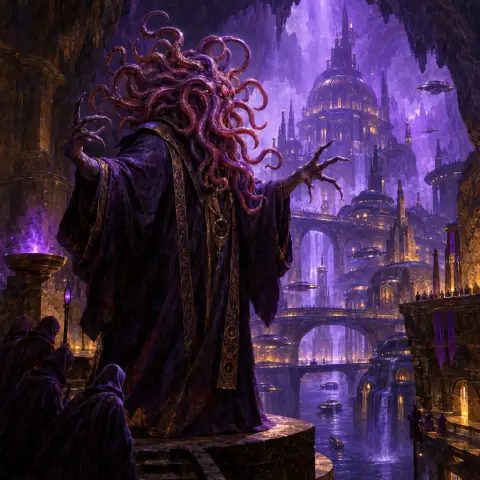
In games, Lovecraft is one of the most important writers who ever lived. Gary Gygax listed him on Appendix N and named him among the six "most immediate influences" on AD&D. TSR's Deities & Demigods (1980) gave Cthulhu, Nyarlathotep and their kin game statistics, but Chaosium already held a license; after a dispute the two companies agreed TSR could keep the material with credit, and TSR instead dropped the section from later printings. The tentacled Mind Flayer (Illithid) shows the Mythos' reach even at one remove: Gygax said he was inspired by the paperback cover of The Burrowers Beneath by Brian Lumley, a later Mythos writer.
The decisive translation came in 1981, when Sandy Petersen's Call of Cthulhu for Chaosium made investigators, not warriors, the heroes, and gave them a Sanity score that falls as they encounter the unknowable — perhaps the most influential single mechanic ever lifted from a novelist's themes. From there Lovecraft spread through board games such as Arkham Horror (1987), video games from Alone in the Dark (1992) to Bloodborne (2015), and the tentacled aberrations from beyond the stars that haunt D&D's own cosmology. The unknowable is now a genre of play.
Marginalia
- Both of Lovecraft's parents ended their lives in Providence's Butler Hospital: his father in 1898, his mother in 1921.
- His first story for Weird Tales, 'Dagon', appeared in 1923; 'The Call of Cthulhu' followed in February 1928.
- He wrote an estimated tens of thousands of letters, far more words than he ever put into fiction.
- He heard Lord Dunsany lecture in Boston in 1919, and wrote a series of Dunsany-inspired 'dream' stories afterward.
- TSR's Deities & Demigods (1980) included a Cthulhu Mythos section, which was dropped from later printings after a licensing dispute with Chaosium.
- Sandy Petersen's Call of Cthulhu (Chaosium, 1981) introduced a Sanity statistic that erodes as investigators learn the truth.
Quick answers
- Who was H. P. Lovecraft?
- A reclusive Providence gentleman who died nearly unknown, then became the patron saint of cosmic horror — and, through Call of Cthulhu, the reason tabletop characters go insane.
- When was H. P. Lovecraft born?
- H. P. Lovecraft was born in 1890 in Providence, Rhode Island and died in 1937.
- Why does H. P. Lovecraft matter to fantasy and games?
- Lovecraft's Cthulhu Mythos is one of the most borrowed shared universes in fiction. Gygax named him among AD&D's most immediate influences, and Chaosium's Call of Cthulhu built an entire genre of horror roleplaying on his work.