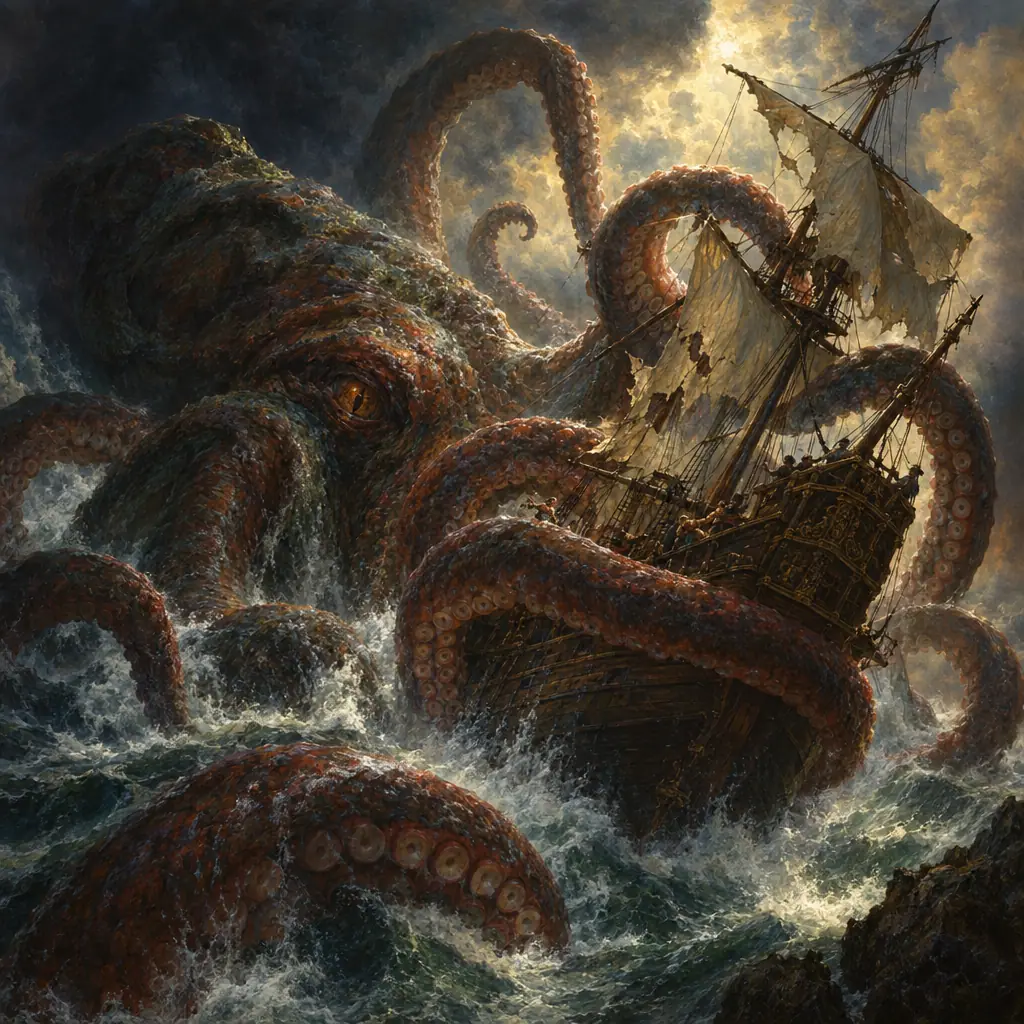
The kraken is the great monster of the deep in fantasy and games, and a rare case where a folk monster turned out to have a real animal, the giant squid, lurking behind it.
Origins
The kraken was a fisherman's monster. Along the coast of Norway, people told of a creature so large that when it rose from the deep it looked like a cluster of islands, and so good for fishing that crews would row out over it on calm summer days, watching their plumb lines for the sudden shallows that meant it lay below. The name comes from Norwegian krake, from Old Norse kraki, a crooked, stunted tree, a fitting word for a mass of branching arms.
Medieval Scandinavia had its own giant sea beasts. The Norwegian treatise known as The King's Mirror (c. 1250) describes the hafgufa, the largest monster of the Greenland Sea, and a later version of Örvar-Odds saga pairs it with the lyngbakr, a whale mistaken for an island. In the 18th century the missionary Hans Egede equated the hafgufa with the kraken, though many scholars think the medieval beast was a garbled whale.
The kraken itself enters print by name in 1646, in Christen Jensøn's glossary of Norwegian words. The Danish-Norwegian bishop Erik Pontoppidan made it famous in his Natural History of Norway (1752–53), which reached English readers in 1755. He reported a creature so large it was mistaken for islands, speculated that it might be a giant crab, a starfish or a polypus (octopus), and recorded a small one, "perhaps a young and careless one", said to have washed ashore and died in 1680. Carl Linnaeus had earlier listed a doubtful sea-monster genus, Microcosmus, that later writers linked to the legend.
Science caught up with the story in the 19th century. Japetus Steenstrup named the giant squid Architeuthis in 1857, and specimens found off Newfoundland in the 1870s made the kraken look like a garbled report of a real animal. Writers seized on it. Alfred Tennyson's sonnet "The Kraken" (1830) imagined it sleeping "below the thunders of the upper deep", Victor Hugo's Toilers of the Sea (1866) set a man-eating octopus against its hero, and Jules Verne sent giant cephalopods against the Nautilus in Twenty Thousand Leagues Under the Seas (1870).
Into the dungeon
Tentacled sea monsters arrived early in fantasy gaming; the Blackmoor supplement to Dungeons & Dragons (1975) already had a giant squid. The kraken by name followed in Advanced Dungeons & Dragons' Monster Manual II (1983), a colossal and intelligent squid, and later editions made it a titan of the ocean, worshipped by cults and capable of sinking fleets.
In video games the kraken became the obligatory boss of the sea. Final Fantasy (1987) made Kraken the Fiend of Water, one of four elemental tyrants alongside the Lich and Tiamat, and the name has recurred throughout the series. Naval games from the pirate sandbox Sea of Thieves (2018) onward send tentacles through the hull as a signature set piece.
Variations
The most influential kraken of all is not Norse. In the 1981 film Clash of the Titans, the last feature by the special-effects artist Ray Harryhausen, Zeus looses the Kraken on the city of Argos, the goddess Thetis later demands Princess Andromeda as its sacrifice, and Perseus turns the monster to stone with Medusa's head. The 2010 remake's line "Release the Kraken!" became an internet catchphrase, and the film made the kraken a Greek monster in popular imagination. Pirates of the Caribbean: Dead Man's Chest (2006) gave it back to sailors as Davy Jones's ship-crushing pet.
Fantasy often blends the kraken with the Leviathan of the Bible, the Dragon-like sea serpent, and H. P. Lovecraft's tentacled deities, so that "kraken" now names almost any giant cephalopod of the deep. Beneath the variations lies Pontoppidan's image: the calm sea that is not what it seems.
Migration
How the creature traveled from story to story.
- 1250The King's Mirror (Konungs skuggsjá)The Norse treatise describes the hafgufa, a vast sea monster later equated with the kraken — though many scholars think it was a garbled whale.
- 1646Christen Jensøn's Norwegian glossaryThe first description of the kraken by name: a many-armed creature that seizes boats.
- 1753Erik Pontoppidan, Natural History of NorwayThe bishop of Bergen makes the kraken famous: so huge it is mistaken for islands, so rich in fish that fishermen risk rowing over it.
- 1830Tennyson, 'The Kraken'The young poet's sonnet of a monster sleeping 'below the thunders of the upper deep' fixes the kraken in English literature.
- 1870Jules Verne, Twenty Thousand Leagues Under the SeasGiant cephalopods attack the Nautilus — the kraken reimagined after the giant squid became a scientific fact.
- 1981Clash of the TitansRay Harryhausen's stop-motion Kraken transplants the Norse monster into the Greek myth of Perseus and Andromeda.
- 1983AD&D Monster Manual IIThe kraken enters D&D as a colossal, intelligent squid — the deep-sea counterpart to the dragon.
- 1987Final FantasyKraken is the Fiend of Water, one of the four Elemental Fiends the Warriors of Light must defeat.
Marginalia
- The word comes from Norwegian krake, from Old Norse kraki, a crooked or stunted tree — perhaps for the tangle of branching arms.
- Pontoppidan wrote that fishermen who made a huge catch were told, 'You must have fished on Kraken.'
- Pontoppidan wavered over whether the kraken was a giant crab, a starfish or an octopus.
- Danish zoologist Japetus Steenstrup named the giant squid Architeuthis in 1857; a French warship, the Alecton, tried to haul one aboard in 1861.
- The kraken is Norse, not Greek; Clash of the Titans (1981) borrowed it for the story of Perseus and Andromeda.
- Final Fantasy's Fiend of Water shares the name, and Lich and Tiamat, two of its fellow fiends, are also D&D names.
Quick answers
- Where does the Kraken come from?
- Norwegian sailors' lore; first described by name in a 1646 Norwegian glossary and popularized by Bishop Erik Pontoppidan (1752–53)
- When did the Kraken first appear?
- 1646, in Christen Jensøn's Norwegian glossary.
- How did the Kraken get into games?
- Key appearances: AD&D Monster Manual II (1983) and Final Fantasy (1987).
- Why is the Kraken significant?
- The kraken is the great monster of the deep in fantasy and games, and a rare case where a folk monster turned out to have a real animal, the giant squid, lurking behind it.