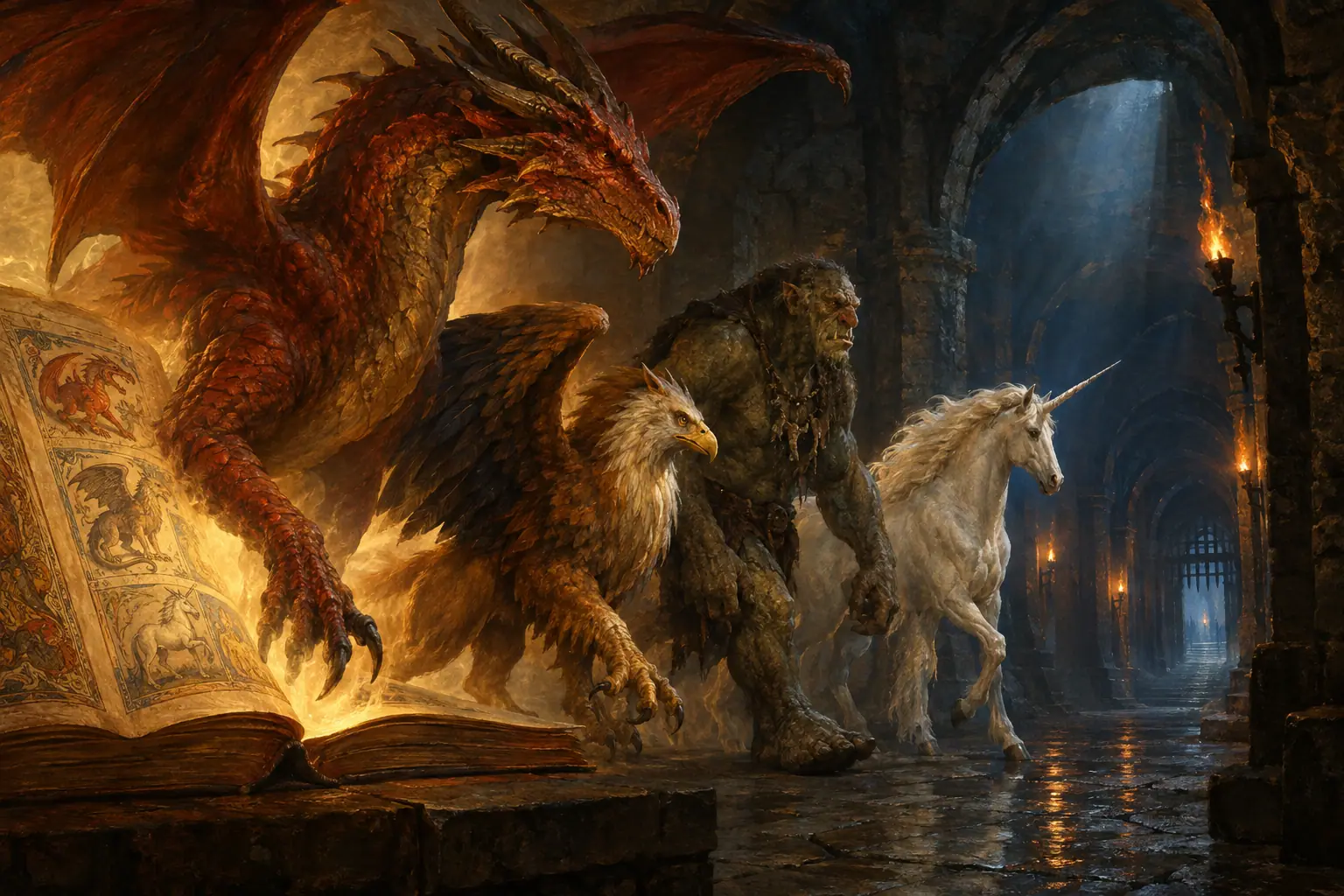
Monsters on the Move
How creatures migrate from myth to game
Every fantasy game draws on a shared bestiary, and almost none of its creatures were invented for the game in which you met them. This tour follows thirteen of them on their journeys.
Monsters migrate along several different routes. Some come from myth and ancient natural history: the Dragon, the Minotaur, the Basilisk and the Griffin were described by poets, priests and naturalists long before anyone rolled dice. Others arrive through modern literature. Tolkien turned an Old English word into the Orc and created the Ents, and Poul Anderson gave the Troll its famous ability to regenerate. When those creatures reached Dungeons & Dragons, they sometimes had to change their names, which is how the Ent became the Treant.
Other monsters have no literary ancestors at all. Gary Gygax turned a bag of cheap plastic toys into the Owlbear and the Rust Monster, and players at his own table invented the Beholder. The Mind Flayer (Illithid) shows Lovecraft's influence arriving through a book cover. Once invented, these creatures traveled onward into novels, computer games and films as freely as any creature from myth.
Games also exchange monsters with one another. The formless ooze of Western dungeons became the Slime of Dragon Quest, and Final Fantasy added creatures, such as the Chocobo, that belong to games alone. The final stop, the Tarrasque, shows the process running in reverse: a game borrowing a creature from a medieval legend and making it bigger than it ever was.
At each stop, ask where the creature came from, what changed when it crossed into a new medium, and what rules a game had to invent to make it work.
- 1DragonDragon · 2300 BCE
Start with the oldest traveler. The dragon runs from ancient Near Eastern myth through Beowulf's barrow and Tolkien's Smaug to D&D's color-coded wyrms and Dragon Quest's Dragonlord. It is the pattern for every migration on this tour: each age keeps the shape and changes the meaning.
- 2MinotaurMonstrosity · 550 BCE
Greek myth gave us one monster in one maze. D&D turned the Minotaur into a species in 1974, and the labyrinth became the dungeon. Notice how games turn unique mythic beings into populations.
- 3BasiliskMonstrosity · 150 BCE
Here natural history, not myth, supplies the monster: Pliny's serpent whose glance kills. D&D made its gaze turn victims to stone, and the basilisk later coiled through Harry Potter's pipes. Watch how powers are translated into rules.
- 4GriffinMonstrosity · 3300 BCE
Lion and eagle combined appear in art thousands of years before the Greeks named them. The griffin passed through heraldry to D&D, where griffons still hunt horses, and to World of Warcraft's flight paths.
- 5OrcHumanoid · 1000
An Old English word for a demon, which Tolkien made into a people. D&D kept the name, Warhammer and Warcraft gave orcs green skin and cultures of their own, and later games made them heroes.
- 6TrollGiant · 1220
Scandinavian folklore supplied trolls; Poul Anderson's Three Hearts and Three Lions supplied a severed troll hand that crawls back to its body. D&D took that regeneration, and fire and acid became the standard answer to trolls in games.
- 7TreantPlant · 1954
Tolkien's Ents walked into Chainmail and early D&D under their own name. Legal pressure over Tolkien's names turned them into treants, and 'treant' has since become the generic walking tree of fantasy games.
- 8OwlbearMonstrosity · 1975
Now the tour turns to monsters with no myth behind them. Gygax built the owlbear from a cheap plastic toy bought to use as a miniature. Sometimes the source of a legend is a dime-store bag.
- 9BeholderAberration · 1975
A player at Gygax's table, Terry Kuntz, invented this floating orb of eyes, and it debuted on the cover of the 1975 Greyhawk supplement. D&D later kept it out of the Open Game License, a sign of how valuable an original monster had become.
- 10Mind Flayer (Illithid)Aberration · 1975
The mind flayer came from Lovecraft's cosmic horror by way of a paperback cover, and debuted in 1975. Five decades later its tadpole drives the plot of Baldur's Gate 3. Invented monsters can accumulate their own mythology.
- 11SlimeOoze · 1936
Pulp horror's formless ooze became D&D's acid-dripping slimes and jellies. In Japan, Dragon Quest reinvented it as a grinning blue teardrop, and the most dangerous thing in the dungeon became the most lovable.
- 12ChocoboBeast · 1988
Some monsters need no ancestry at all. Koichi Ishii sketched this big yellow bird for Final Fantasy II in 1988, and it became a mount, a racer and a mascot. It is a native of games that has never lived anywhere else.
- 13TarrasqueMonstrosity · 1983
End where old and new meet. A dragon tamed by Saint Martha in a Provençal legend became, in 1983, D&D's unstoppable apocalypse on legs. Even the most game-like monster may have a medieval ancestor.