The mind flayer carried the cosmic horror of the Weird Tales circle into the dungeon and became one of the game's signature villains, the monster that gave Stranger Things its season-two antagonist and Baldur's Gate 3 its plot.
Origins
The mind flayer's origin lies in the cosmic horror of the pulp magazines. In "The Call of Cthulhu," published in Weird Tales in 1928, H. P. Lovecraft described a vast being with an octopus-like head and face tentacles on a roughly human body. Lovecraft's circle turned that image into a shared mythology, and the British writer Brian Lumley extended it half a century later. His novel The Burrowers Beneath (1974) was issued with a Tim Kirk cover that showed only the tentacles of its subterranean monsters, the Chthonians. Gary Gygax later named that cover as one of his inspirations.
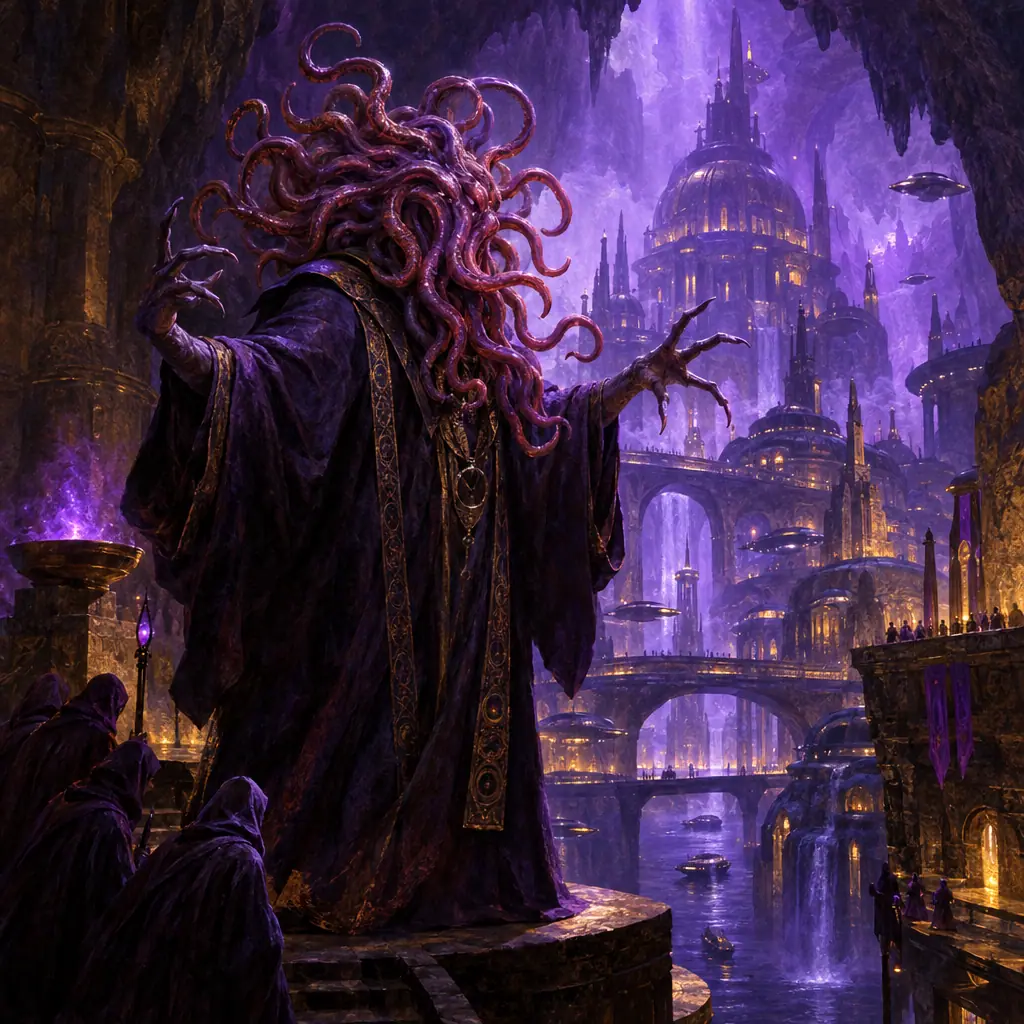
Gygax's creature was published in the first issue of TSR's newsletter The Strategic Review (Spring 1975), the forerunner of The Dragon (see The Strategic Review & Dragon), in a column called "Creature Features." It was described as "a super-intelligent, man-shaped creature with four tentacles by its mouth" that pierce a victim's skull and draw out the brain, which the monster eats. Its main weapon was the Mind Blast, a wave of "Psi force" whose effects depended on the victim's intelligence and ranged from rage and confusion to insanity, coma and death. The first illustration came from Tracy Lesch in the Blackmoor supplement later that year. Lesch said he imagined the creature as Ming the Merciless with the mental powers of Professor X. Eldritch Wizardry (1976) tied it to the game's new psionics rules.
Into the dungeon
The mind flayer entered the Monster Manual of 1977 with Advanced Dungeons & Dragons, and in 1983 Dragon #78 published Roger E. Moore's "The Ecology of the Mind Flayer." Over the next two decades it gained a full society. In the Underdark, the vast cavern world beneath settings such as the Forgotten Realms, illithid cities are ruled by an elder brain that floats in a briny pool. The Illithiad (1998), for second edition, explained how they reproduce. A mind flayer spawns tadpoles, and a surviving tadpole placed in a humanoid host eats the host's brain and takes over the body. The process is called ceremorphosis. Later books added a history in which the illithids had once ruled an empire that enslaved the githyanki and githzerai. Along with the Beholder, the mind flayer was one of the monsters Wizards of the Coast kept out of the open d20 rules as Product Identity, so in the official line it remained exclusive to D&D.
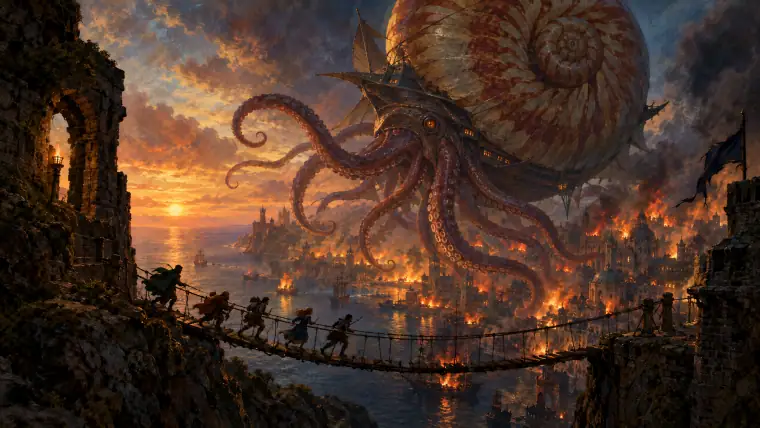
Computer games adopted it quickly. Illithids are among the late-game horrors of Baldur's Gate II (2000), and similar brain-eaters appear in NetHack and in FromSoftware's Demon's Souls (2009), whose Tower of Latria is patrolled by squid-headed "Mind Flayers." The creature also reached a much wider audience. In season two of Netflix's Stranger Things (2017), the boys of Hawkins name the gigantic shadow monster of the Upside Down the "Mind Flayer," after the creature from their game. Six years later Larian Studios made it the premise of Baldur's Gate 3 (2023). The game opens on a mind flayer nautiloid ship, where the player character has just been infected with a tadpole that for some reason does not transform them. The rest of the story is a search for a cure that leads to the Absolute, revealed as an elder brain. Tabletop D&D followed in the same year with Phandelver and Below: The Shattered Obelisk, the first fifth-edition campaign built around mind flayers as its central villains.
Variations
The illithid family is large. The alhoon, or illithilich, is a mind flayer that pursued arcane magic into undeath and is hunted by its own kind for refusing to merge with the elder brain. It first appeared in the Menzoberranzan boxed set (1992). Ulitharids are larger, six-tentacled leaders. The Ravenloft setting gave the illithids a domain, Bluetspur, ruled by a diseased god-brain, and also produced vampiric mind flayers. Fifth-edition lore adds the brainstealer dragon, part illithid and part wyrm. Relatives from other games include the Brain Slayer of Fighting Fantasy and the tentacle-faced horrors that FromSoftware continued to use after Demon's Souls.
The mind flayer is Lovecraft's horror adapted to game rules. It has hit dice and a weakness to a well-timed sword, yet it still suggests something vast and hostile beneath the ordinary dungeon, the same unease that Call of Cthulhu made the whole subject of a game.
Migration
How the creature traveled from story to story.
- 1928"The Call of Cthulhu," Weird TalesH. P. Lovecraft's octopus-headed, man-shaped cosmic entity supplies the template later critics see in the illithid's face.
- 1974Brian Lumley, The Burrowers Beneath (DAW)Tim Kirk's cover of tentacled Chthonians is the image Gygax later named as one inspiration.
- 1975The Strategic Review #1 (TSR)"Creature Features" introduces a super-intelligent man-shaped creature with four mouth tentacles that draw out the brain; the Blackmoor supplement prints the first picture.
- 1977AD&D Monster ManualThe mind flayer enters the core bestiary; Dragon #78 (1983) adds "The Ecology of the Mind Flayer."
- 1998The Illithiad (TSR)The elder brain, tadpole larvae and ceremorphosis are codified in a full sourcebook.
- 2009Demon's Souls (FromSoftware)Squid-headed Mind Flayers stalk the Tower of Latria, a sign of how far the design had spread.
- 2017Stranger Things season 2The Hawkins boys name the shadow monster from the Upside Down after the D&D creature.
- 2023Baldur's Gate 3 (Larian)An illithid tadpole in the hero's brain drives the whole story, ending at an elder brain.
Marginalia
- Mind flayers first appeared in The Strategic Review #1 (Spring 1975), TSR's newsletter, in a column called "Creature Features."
- Gygax cited Tim Kirk's cover for Brian Lumley's The Burrowers Beneath, which showed only the tentacles of its burrowing monsters, as one inspiration.
- Their first illustrator, Tracy Lesch, pictured them as Ming the Merciless with the mental powers of Professor X.
- The signature attack in 1975 was the Mind Blast, a wave of "Psi force" whose effects ranged from rage and confusion to coma and death.
- Critics have long compared the illithid's octopus-like head to Lovecraft's Cthulhu.
- In D&D lore a tadpole placed in a humanoid's brain consumes it and becomes a new mind flayer, a process called ceremorphosis.
Quick answers
- Where does the Mind Flayer (Illithid) come from?
- Created by Gary Gygax for The Strategic Review #1 (1975), partly inspired by the Lovecraftian cover of Brian Lumley's The Burrowers Beneath.
- When did the Mind Flayer (Illithid) first appear?
- 1975, in The Strategic Review #1 (TSR).
- How did the Mind Flayer (Illithid) get into games?
- Key appearances: The Strategic Review #1 (TSR) (1975), AD&D Monster Manual (1977), The Illithiad (TSR) (1998), Demon's Souls (FromSoftware) (2009) and Baldur's Gate 3 (Larian) (2023).
- Why is the Mind Flayer (Illithid) significant?
- The mind flayer carried the cosmic horror of the Weird Tales circle into the dungeon and became one of the game's signature villains, the monster that gave Stranger Things its season-two antagonist and Baldur's Gate 3 its plot.